605 results

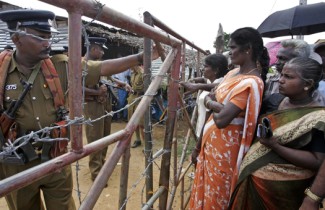
Sri Lanka may be undertaking a change of course towards accountability for atrocities committed during its 26-year civil war.

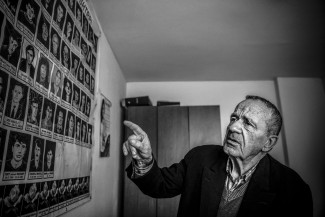
Forced disappearance is a crime against humanity. The decisions made by politicians and officials authorizing such practices in different countries cannot be justified legally or morally. They must be held to account and be shown for what they are: enemies of a civilized society.

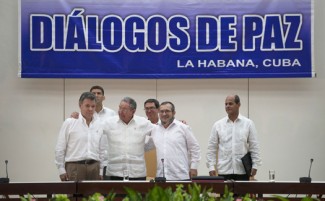
New York—On February 26, ICTJ and NYU Law’s Center for Human Rights and Global Justice will welcome former President of Colombia and Nobel Peace Prize Laureate Juan Manuel Santos for a conversation on the role of transitional justice in peace negotiations.

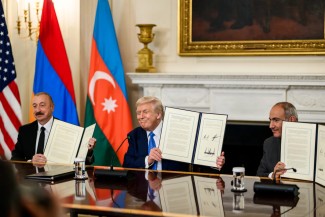
On August 8, Armenia and Azerbaijan signed the Joint Declaration on Future Relations. Hailed by some as a “historic peace deal,” it neither is a treaty nor ends the 37-year Nagorno-Karabakh conflict. Rather, it is a political framework that requires international support and attention.

Colombia currently faces a transformed, fragmented form of violence centered on territorial and social control rather than the traditional insurgency. This briefing paper argues that state security strategies remain misaligned, relying on outdated military approaches and metrics. To a...

Image of first page of the briefing paper "From Combat to Territorial Control"

Colombia currently faces a transformed, fragmented form of violence centered on territorial and social control rather than the traditional insurgency. This report argues that state security strategies remain misaligned, relying on outdated military approaches and metrics. To avoid lon...

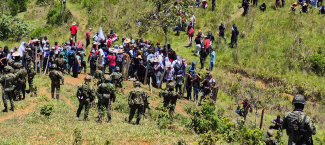
An aerial view of a group of soldiers interacting with a large civilian crowd in a rural setting

To commemorate the 20th anniversary of the Justice and Peace Law—which created Colombia's first transitional justice system—media outlet Verdad Abierta, the Friedrich Ebert Stiftung, and ICTJ partnered to produce an investigative four-part series in Spanish that critically assesses its legacy. Now translated into English, this first installment provides an overview of the process.

The Special Court for Sierra Leone (SCSL or Special Court) was established in 2002 when the two United Nations (UN) ad hoc international tribunals for the former Yugoslavia and for Rwanda had already existed for several years and when the first lessons could be drawn from their experi...

From May 25 to June 1, 2025, ICTJ held a series of community dialogues in three rural regions of the Gambia on sexual and gender-based violence, including crimes committed during the Yahya Jammeh dictatorship. The dialogues brought together 122 individuals, including community leaders, victims, and young people, to share their experiences and discuss pathways for justice.

This study explores specialized units established in 23 countries to investigate and prosecute serious international crimes. Notwithstanding the challenges faced by these units, the study concludes that countries with a specialized institutional approach are considerably more successf...

several judges dressed in black gowns sit on a judicial bench.