390 results

For decades, Kenyans have yearned for a police service that is accountable to the people and adheres to national laws and international human rights standards. The police stand accused of regularly meting out violence on the public, extra-judicial killings, and other human rights viol...

Victims in Nepal have been calling on the government for public consultation to ensure wider discussion, a process that would allow them to share their expectations, help them to comprehend the dense language of the proposed amendments and its many gaps. They needed to understand the dubious phrasing especially on issues of criminal accountability that created suspicion, instead of trust and legitimacy in the process.

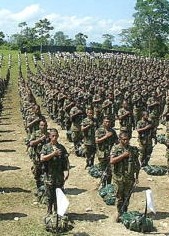
Colombia’s Justice and Peace Law (JPL) lies at the heart of the country’s efforts to dismantle notorious paramilitary groups and provide justice to thousands of their victims. As the government seeks to reform the JPL to allow for a more effective process, ICTJ will run a series of features to provide a deeper insight into the background and successes and challenges of the law.

The political crisis in Venezuela seems to have reached a stalemate. In September, the Norway-mediated negotiations between the Maduro government and the opposition came to a halt, leaving both sides struggling for the upper hand. But since it remains difficult for either party to prevail, it is likely that this impasse is a momentary setback rather than an indication that the negotiations are defunct.

On September 15, ICTJ organized a side event on the missing and disappeared in Syria, sponsored by the governments of Luxembourg and Finland, during the 77th session of the United Nations General Assembly. The event was a timely one, as it addressed a recent proposal for the creation of a new...

More than 20 years after the end of the Yugoslav Wars of the 1990s, Kosovo is still contending with unresolved ethnic tensions. Formerly an autonomous region of Serbia within the former Yugoslavia, Kosovo declared independence in 2008. Ethnic tensions were a root cause of the violent conflicts, during which an estimated 140,000 died and numerous atrocities were committed. ICTJ recently sat down with ICTJ's Anna Myriam Roccatello and Kelli Muddell to learn more about ICTJ's work and the present challenges to truth and justice in the country.


When reflecting on peace agreements and their implementation, it is tempting to begin by saying that these processes are generally slow and complex. While that may be true in many contexts, it contributes little to the discussion about what has happened in Colombia since the government signed a final peace deal in November 2016 with the Revolutionary Armed Forces of Colombia, or FARC-EP—the oldest and largest guerrilla group in the county—that ostensibly ended 50 years of war.

In this op-ed, ICTJ's President David Tolbert urges President Uhuru Kenyatta and Kenyan institutions to take concrete actions without further delay to provide reparations for victims, tackle the struggling police vetting reform, and prosecute the serious crimes that were committed during the post-election violence.

This past month, the United States officially observed Juneteenth for the fourth time since President Joe Biden declared it a federal holiday in 2021. Commemorations are a chance to acknowledge past milestones and reflect on their relevance to the present. In the spirit of Juneteenth, it is important to highlight and celebrate the wins and progress made toward fulfilling the promise of liberty for all.

Forced disappearance is a crime against humanity. The decisions made by politicians and officials authorizing such practices in different countries cannot be justified legally or morally. They must be held to account and be shown for what they are: enemies of a civilized society.