407 results

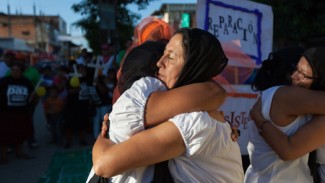
For the past three years, April 9th has become an important date to recognize more than 6 million victims of the armed conflict in Colombia. This year, hundreds of Colombians again went to the streets, to mark the National Day of Memory and Solidarity with Victims, as established by Law...

Colombia’s new president Gustavo Petro was elected to office on a progressive campaign to strengthen democracy, implement social reforms, and bring “total peace” to the country. His approach to peace encompasses political negotiations with all remaining insurgent groups and simultaneous dialogues with criminal organizations geared toward their voluntary submission to justice in exchange for punitive leniency. But eight months into his administration, Petro’s efforts to deliver on his campaign promise are facing numerous challenges.

In 1998, Colombian filmmaker Sergio Cabrera released “Time Out,” a fictional comedy in which guerrilla members and soldiers — usually mortal enemies — call a momentary truce to watch the national soccer team play in the qualifiers for the 1994 World Cup. Twenty years later, former combatants of both sides, members of the security forces, and victims of the conflict came together at Llano Grande in the region of Dabeiba to watch Cabrera’s film and play a game of soccer.

Recent developments in the country are challenging the taboos of publicly acknowledging sexual violence and paving the way to addressing the impact of conflict on women. Steadily, a broader conversation on a gender-sensitive approach to truth and accountability is burgeoning in Colombia, as well as on promoting women’s active participation in decision-making processes to redress victims of human rights violations.

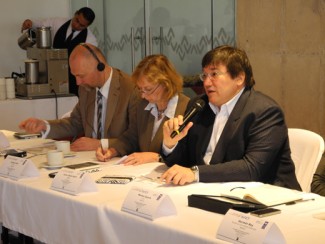
Media play an essential role in peace negotiations and post-conflict situations. In the highly polarized and politicized context of Colombia, the Gabriel García Márquez Foundation for New Ibero-American Journalism (FNPI) chose May 3, Worldwide Freedom of Expression Day, to bring together directors and editors of Colombia’s main news media to reflect on their role at a historic moment for the country: the government’s peace talks with the FARC, which represent a possible end to five decades of armed conflict.

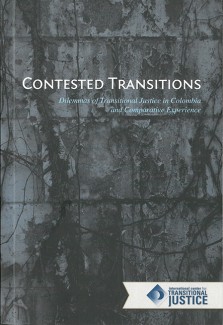
This volume examines the effects, risks, and potential of extending the field of transitional justice to cases that do not present a key moment of political transition to peace or democracy and instead are defined by political continuity and ongoing conflict. It begins with analyses o...

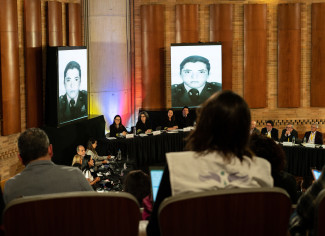
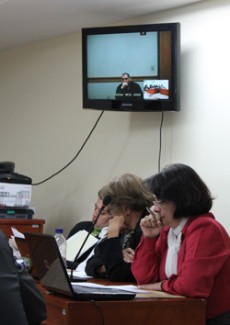
The Justice and Peace Chamber ruling in the hearing to verify the legality of the charges against Hebert Veloza Garcia contained information on the context in which these occurred. According to the Tribunal, it thus seeks to “contribute elements that underpin the analysis of the modus operandi, the patterns, if any, and the dynamics in which the criminal structure under the command of Hebert Veloza Garcia, alias “H.H.” was organized, as well as to “establish the judicial truth with respect to the criminal actions of the paramilitary groups in different regions of the country.”

This manual was developed within the Framework Agreement for Cooperation between the International Center for Transitional Justice (ICTJ) and the Attorney General's Office in Colombia. This agreement was signed to provide technical assistance to the National Analysis and Context Unit ...

As the United States and Colombia near the signing of a free-trade agreement and resolve differences over labor rights and other issues, the problematic extraditions of paramilitaries accused of savage crimes committed during the years of counter-insurgency remain far from the spotlight.

This Brief of Amici Curiae is respectfully submitted by several human rights and torture treatment organizations pursuant to Federal Rule of Appellate Procedure 29 and District of Columbia Circuit Rule 29. The Brief is filed in support of the Plaintiffs-Appellants and seeks the revers...