

245 results

This guide is designed to engage young people who are interested in or are working on transitional justice issues in their communities. Intended to serve primarily as a training tool, it provides basic information about transitional justice and related principles and offers tips and s...

In 1998, Colombian filmmaker Sergio Cabrera released “Time Out,” a fictional comedy in which guerrilla members and soldiers — usually mortal enemies — call a momentary truce to watch the national soccer team play in the qualifiers for the 1994 World Cup. Twenty years later, former combatants of both sides, members of the security forces, and victims of the conflict came together at Llano Grande in the region of Dabeiba to watch Cabrera’s film and play a game of soccer.

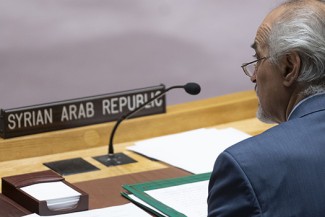
The Syrian Constitutional Committee has finally been agreed upon. The 150-member committee — made up of representatives of the Syrian regime, the opposition, and civil society members — is tasked with writing a new constitution for Syria. In an ideal world, this new constitution could be the first step to bringing an end to the deadly conflict that has left the country, and the lives of countless Syrian people, in ruins.

“Vetoes and excuses get in the way of what is right and just.” With those words, Amina Khoulani, Cofounder of Families for Freedom, spelled out the failings of the United Nations Security Council, as she described in lurid detail the harsh realities facing families of the disappeared in Syria. Actors with the power to stop the killing of detainees and to free those still imprisoned are forsaking their responsibilities.

This study, carried out in partnership with Aulas de Paz and Universidad Santo Tomás, explores experiences of acknowledgment of responsibility under Colombia’s Justice and Peace Law. Drawing on interviews with victims, former combatants, and judicial officials, it identifies key lesso...

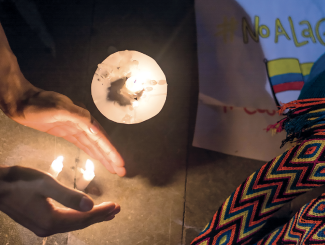
A person lights a candle during an anti-war protest in Barranquilla, Colombia.

The trend of missing and disappeared persons due to conflict remains more prevalent than ever today. Many governments around the world have remained undeterred in their abuse of power to invade a home or community and remove persons deemed to be a threat. This intractable problem has received global attention largely due to the efforts of family members who often risk their lives in pursuit of the right to know and ‍‍to bury their loved ones.

In February 2019, ICTJ hosted an international symposium on gender and transitional justice in Tunisia that brought together representatives from eight countries where ICTJ has been actively engaged in implementing a gender-focused approach to its programming. This briefing paper...

Fifteen years ago, a young nurse named Cristina Cobo was forcibly disappeared by members of the paramilitary group United Self-Defense Forces of Colombia. Paulina Mahecha, her mother, preserves her memory and that of over 20 other disappeared women from the departments of Meta...

Since the 1950s, the FARC had been present in the southern department of Caquetá in Colombia. The local population suffered from decades of armed confrontations between the FARC and the Colombian Army. This is the story of the collective memory project implemented with the El Pato municipal farmers’ association (AMCOP) in the El Pato-Balsillas farmer reserve zone.

This is the second of our Stories of Change series; in it, Tarek al-Massri, an 18-year-old from Homs now living in Germany, knows all too well the horrors of the Syrian conflict and its devastating impact on schools.