
162 results

Civil society actors involved in transitional justice processes use narrative communication in strategic and agile ways. This work is vitally important, and yet it does not receive the attention and support it should.

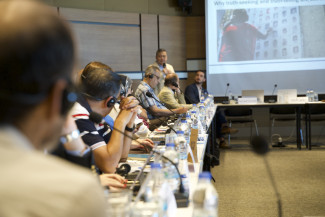
At an ICTJ-organized symposium in Istanbul, artists, civil society leaders, journalists, academics, and transitional justice practitioners from around the world discussed the ways art can serve as a catalyst for change in societies emerging from conflict or repression as well as explored local non-state-led approaches to truth seeking and truth telling.

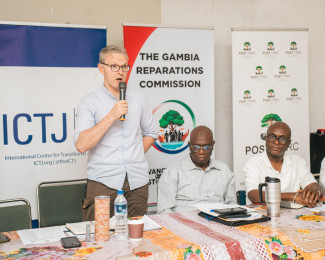
The establishment of the Reparations Commission in April 2025 and the recent appointment of British barrister Martin Hackett in April 2026 as The Gambia’s first special prosecutor represent crucial and long-awaited steps in the country’s transitional justice process. But to succeed, both require sustained public, political, and financial support.

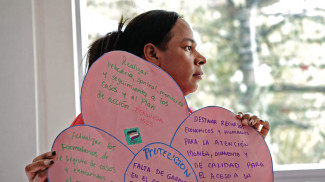
This research report examines how civil society actors involved in transitional justice processes narrate and communicate their role, impact, and value. The study focuses on actors in Colombia, The Gambia, and Kenya, describing the content, form, and audiences of their communication w...

A person holds up a poater collage made up of pink paper with text in Spanish

This book features testimonies of young migrants originally from or currently residing in Lebanon, Libya, or Tunisia who left their home countries for political or socioeconomic reasons. The authors all took part in ICTJ’s 2023 writing contest titled “Overseas.” The contest aimed to e...

An illustration of people rowing in canoes

Even though young people were driving forces behind the revolutions in Tunisia, Libya, and Lebanon, their lives have not significantly improved since then. Many have been pushed to leave their home countries for socioeconomic or political reasons. A new ICTJ book features the testimonies of 18 young migrants who made this difficult choice.

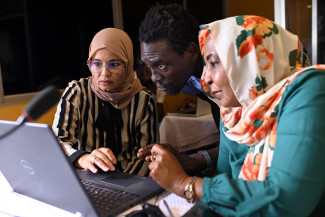
ICTJ recently convened human rights defenders, journalists, and lawyers from Libya, Sudan, Syria, Tunisia, and Yemen for a workshop on digital, open-source investigations. Held on November 3-8 in Kampala, Uganda, the course trained participants on open-source tools with a view to strengthening their work investigating, documenting, and monitoring human rights violations.

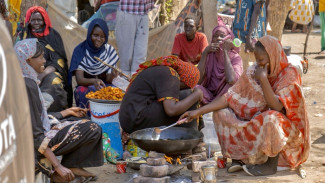
South Sudanese refugees and displaced persons currently comprise 40 percent of the country’s total population. Yet, these groups have been largely excluded from ongoing policy discussions related to South Sudan's transitional justice process in South Sudan. A new ICTJ report aims to amplify the perspectives and expectations of these groups and ensure they are included in the process's design and implementation.

This study aims to communicate the perspectives, expectations, and needs of South Sudanese displaced persons to relevant policymakers and thereby inform the ongoing transitional justice efforts emanating from South Sudan’s 2018 revitalized peace agreement. It also provides lessons lea...

several women in colorful dresses crouch around an open fire pit, cooking food in a large pan.

Throughout 2025, ICTJ’s experts offered thoughtful analysis on conflicts and major political developments in more than 10 countries as part of the World Report newsletter. Their insightful commentaries shed light on the obstacles that victims, civil society, and their partners must navigate as they pursue sustainable peace and justice. In this edition, we look back on the past year through the Expert’s Choice column.