
ICTJ recently convened an international symposium in Istanbul, Türkiye, that brought together artists, civil society leaders, journalists, academics, and transitional justice practitioners from Colombia, Lebanon, Libya, South Africa, Syria, Tunisia, and Yemen. During the three-day event, participants discussed the ways art can serve as a catalyst for change in societies emerging from conflict or repression as well as explored local non-state-led approaches to truth seeking and truth telling.
The symposium kicked off with the Arts for Justice Conference focusing on the power of artistic expression to advance truth, justice, and the rights of victims and other marginalized groups. The event showcased works by those who are using art to document and memorialize their communities’ stories and advocate for their rights in times of instability, resistance, and change. As part of its work to advance justice and accountability, ICTJ engages youth and other marginalized groups through artistic expression across countries in Africa, the Middle East, and South America.
“Through creative writing, storytelling, and artistic competitions, we have sought to engage artists and young people in our work, while highlighting the importance of justice and creating new spaces for dialogue and opportunities for their meaningful participation.” explained ICTJ's Head of Lebanon and Yemen programs, Nour El Bejjani. “We need to continue innovating and developing new tools that allow us to reach different groups across society.”
As part the conference, the ICTJ team launched the book, “Overseas: Young Migrant Voices from Lebanon, Libya, and Tunisia,” which features short written testimonies by young people from the region who took part in a writing competition organized by ICTJ that encouraged contestants to reflect, from a justice perspective, on the reasons for leaving their home countries. Their testimonies reveal how structural socioeconomic challenges, pervasive inequality and marginalization, as well as ongoing conflict are factors leading many young people to migrate. The book demonstrates how creative expression can help amplify the voices of young people and others disproportionately affected by political and social upheaval.
In a series of panels, participants discussed how art can contribute to transitional justice efforts, particularly in contexts where formal processes at the state level are absent, delayed, fragmented, exclusionary, or politically constrained. “Transitional justice, reimagined as a sociocultural project, emphasizes how individuals and communities transform their lives during or in the aftermath of political violence. Art can play the role of a facilitator to a peaceful transition and toward that transformation,” asserted ICTJ Senior Expert Salwa El Gantri. “Art can serve as a form of preserving memory and documenting what happened. Even if it is not used at the time, it can become a reference in the future for understanding what happened during a particular period.”
Lucia González, a former commissioner from Colombia’s Truth Commission, elaborated on the value of integrating the arts into transitional justice official mechanisms during the conference. “What we need to seek is for communities to be heard through their artistic and cultural practices, because they are already telling us things. They are already giving a name to their pain, and they are also giving a name to their dreams,” she stressed. “Enabling communities to reflect through art and to become witnesses, while also engaging in resistance, contributes greatly to making [transitional justice] a collective process.”
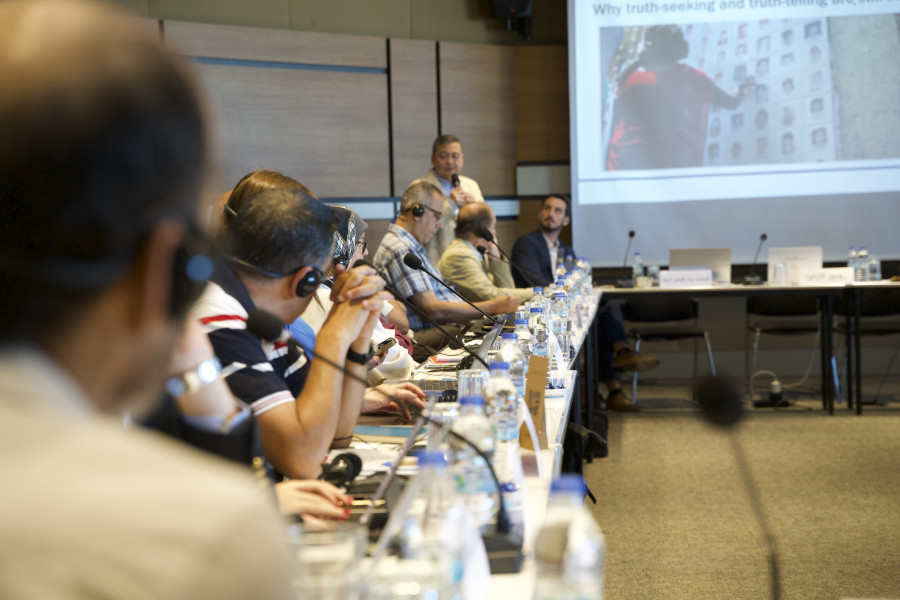
Following the Art and Justice Conference, the ICTJ team conducted a workshop with the symposium participants focused on non-state-led truth-seeking efforts. The workshop explored truth seeking in relation to several topics, including economic, social, and cultural rights violations; land and displacement; security challenges; trauma-informed victim engagement; and the impact of digital technology. For each issue, participants considered relevant examples of unofficial truth-seeking bodies, how they developed, how they adapted to different political situations and victims’ needs, and how they can inform similar emerging and future initiatives.
“We wanted to encourage a conversation about the role and value of civil society-led truth-seeking efforts in their own right,” explained ICTJ Programs Expert Emma Merritt-Cuneo. “We also wanted to discuss strategies for how these initiatives can respond to and capture diverse violations and harms to contribute to a variety of transitional justice processes, whether there is a state-led process or not.”
Participants from Lebanon, Syria, Tunisia, and Yemen shared their experiences with unofficial truth-seeking efforts in their countries and how they helped sustain momentum for change and lay a foundation for documentation upon which state-led processes could build. Participants also spoke about how these efforts complemented broader state-led processes by filling gaps in implementation and making the process more inclusive and responsive to victims.
“An important aspect was to build a space for countries within the region to learn from each other, especially over a decade after the Arab Spring revolutions and where armed conflict has replaced many of the dictatorships that were overthrown,” noted ICTJ Senior Expert Ruben Carranza. “In these situations, there is an assumption that you cannot have transitional justice processes, or they might not be enough. We want to cultivate civil society-led initiatives that might involve art and culture, call for memorialization, or be just about documentation, open-source investigations, and other means of preserving truth whether it’s for a future with or without an official transitional justice process.”
Over the course of the workshop, participants repeatedly returned to a shared idea: Truth-seeking efforts are meaningful when they respond to the needs of those most affected and create opportunities for their experiences to be heard, preserved, and recognized. “There is a common pattern, people from different countries expressed the same requirements that it would take to participate in a truth-seeking action,” reflected ICTJ Programs Expert Clément Eyraud, following a small group breakout activity in which participants brainstormed the core criteria for a truth-seeking mechanism.
The discussions among the diverse participants underscored that truth seeking is not limited to official commissions or state-led processes and pushed thinking about it beyond documenting evidence for criminal prosecutions and advocacy. Effective and impactful truth-seeking initiatives can in fact be local and led by civil society or community actors, and they can involve art, culture, and memorialization to bring to light different experiences of conflict, repression, and marginalization. The exchanges also sparked ideas for projects that harness the potential of artistic expression to foster dialogue and promote justice. Overall, the symposium offered a reminder that even where formal transitions remain elusive, the pursuit of truth and justice continues.
_________
PHOTO: Participants take part in a session, led by ICTJ's Ruben Carranza, on non-state-led truth-seeking initiatives and the role of civil society activists, youth, and artists in them. (Firas BouZeineddine/ICTJ)

