1519 results

Reparations play a unique role within the transitional justice framework in providing justice for victims.

As with most post-conflict challenges, the issues of displaced populations and weak security institutions each have profound effects on the other. A common cause of displacement in post-conflict environments is a lack of physical security, either because formal security institutions f...

This paper examines linkages between transitional justice processes and the broader issue of land tenure reform in countries with a long and complex history of property dispossession or where land has been a root cause of conflict. It is argued that greater coordination between t...

As human rights advocates and state representatives increasingly acknowledge the necessity of involving children in truth-seeking processes, there is a growing need for practical tools that facilitate children’s participation while prioritizing their protection. This statement-taking ...

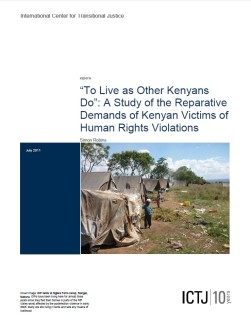
As Kenya continues to address its 2007-08 postelection violence, greater emphasis should be placed on victims’ reparative justice demands, according to a new ICTJ report. The report, “To Live as Other Kenyans Do”: A Study of the Reparative Demands of Kenyan Victims of Human Rights Violations, is a...

This paper documents the opinions of victims of human rights violations in Kenya about the country’s unfolding transitional justice process. The first section gives background into the human rights violations; the second section presents victims ideas about reparative justice. The rep...

Tunisia's Truth and Dignity Commission continues its public hearings, focusing on violations of digital freedom.

At 3 pm, Eastern Time, Tunisia's Truth and Dignity Commission is scheduled to resume its public hearings with a session focusing on violations against women. Watch the livesteam below and follow us on twitter at @theICTJ for live coverage.

Among the key challenges facing the Democratic Republic of Congo (DRC) today is the question of how the country will address the massive human rights atrocities of its recent past to establish a foundation for peace and security, the rule of law, and respect for human rights to prevai...

In the brutality of armed conflict or tyranny of a repressive regime, many who go missing are never found again: whether “disappeared” by agents of the state or abducted by an armed faction, the whereabouts of thousands are still unknown to this day. On this International Day of the Disappeared, ICTJ recognizes that enforced disappearances constitute crimes against humanity, and they affect women in ways unique from the impact on men.

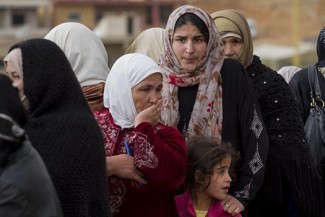
This report examines the impact on women of enforced disappearances committed during Lebanon’s civil war, focusing in particular on the effects on wives of the missing or disappeared—and their children. The research is based on interviews conducted by ICTJ with 23 wives of missing or ...

Local justice is sometimes presented as an alternative to or substitute for other measures of transitional justice, often due to political, cultural, or practical considerations. This chapter argues that local justice addresses the (comparatively neglected) reintegration asp...

The millions of Syrians displaced by the grinding decade-long war have sought out safety far and wide, in safe havens within the country, in neighboring countries in the region, and further afield. Those who managed to reach Europe often did so against the odds and often after experiencing displacement more than once. Now, one of these countries, Denmark , is taking away from Syrians living in its borders the protection they so desperately sought and still need and, with it, the tiny bit of hope that they have worked so hard to preserve.

As subscribers, you enjoy timely commentary on what’s happening in transitional justice around the world written by one of our experts exclusively for our monthly World Report newsletter. In this month’s edition, we bid farewell to 2019 by looking back on the experts’ choices of the past year.

As part of a transitional justice process, truth commissions are crucial mechanisms for clarifying the past and safeguarding victims’ rights. With over 50 truth commissions worldwide, they remain relevant in increasingly complex contexts shaped by rapid technological change and challe...

Cover of the book Una mirada a la Comisión de la Verdad de Colombia

The study of macro-criminality is critically important to transitional justice and specifically to efforts to pursue accountability for large-scale, systematic human rights violations. To help enliven debates concerning macro-criminality and broaden access to them, ICTJ has translated into Spanish for the first time ever the seminal essay "Can Politics Be Criminalized?" written by German criminologist Herbert Jäger.

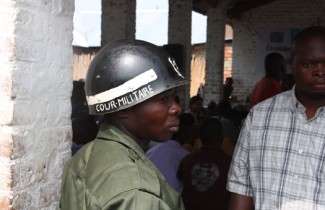
In cooperation with the High Judicial Council, ICTJ held a seminar today with senior representatives of the Congolese military and civilian judiciary and prosecutor’s office to discuss the dual jurisdiction of military and civilian courts over international crimes in the DRC.

The Maine Wabanaki-State Child Welfare Truth and Reconciliation Commission (TRC), the first of its type in the United States, marks one year of work.

Maine’s foster care system was intended to act in the best interests of all children. But for indigenous children removed from their communities and placed with white families, often without the consent of their parents or tribes, the foster care system caused the painful loss of their cultural identity and traumatic severing from their heritage.

ICTJ advocates for the inclusion of mental health and psychosocial support (MHPSS) in all transitional justice initiatives and undertakes research on best practices for the field. Leading this work is ICTJ Senior Expert Virginie Ladisch. She is the lead author of the forthcoming report, ‘The Search for People’s Well-Being’: Mainstreaming a Psychosocial Approach to Transitional Justice. In this interview, Ladisch discusses the importance of MHPSS for transitional justice and her work on the topic.

As gunfire dies down over Tripoli, the new Libyan authorities will be coming to terms with enormous dilemmas about the hierarchy of priorities in building a new society. Their offices will see long processions of emissaries from near and far in the coming days and weeks. Some will be sternly pressing for issues of security to be immediately addressed and others will demand that business and development concerns precede all else, while there are also bound to be those advocating for justice to be done first and quickly.

In this op-ed, ICTJ Vice President Paul Seils argues that the front line of justice must always be national courts and justice systems. "Citizens must see social institutions at work in their home countries, as it is there that courts can repudiate wrongdoing and reaffirm the most fundamental elements of the contract that binds a society together. It is there that having the dignity of a citizen can have its fullest meaning," writes Seils on International Justice Day.

The Task Force on Justice is gathering inputs in order to encourage greater provision of justice to people and communities outside the protection of the law. As the Task Force has pointed out, the “justice gap” that it seeks to reduce is greatest in conflict-affected countries, where only 3 percent of development assistance goes to justice.

Mali's Truth Justice and Reconciliation Commission has a mandate to examine violence dating back to 1960, but it faces serious challenges. Can it serve as a foundation of a peaceful future in Mali? We discuss with transitional justice expert Kora Andrieu, who is currently working with the TJRC as an independent consultant.