



1526 results

This briefing paper sets out the obligations of the state and international best practice with respect to the right to truth, both as a key element of a transitional justice strategy and as a critical component of providing effective remedy to victims of gross violations of human righ...

Six years after the conflict ended, the government of Nepal has failed to initiate a comprehensive investigation into the past. As a result, it has failed to uphold the rights of victims and Nepali society to know the truth about abuses. Inaction is particularly cruel regarding the relatives of the disappeared, for whom lack of information on the fate and whereabouts of their loved ones equates to permanent anguish and extreme suffering.

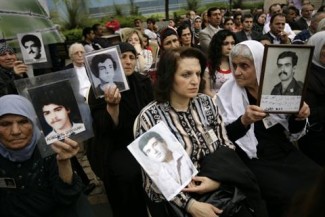
Lebanon has ruled that families of missing and disappeared persons would be allowed access to the investigation files and full report of the Commissions of Inquiry on the Missing and Forcibly Disappeared in Lebanon. In a new episode of our ICTJ Forum, we speak with lawyer Nizar Saghieh about what the ruling means for Lebanese families who continues to search for their missing loved ones.

The importance of an independent, representative, and competent truth and reconciliation commission (TRC) to guarantee the rights of victims to truth, justice, and reparations should not be underestimated. Key recommendations in this regard are included in this briefing.

Some habits die hard. This is especially true of ways of thinking. Despite significant changes in national and international law and practice in the last thirty years—the period that corresponds with the emergence of transitional justice as a field—the recent upheaval in the Middle East and Northern Africa region has provoked proposals that hearken back to a period that we may have thought long gone.

The purpose of this paper is to provide an overview of some of the major issues and recent developments in transitional justice in Serbia and Montenegro. In particular, it examines the International Criminal Tribunal for the former Yugoslavia (ICTY), local trials, the national Truth a...

Since the end of open armed conflict in the former Yugoslavia, there has been little progress in transitional justice. This particularly applies to Serbia and Montenegro, which has lurched from one political crisis to another. This paper provides an overview of some of the major issue...

The application of transitional justice mechanisms, such as war crimes trials and reparations, has significant flaws in Serbia. Lack of progress may be even greater in truth-seeking and vetting of public officials. Serbia must do much more in all areas of transitional justice, for its...

On March 31, 2010, the Serbian parliament adopted a declaration "condemning in strongest terms the crime committed in July 1995 against Bosniac population of Srebrenica" and apologizing to the families of the victims. The declaration is a step in the right direction and, potentially, an educational...

This report examines the preventive impact of transitional justice mechanisms in Colombia before the 2016 peace agreement. It finds that these measures have contributed to prevention by strengthening institutional responses to rights violations, shaping the public agenda, developing a...

As ArcelorMittal, the world’s largest steel company, invests 19.2 million pounds of steel to construct a monument marking London’s Olympic Games, a disturbing story is emerging about the refusal to memorialize a former concentration camp in Bosnia it owns today. Not only is ArcelorMittal unwilling to provide even a fraction of the cost of the London “Orbit” to commemorate the suffering of Bosnians in the notorious Omarska camp, but it has recently started denying victims access to the site.

On June 8, Colombia woke up to the grim news that Miguel Uribe Turbay, a 39-year-old senator and presidential hopeful for the right-wing Centro Democrático party, had been gravely wounded after being shot. More than three weeks have passed since the attack and Uribe remains in critical condition, while Colombians, concerned about renewed democratic instability, have found themselves haunted by ghosts from the past.

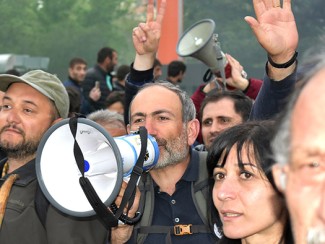
In July, ICTJ’s Program Director Anna Myriam Roccatello and Senior Transitional Justice Expert Ruben Carranza traveled to Yerevan to meet with civil society organizations, human rights and anti-corruption activists, and key government officials, to join them in exploring strategies for change.

On February 8, ICTJ held an event in The Hague on the missing and disappeared in Syria, in partnership with the Dutch Ministry of Foreign Affairs. The event brought together activists, journalists, artists, and policymakers to reflect on the critical humanitarian needs of victims and their families and the role of the newly established international body on the missing in Syria, which is mandated in part to address these needs.

Years after conflict, dictatorship, or historical injustice, victims throughout the world are still seeking redress and for their dignity to be affirmed. ICTJ has been standing alongside victims since 2001. We have worked in more than 50 different countries, helping to advance transitio...

On August 30, 2012, ICTJ joined government officials and civil society in Freetown to celebrate the launch of a new website for the Truth and Reconciliation Commission of Sierra Leone and welcome the prospects for revitalization of Sierra Leone’s reconciliation.

Sierra Leone has made tremendous progress in implementing transitional justice commitments incumbent on the authorities under the Lomé Peace Agreement (LPA) and international law.

This handbook explains the mandate, origins, purposes, and operating methods of the Truth and Reconciliation Commission (TRC) and Special Court in Sierra Leone. It discusses the differences and similarities between them, in clear, non-technical language. The TRC and Special Court can...

On International Justice Day, July 17th, ICTJ looks at the legacy of the Special Court for Sierra Leone through the voices of those to whom its work was most important: the citizens of Sierra Leone. Our new multimedia project, “Seeds of Justice: Sierra Leone,” presents five portraits of Sierra Leoneans whose lives were impacted by this court.

After periods of extended political conflict and of repression or state terrorism, there is an active political struggle about the meaning of what occurred. This paper illustrates some processes through which silenced or hidden ethnic, cultural or gender dimensions come to light ...

This paper explores political exclusion in Kenya and its consequences on the social fabric of the nation. It draws from past governmental reports and analysis to formulate new recommendations that can inform current discourse. It first provides an overview of ethnicity in Kenya. ...

Six years to the day after Ben Ali fled the country, Tunisians are gathering around televisions, radios and computers for more victim testimony hosted by the Truth and Dignity Commission. Watch the livesteam below and follow us on twitter at @theICTJ for live coverage.

In Congo over the past decade, demands for justice have been largely unmet in peace negotiations: impunity for the worst crimes is entrenched, and the root causes of the conflict remain unaddressed. As the European Union, often through the European Union Special Representatives (EUSRs...

Many experts—including development agencies—are trying to improve donor support to democratic governance in fragile and conflict-affected countries. Yet aid institutions tend to promote better governance by promoting capacity in executive government, representation and accountability ...

ICTJ Vice President Paul Seils interviewed South African judge and human rights activist Albie Sachs.