

The relationship between violent conflict and the environment has been increasingly recognized in the past few decades. Practitioners, advocates, and scholars have underscored both the damage that war and repression can cause to ecological systems and the ways in which resource scarcity can act as a driver of conflict. In the current global context, however, the outlook for effectively incorporating environmental issues into peacebuilding efforts may seem dire.
This past June, experts in the growing field of environmental peacebuilding gathered at the University of Ottawa for the 4th International Conference on Environmental Peacebuilding to discuss the challenges confronting the field and how best to meet them. Participants considered difficult questions similar to the ones that currently face those who work in all fields related to human rights, justice, peace, and development.
In a world of increasing conflict and authoritarianism, where governments are prioritizing security, national interests, and deregulation, and where climate change is worsening and the energy transition is morphing into geopolitical competition, what can be done? With funding being reduced, organizations closing, and international dialogue becoming more restricted due to border controls, what will the field look like in 5 or 10 years?
At the same time, there was palpable optimism among those assembled in Ottawa. In spite of these obstacles, new international standards are being established, new accountability mechanisms developed, and new coalitions of willing actors formed. Indigenous and grassroots collective action is making a real difference, and renewable energy is facilitating recovery after conflict.
As the keynote speaker, Professor Philippe Le Billon of the University of British Columbia, put it, conflict over resources is not going away, but there remains a role to play for environmental peacebuilding. It is a difficult, but still hopeful moment.
Transitional justice actors have a role to play as well. In peace agreements, for example, provisions for justice mechanisms can and should include stronger measures directed at restoring and protecting the environment going forward, potentially reducing the likelihood of a recurrence of conflict.
In a panel discussion on transitional justice and environmental harms, ICTJ representatives spoke about the organization’s ongoing research on the topic, including on the impact of violent conflict and repression on the environment, the legal and policy frameworks that are enabling justice responses to environmental damage and harm, and the practical and legal challenges that such responses encounter.
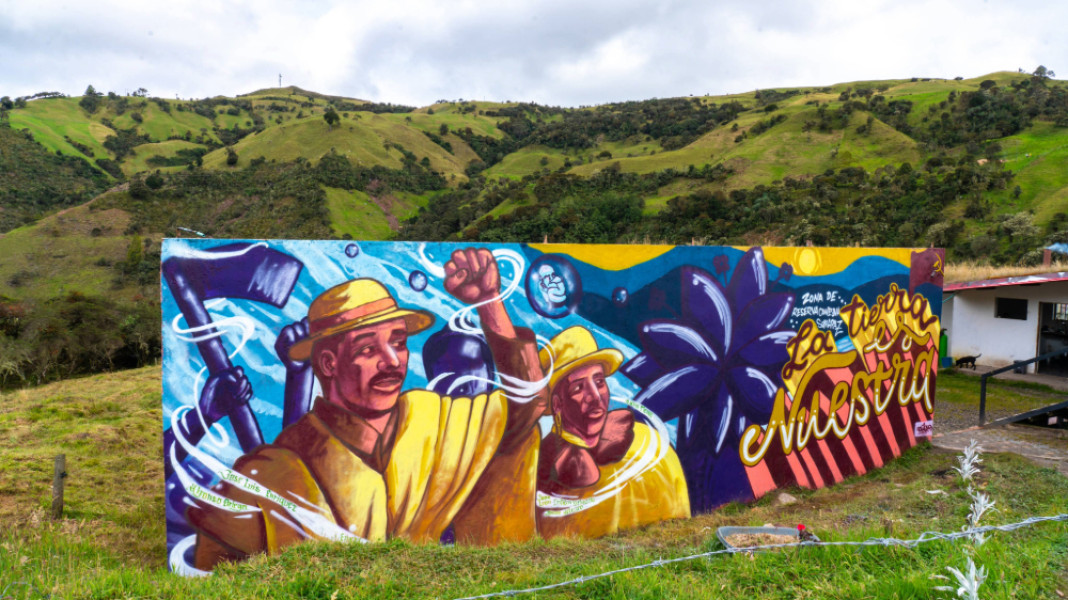
While transitional justice processes in some countries, such as Colombia, have addressed the environment through truth, reparation, and accountability initiatives, the field as a whole has not given the issue the attention it deserves. In order for transitional justice to fully address the drivers and consequences of conflict and repression, and to be as inclusive as possible, it needs to become an integral element of environmental peacebuilding.
___________
PHOTO: A mural depicts members of the Sumapaz peasant farmer reserve zone in Cundinamarca, Colombia. The text reads "The Land Is Ours." (Maria Margarita Rivera/ICTJ)

