
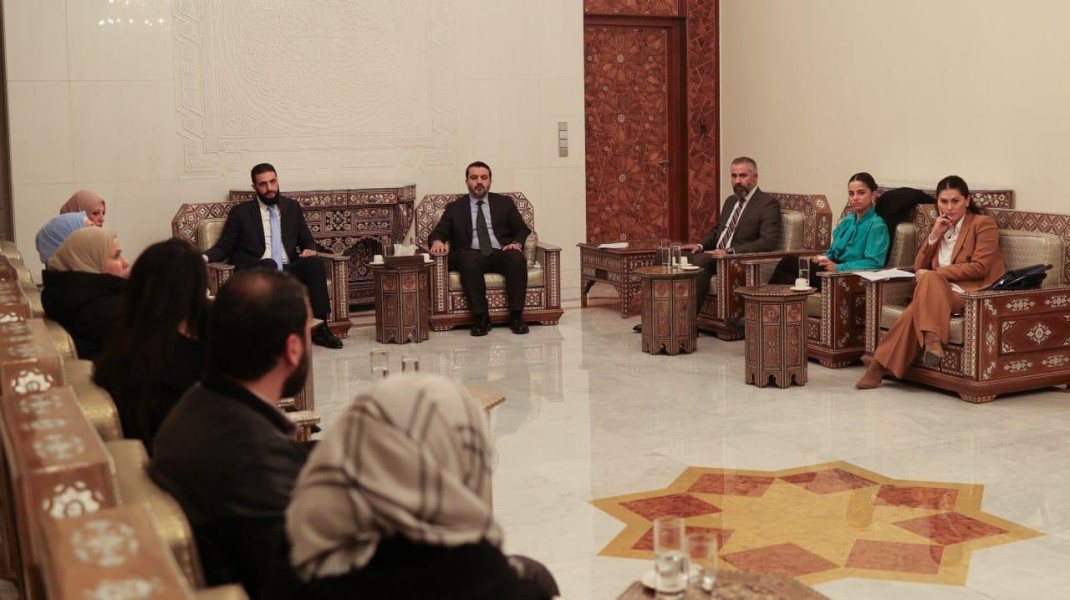
On February 1, 2025, ICTJ facilitated a meeting between family members of the missing and detainees and Syria’s transitional president, Ahmed Al-Sharaa, and the minister of foreign affairs, Asaad Al-Shaibani, at the Presidential Palace in Damascus.
In the meeting, family members and representatives of victims’ associations demanded immediate and serious action to uncover the fate of the tens of thousands of missing and forcibly disappeared, reveal the truth about what transpired in prisons and detention centers during the Al-Assad regime, and hold to account those responsible for abuses. They stressed that the issue concerns all Syrians and that tackling it represents a non-negotiable right of victims and a key condition for achieving justice and lasting peace in Syria.
For his part, President Al-Sharaa underscored the transitional government’s commitment to the issue of the missing and forcibly disappeared and affirmed that it will establish a dedicated body to address it. He promised that the government would maintain regular communication with victims’ associations and the families concerned. He further asserted that authorities should not declare individuals who are missing or disappeared as deceased without concrete evidence.
“I am deeply honored and proud of the crucial role that ICTJ has played in organizing the first-ever meeting between families of the missing, disappeared, and detained with the president and minister of foreign affairs,” said Nousha Kabawat, head of ICTJ’s Syria program. “For the first time, these families—who have long been silenced and ignored—were given a direct platform to speak to the government, demand answers, and seek justice.”
The attendees presented a number of specific urgent demands, which included the following:
- Ensuring families have access to all available information about their missing loved ones
- Preserving evidence in detention centers, places of confinement, and security headquarters; protecting mass graves; and halting any acts of looting, vandalism, or violation that could compromise the truth
- Ensuring that victims and their families, alongside Syrian human rights organizations, play a pivotal role during this period and in all efforts to achieve transitional justice
Given the complexity of the issue, addressing it requires the combined efforts of the Syrian government; victims and their families; and local, international, and multilateral organizations. ICTJ and its partners will closely monitor these efforts and apply the necessary pressure to advance them.
Since 2014, ICTJ has been steadfast in its support of Syrian civil society organizations and victims’ groups. ICTJ has persistently advocated for Syrian victims and facilitated their active participation in international fora, including the United Nations and the International Criminal Court. This meeting and their substantive contributions to it demonstrate how important it is that Syrian civil society and victims take part in the critical discussions about the country’s future.
“This historic step is the result of years of tireless work from families and civil society, pushing for a transition that is now beginning,” said Kabawat. “But for this transition to succeed, it must be built on justice, truth, and reparation. The voices of the families must not only be heard but acted upon, ensuring that the pain of the past is never repeated.”
_______________
PHOTO: Syrian President Ahmed Al-Sharaa (center left) and Minister of Foreign Affairs Asaad Al-Shaibani (center right) meet with families of the missing and detainees and ICTJ's Nousha Kabawat at the Presidential Palace in Damascus on February 1. (Syrian Presidential Palace)

