
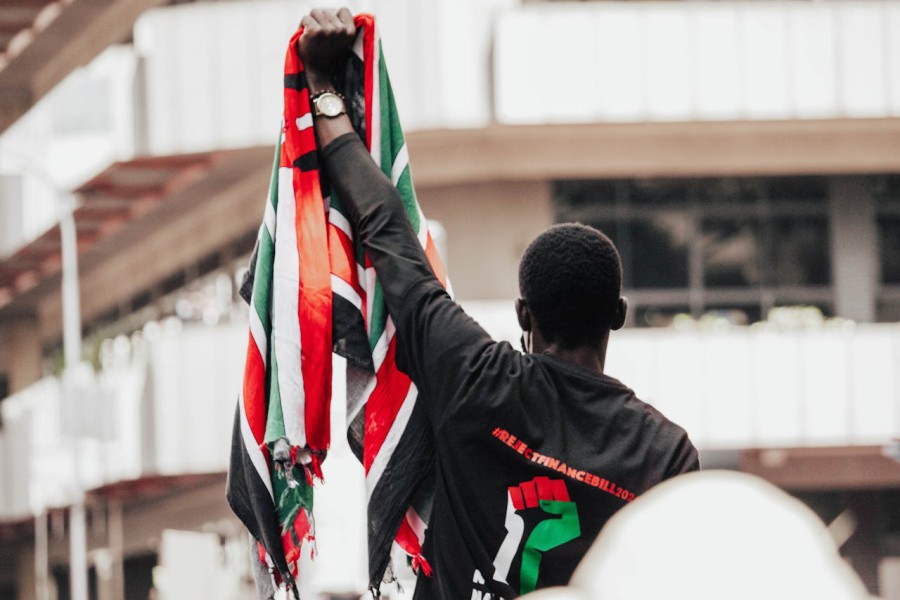

The police response to the peaceful anti-government protests in Kenya over the past year has been deadly and brutal. Their actions have rocked the country and reaffirmed the 2013 findings of the Kenyan Truth, Justice and Reconciliation Commission (KTJRC) that state security agencies, particularly the police, have historically used excessive and disproportionate force and “been the main perpetrators of bodily integrity violations of human rights in Kenya including massacres, enforced disappearances, torture and ill-treatment, and sexual violence.”
Burdened by the rising cost of living, Kenyans took to the streets in June 2024 to protest the government’s then-recent decision to raise more taxes as part of the 2024 Finance Bill. The peaceful demonstrations, largely led by young people belonging to Generation Z, grew in size and frequency, spreading across the country. Protesters denounced the tax increase, which appeared punitive considering the country’s runaway unemployment, stagnant wages, and lackluster economic growth. Meanwhile, the government has done little to curb government waste, combat endemic corruption, and hold those responsible to account.
Police officers are on record as having used live ammunition on the June 2024 protesters resulting in at least 39 deaths and 361 injuries, according to the Kenya National Commission for Human Rights. In past months, the sporadic peaceful protests have morphed into a pro-democracy movement demanding equitable economic policies, an end to corruption, security sector reforms, and justice for all those killed and the many hundreds maimed, arrested, or disappeared by security agents during their crackdown.
President William Ruto and other high-ranking politicians have openly commended security agents for thwarting what they term as a treasonous coup attempt. Consequently, police officers no longer fear any repercussions for their actions. Indeed, reports have surfaced that some officers have assaulted or murdered individuals in their custody and abetted violent gangs during the protests.
The past two government administrations have in various ways undermined important security sector reform initiatives that came out of the national process to address the 2007-2008 post-election violence in Kenya. They have weakened the Independent Policing Oversight Authority (IPOA) and the National Police Service Commission and impeded the police vetting process that began in December 2013 to foster a policing culture committed to constitutional and international standards of human rights and professional conduct. As a result, the police force has remained largely insulated from accountability measures.
Though commendable, Kenyan civil society’s relentless efforts to hold individual police officers to account through the legal system barely scratches the surface. Moreover, authorities continue to suppress public outcry in the form of peaceful protest, despite Article 37 of the 2010 Constitution and Chapter 6 of the Bill of Rights, which guarantee the rights to free speech, assembly, and protest for all Kenyans. The arrests, abductions, and disappearances of protesters and organizers by the police epitomize this repression. The recent moves by the judiciary to set exorbitant bails and the director of public prosecutions to charge arrested protesters with crimes under the Prevention of Terrorism Act are a testament to the state capture and weaponization of the criminal justice system.
The recommendations of the KTJRC, the 2009 National Task Force on Police Reforms, and the Commission of Inquiry into the Post-Election Violence are still valid after all these years and must be fully implemented in order to transform the police force into an institution that incorporates international best practices and genuinely serves the public. As a necessary step, the IPOA must be strengthened and its independence upheld so that it can act as a credible and permanent mechanism for investigating human rights violations and holding those responsible to account. These measures would not only address the abuse of power by police but help restore the rule of law as provided in the 2010 Constitution of Kenya.
_____________
PHOTO: A man holds up a Kenyan flag during a street protest in the capital Nairobi on June 25, 2024. (MC G'Zay/Pexels)

