
Andrea López-Tomàs
Ferdos Agha is looking for a face she does not know, even though it resembles her own. Since early childhood, Agha has been obsessed with a visage she is unable to recollect: Eyes that stopped seeing her 43 years ago, almond-colored, like hers. The same eyes that light up when she describes the virtues of the man with the blurred face. A man who did not simply leave but was taken from her. A man who, to this day, has never returned. That was at the time of Lebanon’s never-ending civil war. Since then, the Agha family has spent more than four decades searching for their father. This simple fisherman adds to the harrowing total of 17,425 people who were disappeared or abducted during those long, brutal, and never fully resolved 15 years of civil conflict. In 2025, half a century after the war began, many wounds remain open.
“He had no political affiliation, nothing at all, and he disappeared,” recalls Ferdos about her father, Nazih. “It has been 43 years and we know nothing about him,” she laments from the offices of the Committee of the Families of the Disappeared and Kidnapped in Lebanon (CFDKL) in Beirut. However, she can scarcely remember him. It is impossible for her to do so, since she was only two and a half years old when he vanished. Her four siblings struggled to grasp what was happening. The youngest was just four months old. Their young mother, only 24 at the time, embarked on the fight that Ferdos now personifies with tireless energy. “I feel that, through everything I do on the committee, I am giving a voice to my disappeared father,” she says.
A Cause That Belongs to Everyone
It has taken many decades for their voices to be heard. And even now, their demands are given little weight—at least in Lebanese politics. The commemoration of 50 years since the outbreak of the Lebanese civil war in the spring of 1975 has once again brought this unresolved issue to the fore. “It is the only unifying and cross-sectarian cause, because the families of the disappeared represent a group that spans all sects, all religions, all regions, and all ideological and political affiliations in Lebanon,” explains Wadad Halwani, the founder and director of the CFDKL. The country of the cedar tree rests on a multi-sectarian system that officially recognizes 18 religious sects spread across the territory, dividing power among them.
“That is why, even with all the diverse versions of history that each sect recounts to explain the civil war, this cause belongs to everyone; all are involved and all share responsibility for finding a solution,” Halwani reflects. When she introduces herself, she uses her maiden name: Wadad Murad. But promptly in her life story appears Adnan, “my beloved”, her husband, the father of her children and the face she has only seen in photographs for the past 43 years. Wadad bore witness to how, on a September afternoon in 1982, her life was set to change forever. She followed the two armed men who were taking her husband from their home in Beirut to the doorway. “We’ll bring him back in five minutes,” they told her. She has not seen him again since.
From Mothers to Daughters
While she moved heaven and earth to find him, everyone—“government officials, political parties, official authorities”—showed her compassion. “They told me they were sorry and that they supported me, but they always added: ‘Others have gone through the same thing, many have lodged complaints’. And yet I kept thinking: Who are these others?’”, Wadad recalls from her spacious office, adorned with photographs of the disappeared, at the CFDKL headquarters in Beirut. “I began to look for them, and at first I found no one,” she remembers. But the radio worked its magic. One autumn day, Wadad phoned a well-known Lebanese station and sent out a message so that all those “others” could gather at a specific place to join forces and support one another.
Those “others” turned out to be other women. “At that meeting, held exactly two months after Adnan’s abduction, hundreds of women came, many of them with their children,” she recalls, her voice still carrying the same emotion and enthusiasm, even though she has told this story countless times. Since then, they have not stood still for a second. All these women continue to search for their husbands, children, parents, or siblings. Some, like Ferdos, inherited the cause from their mothers. “This happens naturally, though we never wanted it to; we fought hard to keep this burden from falling on our children and our grandchildren,” Halwani says mournfully.
A National Commission
Nevertheless, their struggle has not been in vain. In 2018, “after 36 years of many tears, protests, and outcry”, as Halwani puts it, the Lebanese Parliament passed Law 105 on Missing and Forcibly Disappeared Persons. “This legislation not only laid the foundations for the families’ right to know, which is a major achievement, but also established the National Commission for the Missing and Forcibly Disappeared two years later,” explains Nour el Bejjani, Head of Lebanon Programs at the International Center for Transitional Justice, which played a leading role in drafting the law. But good news in the land of the cedar tree rarely lasts. This July, the commission’s mandate expired with little to show of the work of its 10 members.
“We did not have the necessary resources. The budget was very small, wholly inadequate for the scale and significance of the task at hand, and we did not even have an office,” Halwani, herself a member of the commission, notes critically. Yet the statements by newly appointed President Joseph Aoun and Prime Minister Nawaf Salam in their inaugural speeches —after nearly three years without either office being filled— have restored some hope to these families, since they both mentioned the struggle of the families of the disappeared. “Provided there is the political will, and they truly wish this commission to work, [the commission] will ultimately fulfil its profoundly human and national mission,” stresses the CFDKL founder.
For these families, the war did not end in 1990 with the Taif Agreement. Nor did it end with the general amnesty law passed the following year. “It was an unconditional amnesty that granted amnesty to perpetrators for crimes committed before 1991,” explains El Bejjani. For these families, the guns may have gone silent, but the violence continues, and so does their struggle. “Some people ask us why we dwell on the past, as if it were ancient history that we have left behind. They offer their condolences and ask us to let it go,” says Ferdos. “But no matter how many years or days have passed, we will continue digging until we know the truth,” she concludes, her almond-shaped eyes shining, like her father's.
This feature story first appeared in the Spanish outlet El Periodico on August 14, 2025.
___________
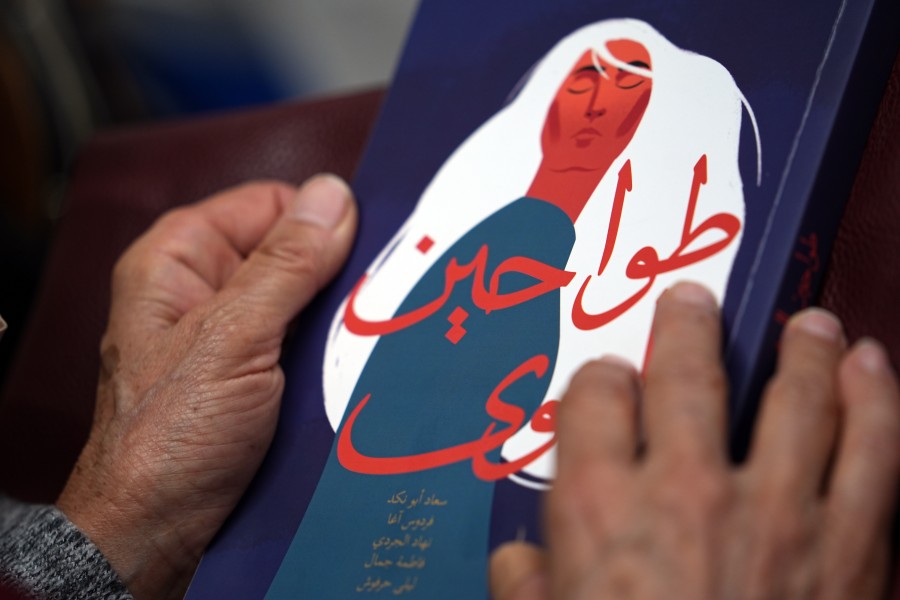
PHOTO: One of the authors of Windmills of Our Hearts holds the book during a reading organized as part of the Beirut International Book Fair on November 30, 2023. Coproduced by ICTJ and CFKDL, the book features short stories by 15 women relatives of missing and forcibly disappeared persons in Lebanon. (Mohammad Salman/ICTJ)

