
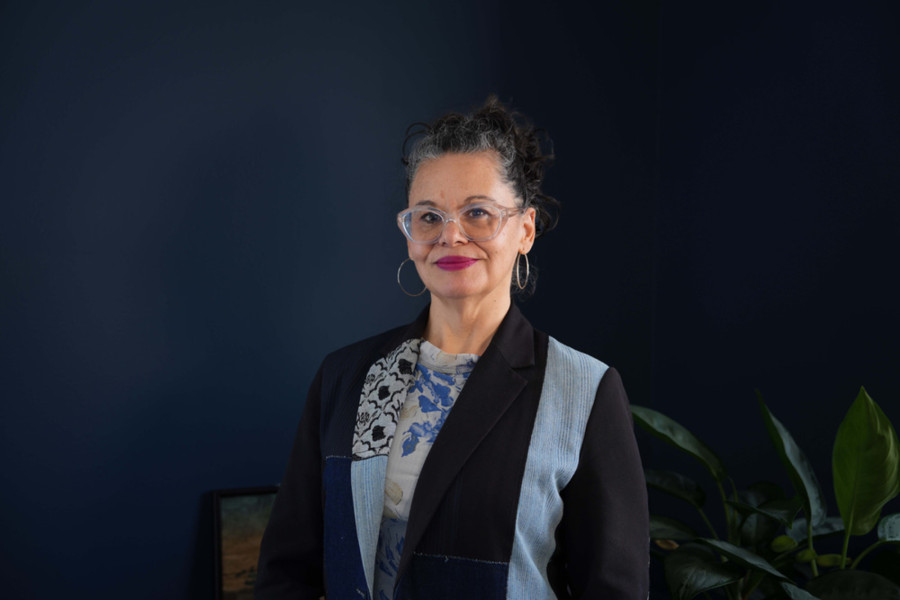
At ICTJ, 2026 is a year of milestone anniversaries. First, the organization is proudly celebrating a quarter century of building bridges toward a more just future. Second, ICTJ is commemorating 20 years of continuously contributing to transitional justice efforts in Colombia. Finally, ICTJ, along with Colombians and many others around the world, is observing the 10th anniversary of the final peace agreement between the Colombian government and the now-defunct Revolutionary Armed Forces of Colombia–People's Army (FARC–EP) guerrilla group.
María Camila Moreno, head of ICTJ’s office in Colombia, recently sat down with ICTJ Communications Associate María Margarita Rivera to reflect on the meaning of these convergent anniversaries, the achievements and setbacks over the past two decades, and what other societies around the world seeking justice and lasting peace can learn from Colombia’s experience.
María Margarita Rivera: How did ICTJ first come to Colombia 20 years ago?
María Camila Moreno: In 2005, the Justice and Peace Law was enacted, as the result of negotiations between the United Self-Defense Forces of Colombia [AUC] and the government of President Uribe. This law created the National Commission for Reparation and Reconciliation. In 2006, this commission requested technical assistance from ICTJ to formulate its first strategic plan, with the help of Eduardo González, then part of the ICTJ team in New York, and Carlos Iván de Gregory, who had served as commissioner of Peru’s Truth and Reconciliation Commission. This is how the ICTJ launched its first program in Colombia.
The office subsequently grew stronger under directors such as Javier Ciurlizza and Michael Reed. Throughout these years, ICTJ has supported the efforts of successive governments, as well as civil society and victims' organizations, to develop mechanisms to advance truth, justice, reparations, and guarantees of non-repetition within a complex context.
Rivera: What makes the Colombian context so complex and in need of a robust transitional justice agenda?
Moreno: Colombia has faced a situation characterized by massive human rights violations, with a staggering number of victims and perpetrators. This clearly overwhelmed the capacities of the state, the mechanisms of the ordinary criminal justice system, and public policies, which needed to address a situation that was becoming increasingly evident and that truly required extraordinary efforts in terms of budgets and the development of specific programs.
Rivera: What is your perspective on the more than 20 years of transitional justice in Colombia?
Moreno: Over these 20 years, Colombia has made remarkable progress and has much to teach the world. Colombia is a country with extensive experience in conflict, but also in peace. We have had many peace processes, and, as Colombians, we often struggle to learn from our own experiences. What was consolidated [in the 2016 peace agreement] as the Comprehensive System for Truth, Justice, Reparation, and Non-Repetition is the result of this long process of developing agendas to guarantee the rights of victims.
During these 20 years, unfortunately, we have not been able to definitively end the armed conflict, but there have been very important achievements.
I already mentioned the negotiations with the AUC, but of course, then came the negotiations with the FARC and the final peace agreement. This year marks its 10th anniversary. And this experience has shown us that the perseverance of victims' organizations, of civil society organizations, and society's demand for truth, justice, and memory have been fundamental in consolidating this transitional justice agenda in Colombia.
Rivera: What would you highlight about ICTJ's work in contexts where there have been or still are human rights violations? What is the biggest lesson learned from ICTJ's 25 years of work?
Moreno: The ICTJ has a unique characteristic, not only in Colombia but in the more than 70 countries where it has been present for the past 25 years. It has the ability to read, understand, and even translate the complex contexts in which it operates, and to learn from those contexts.
And when I say translate, I also mean being able to put into clear language, aimed at different societies and victims, what the objectives of transitional justice are at the end of the day.
There is no single model. That's what we've learned in these 25 years.
Every society must ask itself what it needs to confront the legacy of past human rights violations. Every society must ask itself what it hopes to achieve with a transitional justice agenda.
And while we've also learned over the years that every context is different, ultimately societies ask themselves very similar questions, which is why it's both possible and so valuable to draw on comparative experience. Not to copy models, but to be inspired by the questions others have asked themselves and the solutions they've found for their specific circumstances.
Rivera: That's what ICTJ has brought to Colombia for all these 20 years, isn't it?
Moreno: Yes, the possibility of thinking about the country in a broader context, with a global perspective, learning from other experiences, but also very importantly, teaching other contexts how Colombia has faced this complex situation and task of guaranteeing the rights of victims.
In fact, there are experiences in Syria, Ukraine, Sudan, and Yemen that are paying attention to what we are doing in the country, and we are exchanging this Colombian experience and these lessons learned over the last 20 years with colleagues from these countries.
Rivera: In Colombia, ICTJ also works with those responsible for the most serious crimes and human rights violations. Why is this work valuable and important?
Moreno: This has also been an experience that we have been perfecting and learning from throughout these 20 years.
We understood that, in order to advance solid processes of justice, truth, and reparation, but above all for transitional justice to also contribute to reconciliation and sustainable peace, it was necessary to incorporate those responsible.
When we talk about transitional justice, we tend to think about the rights of victims primarily, but we cannot forget that the rights of victims, to a large extent, also depend on the contribution of those responsible, on what those responsible have to say and tell, on the recognition of responsibility, and on the recognition of the damage caused.
Perpetrators must undergo a crucial reflection on their own responsibility from the victims’ perspective to understand what happened, why it happened, and the role they played, and then convey this reflection clearly and genuinely to the victims.
That's why, ultimately, the work also involves dialogue between all parties.
Rivera: Could you elaborate on the dialogue process between victims and perpetrators in Colombia?
Moreno: Dialogue and collaboration with those responsible are so important because it's not just about putting oneself in [the victims’] shoes, but about genuinely and empathetically understanding their pain. And from that place, [they are] able to acknowledge responsibility within a truly restorative framework—not mechanically, but with the genuine purpose of repairing the damage.
Yes, there is prior preparation. This requires in-depth work with the victims, but also in-depth work with those responsible, because in a way it's about building bridges—solid bridges that allow both sides to meet in the middle, to recognize each other's profound humanity, and thus establish a dialogue that allows the victims to understand what happened, but also allows those responsible, in some way, to reclaim their humanity.
That is a crucial dimension of transitional justice in Colombia. With the Special Jurisdiction for Peace, which incorporates restorative justice as a guiding principle, it is even more so. It is perhaps one of the most innovative aspects and one that has generated the most interest in other countries.
Rivera: As you mentioned, the process in Colombia has made significant contributions to the field of transitional justice. Tell us more about the nature of these contributions.
Moreno: I firmly believe that Colombia is currently at the forefront of transitional justice. Its contributions, both conceptual and practical, are very important and are inspiring other contexts and agendas around the world.
To give you an example, when the Comprehensive System for Truth, Justice, Reparation, and Guarantees of Non-Repetition was designed during the Havana talks, the negotiating parties largely learned from the Colombian experience. We already had extensive experience with the Justice and Peace process, which had shed much light on what should and should not be done.
But this negotiation process was also informed by international experience and even conceptual developments—for example, the concept of integrality, a central idea of transitional justice developed by Pablo de Greiff.
In reality, there were not many examples in the world where this idea of integrality had actually materialized, not only in the combination of judicial and extrajudicial mechanisms, but integrality linked to simultaneity.
What the Colombian comprehensive system does is precisely to simultaneously implement judicial and extrajudicial mechanisms that complement each other to achieve the ultimate goal, which is to guarantee victims' rights to truth, justice, reparation, and guarantees of non-repetition. That is truly a great example for the world.
However, in practice it hasn't been so easy. And that's why I believe one of the ICTJ's goals for this 20th anniversary is to revisit these reflections and consider what was designed and what best incorporated international standards and practices.
We know that design on paper is one thing, and putting it into practice is quite another, because obviously there we have to face the limitations of the institution itself, budgetary limitations, and the expectations that are created, among other challenges that Colombia’s comprehensive system has had to face.
In some areas, there have been very important advances and achievements, but in other aspects we have fallen short and still have many pending tasks.
Rivera: What is the risk of losing continuity of the process in Colombia?
Moreno: After these last 20 years, which in fact involves five governments, there has been a constant commitment to a broadly understood peace agenda, to which each government has also given its own nuance.
I say this because we sometimes fall into the common misconception that the transitional justice agenda has been a government commitment, but in reality, it has been a state policy. In that sense, I believe that an effort like the one Colombia has made, which is internationally recognized and has yielded such important lessons and achievements, cannot be allowed to die.
There are also moments for evaluation. Of course, now that we're marking 10 years since the peace agreement, it's also time to take stock. What has worked, what hasn't, what needs improvement, and, looking ahead 20 years, what should we maintain from everything we've accomplished and what our strategy is for the future.
This is extremely important because we haven't finished the task. The conflict remains active in many regions, we haven't consolidated the reintegration of former FARC combatants, and we have much work to do regarding truth and memory. Of course, justice is a central issue where sustained efforts must continue. After so many years, we cannot abandon the idea that the Colombian state has the capacity and the political will to fulfill its obligation to investigate, prosecute, and punish serious human rights violations and grave breaches of international humanitarian law.
Going back on that would make no sense, neither for those responsible, who also expect legal certainty; nor for the victims who expect their right to justice to be guaranteed; nor for society, which has also invested in a 20-year effort through its taxes.
We are doing our part and fulfilling our obligation to fight impunity. And after 20 years, we would not want to abandon this commitment, only to have the International Criminal Court or the Inter-American Court of Human Rights invoke its jurisdiction and sanction the Colombian state for failing to meet its obligation to combat impunity.
Rivera: What might the social change that Colombia needs look like?
Moreno: Colombia is a complex country and a complex society, because sometimes you get the feeling that everything changes only to stay the same, or that we take two steps forward and three steps back. But I believe that these are the processes in all societies. This isn't linear; it's not a matter of going from point A to point B and then moving forward in a straight line, because reality is more complex than that.
I believe that Colombia has made great progress in these 10 years since the peace agreement and in the 20 years that ICTJ has been in the country.
I believe that today we have a country with a political maturity it didn't have 20 years ago. Especially after the signing of the peace agreement, we have had difficult, polarizing discussions and debates, but these weren't the case when we were in the midst of the armed conflict with the FARC, and today there is more space for social protest.
Currently, we're talking about economic, social, and cultural rights. The agenda is no longer solely about war and peace; the demands for health and education have once again taken center stage. I believe that civil society now has a greater capacity to promote its own agendas, and I think that's very important.
But of course, we still have a long way to go. Unfortunately, the conflict has mutated in the country, and today we have a much more fragmented, highly territorialized situation, an armed conflict completely intertwined with organized crime and illicit economies.
New problems are emerging. We continue to have a youth population that, in many regions, faced with a lack of opportunities and the promise of easy money, power, recognition, and a sense of belonging, is joining armed groups. This should force us, as a society, to ask ourselves what we are doing so wrong that there are still young people who believe that taking up arms is the solution. I believe this should make us reflect on how much work there is still to be done in this area.
_______
PHOTO: ICTJ's María Camila Moreno poses for a staff photo in fall 2026. (ICTJ)

