
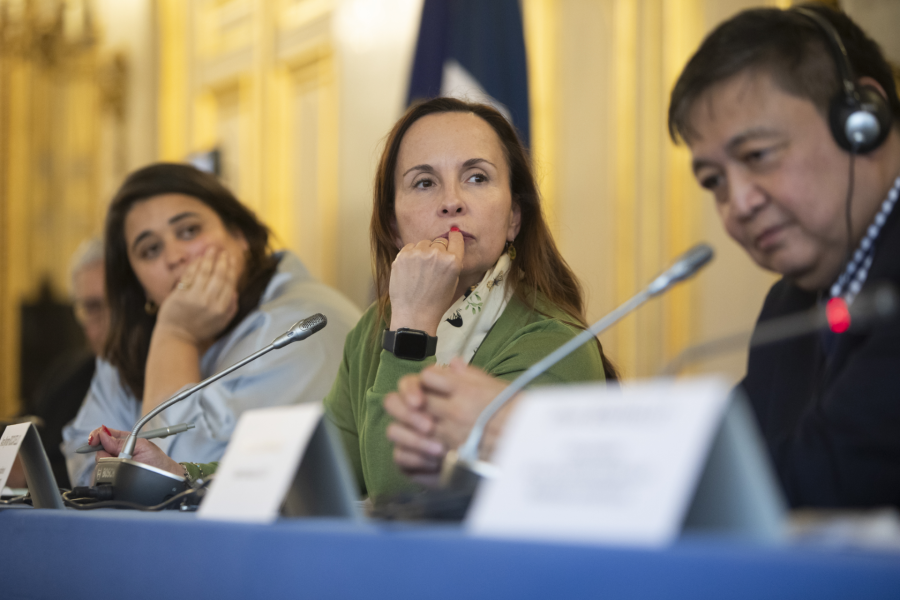

ICTJ recently launched the digital campaign "Reparations Build Justice" across its social media channels aimed at raising awareness about reparations and their vital contribution to sustainable peace and justice, particularly in countries grappling with legacies of mass atrocities. As part of the campaign, the ICTJ team would like to share the keynote address given by ICTJ Director of Programs and Deputy Executive Director Anna Myriam Roccatello at a conference on issues related to providing reparations through international criminal courts. The conference, co-organized by ICTJ and the French Ministry for Europe and Foreign Affairs, was held in Paris on September 30, 2024. In her remarks, Roccatello describes the inextricable link between accountability and reparation as well as ICTJ’s unwavering commitment to victims of massive human rights abuses.
Ladies and gentlemen,
We are deeply honored that the theme of this conference reflects the goals of our work at the International Center for Transitional Justice to repair what was broken by war, dictatorship, colonization, and other forms of occupation; to prevent the recurrence of massive violations of political, civil, economic, social, and cultural rights; and to remember and commemorate what happened to those who suffered the most: the victims of these violations.
We are particularly pleased with the opportunity that the French Ministry of Foreign Affairs has offered us to contribute to conceptualizing this event and working with their experts. France represents a source of expertise and a weight in the development of international law that we need to advance in our mission. I thank the colleagues of the ministry not only for the initiative but also for their generosity, in terms of time and resources, and their support of the fundamental values of justice, which have made the preparation of this conference an opportunity of cultural and professional richness for all of us at ICTJ.
ICTJ fights against impunity and in favor of the rule of law within national jurisdictions and at the international level. This work often begins by supporting civil society efforts to document war crimes and crimes against humanity while they are still being committed, for example in Syria and Afghanistan. It continues when societies negotiate and then make the transition to peace, implementing complex accountability mechanisms such as the Special Jurisdiction for Peace in Colombia.
We provide experts’ assistance, analysis and advice to governments, civil society and justice sector actors or institutions on a range of issues, including amnesties, prosecutorial strategy, amendments to penal codes, selection of judges and prosecutors and modalities of criminal accountability.
We also disseminate lessons learned and best practices from criminal justice initiatives around the world, including in international settings such as the Assembly of States Parties to the Rome Statute.
In all our work, we strive to ensure that victims are supported in their efforts to access and participate in the formal justice system, while ensuring due process rights for those accused. We bring together civil society and victims with judicial personnel to promote victim participation and help build public confidence in judicial proceedings, such as those of the International Crimes Division in Uganda.
To be genuine, accountability must include reparation. However, the right to reparation had to wait for the arrival of the International Criminal Court to exist in international criminal justice.
The acquis now recognized by Article 75 of the Statute of the Court has been reinforced by the creation of the Trust Fund for Victims to support and implement programs addressing the harm resulting from crimes of genocide, crimes against humanity, and war crimes.
The development of a sui generis model of reparations law before the ICC was not always free of implementation challenges. We all know that the distrust that surrounds the ICC today relativizes the potential effectiveness of a reparations order against a state of nationality of the convicted person, or on whose territory the crimes were allegedly committed.
But, the satisfaction of victims through reparations begins first of all with the adoption of approaches centered on the victims themselves. At ICTJ, where we carry out laborious work to accompany victims in their quest for justice in the various transitional justice processes in which we operate, we have clearly witnessed the importance of participatory, accessible, and supportive legal procedures in order to achieve this satisfaction.
I can give you the example of the case of Dominic Ongwen, another former LRA [Lord’s Resistance Army] commander in Uganda accused of war crimes and crimes against humanity, which is currently in the reparations phase at the ICC: a case that we will surely analyze in detail in the course of our work.
The commitment of our organization, with our partners and alongside the ICC Victims Fund, to ensure that they are well informed and can access the envisaged reparation programs, meets the expectations of victims and contributes to strengthening the sense of justice among them. This confirms, once again, that transitional justice—through its restorative perspective—can support international criminal justice in achieving its objectives.
Using a restorative justice framework can shift the focus of justice measures from punishment to rehabilitation and reparation, without excluding the former. Restorative sanctions, for example, can contribute to accountability by solidifying the assumption of responsibility, thereby generating moral sanctions and justifying more limited criminal sanctions, while reintegrating perpetrators to play a productive role in pacifying society.
The acknowledgment procedures within the Special Jurisdiction for Peace of Colombia, within the framework of the country’s comprehensive transitional justice program, are an example of this. They aim to create an environment that, on the one hand, affirms victims and allows them to participate meaningfully, and, on the other hand, does not discourage perpetrators from being frank and providing as much information as possible, so that at a later stage they assume maximum responsibility for serious crimes.
This also applies to accountability efforts aimed at combating corruption and economic crimes, which can have a restorative effect by potentially generating funds through the recovery of ill-gotten assets and by unmasking elitist economic systems. However, care should be taken to ensure that restorative justice at this level is not instrumentalized, especially during a political transition. The experience of Tunisia demonstrates the difficulty of doing so in a context of limited systemic change, in which a discourse of reconciliation is instrumentalized to preserve impunity.
Today, and with the constant evolution of the sine qua non relationship between international criminal justice and transitional justice, it is important to insist on reparation measures that help to guarantee non-repetition, to combat amnesia, and to anchor reforms that are satisfactory for victims as well as for society.
Thank you for your attention.

