

480 results

This research report examines how civil society actors involved in transitional justice processes narrate and communicate their role, impact, and value. The study focuses on actors in Colombia, The Gambia, and Kenya, describing the content, form, and audiences of their communication w...

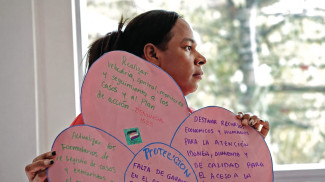
A person holds up a poater collage made up of pink paper with text in Spanish

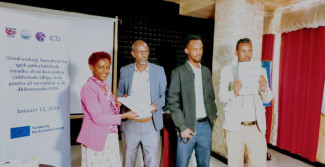
On July 28, 2025, the Somali Regional State Council passed a resolution designating April 6 as Victims’ Memorial Day, formally recognizing those who experienced violence and human rights violations across Ethiopia’s Somali Region. For years, victims and civil society actors, with support from ICTJ and other international partners, have persistently advocated for this acknowledgment, which marks a milestone in Ethiopia’s journey toward accountability and repair.

ICTJ is more than two decades old. At the time it was established, many of those who contributed to transitions in Argentina, Chile, Guatemala, South Africa, and the former Yugoslavia saw the value of a specialized organization that could draw from diverse national experiences to prov...

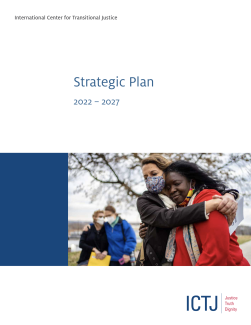
The cover of a report with the text, "2022-2027, Strategic Plan," with an image of people embracing underneath.

The Africa Union's resolution to collectively support a strategy to withdraw from the ICC looks more like a machination of those who have instrumentalized an argument against the court to protect themselves from the long arm of justice, write ICTJ's top experts on Africa.

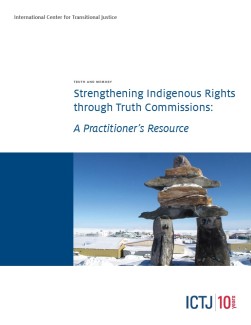
Indigenous peoples are among those most affected by contemporary conflict. The resource-rich territories they occupy are coveted by powerful, often violent groups. Their identity is perceived with mistrust, sometimes with hate. Indigenous communities live at a precarious intersection ...

Over the last 15 years, the Ugandan government has implemented a series of recovery and reconstruction programs in Northern Uganda to address the social and economic devastation caused by the two-decade armed conflict in the region and set it on the path to sustainable peace. While these development programs alone cannot fulfill the state’s obligation to provide reparations to victims of human rights violations, if designed well, they can form a foundation upon which future reparations initiatives can be built.

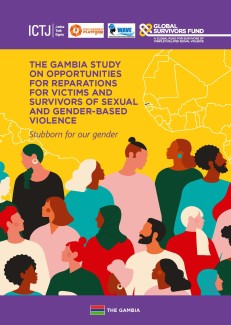
This report presents findings from research on the needs and expectations of survivors of sexual and gender-based violence in The Gambia. Based on focus group discussions with survivors and other stakeholders, it analyses obstacles to, as well as opportunities to improve, survivors’ a...

Cover of the report on SGBV in The Gambia.

Few conflicts have garnered as much attention as the recent one in Darfur. Widespread atrocities reported by several organizations including an International Commission of Investigation compelled the United Nations (UN) Security Council to refer the situation in the western region of ...

As Sudan’s devastating conflict enters its fourth year, the priorities of victims and Sudanese civilians must be central to efforts to end the violence and build sustainable peace. Against this backdrop, ICTJ and the Government of the Netherlands convened a policy roundtable in The Hague on advancing victim-centered justice for durable peace in Sudan.

Cote d’Ivoire has embarked on a process of addressing the legacy of internal strife that culminated in the post-election violence of 2010. On June 12, 2013, ICTJ will co-host high-level talks on strengthening Cote d’Ivoire’s judicial capacity to prosecute serious crimes proscribed by the Rome Statute of the International Criminal Court (ICC).