
On July 28, 2025, the Somali Regional State Council passed a resolution designating as April 6 Victims’ Memorial Day, formally recognizing those who experienced violence and human rights violations across Ethiopia’s Somali Region. For years, victims and civil society actors, with support from ICTJ and other international partners, have persistently advocated for this acknowledgment, which marks a milestone in Ethiopia’s journey toward accountability and repair.
The Somali region has witnessed some of the most serious human rights violations and instances of political violence in the country in recent years. Between 2007 and 2018, the Ethiopian military, the paramilitary group Liyu Police, and the armed opposition forces Ogaden National Liberation Front (ONLF) committed widespread human rights abuses against civilians, including arbitrary detention, torture, extrajudicial killing, sexual and gender-based violence, and forced displacement.
At Jail Ogaden, the region’s central prison, inmates suffered unremitting torture and abuse. Ahmed Kalif, a former detainee, described the horrific conditions at the facility. “Instead of life, in those days, in every minute and hour, the interminable beatings that inmates continuously experienced forced us to pray [for] death.”
When the government released political prisoners during the post-2018 reform period, many of those who were jailed for being suspected members of ONLF began to organize and push for their rehabilitation. At the same time, other victims of human rights violations came together and formed advocacy groups. Four of these organizations—the Organization of Victims and Survivors, Children and Youth Organization, Hormuud Women’s Organization, and Himilo—subsequently established the Somali Region Victims Network (SRVN) to coordinate their efforts. Soon after its establishment, members of the SRVN traveled to the capital, Addis Ababa, to meet with international stakeholders. There, they met with ICTJ experts for the first time.
In 2022, with support from the European Union, ICTJ launched a project to strengthen the capacity of victims’ and civil society groups to contribute to Ethiopia’s transitional justice process. Specifically, ICTJ began working with victims and activists to help them connect their grievances to the root causes of the violence and human rights violations they suffered, formulate common justice priorities, implement small-scale advocacy projects to advance these priorities, and actively participate in the regional and national transitional justice processes. ICTJ also brought together various civil society organizations working on human rights issues in an effort to build trust among all of them.
ICTJ held capacity-building workshops and consultations to help victims’ and civil society groups identify their justice demands and advocacy priorities. Among those demands for which the various groups believed they could jointly advocate was the designation of an official victims’ memorial day by the Somali regional government.
“As former prisoners, we have always wanted to have a commemoration day, but we did not advocate for it in a systematic and organized manner,” explained Ahmed Sheik Mohammed, a communications officer with the Organization for Victims and Survivors. “The training and various consultations with ICTJ have helped us analyze the general context and the benefits of coming together with other similar groups and consolidate our actions.”
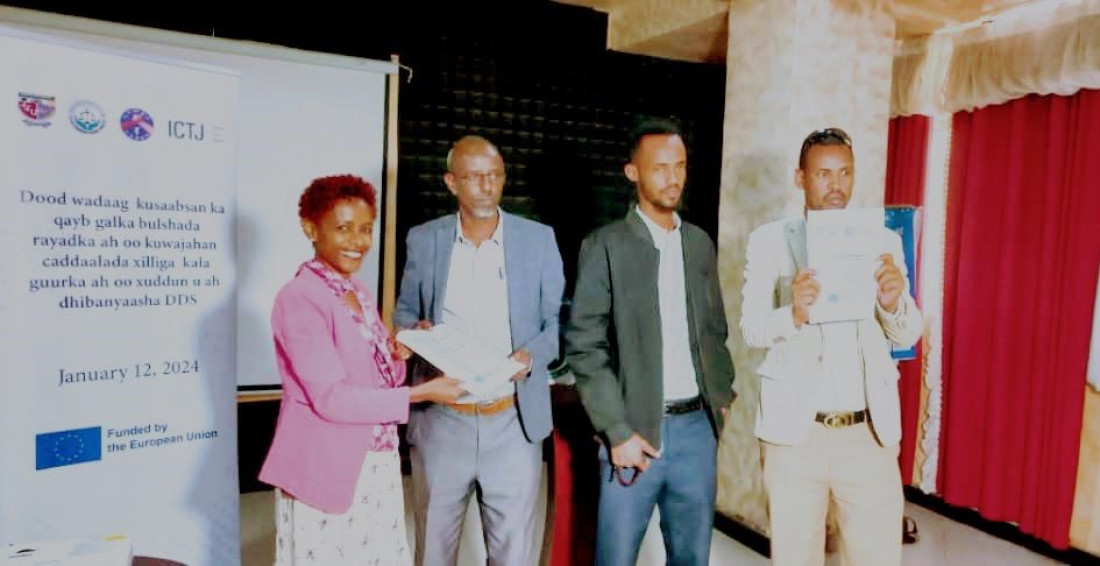
With ICTJ’s technical support, the victims and civil society actors in 2024 produced the policy brief, “Forgive and Not Forget,” which describes the history of systematic marginalization and human rights violations in the region and presents their demand for the establishment of an official memorialization day for victims. ICTJ helped the partners to use the policy brief in high-level advocacy efforts with the Somali regional government, including by disseminating it in a multi-stakeholder workshop that garnered support for the idea from the region’s Commission for Investigation of Violence and Reconciliation and Reparation of Victims, the regional Justice Bureau, and the University of Jigjiga.
As a result of the partners’ consistent advocacy, in 2024, the Somali Regional State Council approved the proposal to publicly observe Victims’ Memorial Day on April 6 each year. The following summer, the council passed the resolution that made it official. This official day of commemoration has great moral and political significance, and it carries profound meaning for the victims.
“This commemoration is not just symbolic, it is a long-awaited recognition of the pain, resilience, and dignity of those who have endured unimaginable hardship,” asserted Gaari Ismaili, executive director of the Hormuud Women’s Organization. “For many of our members, it marks the first time their stories are publicly acknowledged, not as statistics, but as lived experiences that deserve justice, healing, and respect.”
The achievement also demonstrates the remarkable resilience and determination of victims in the Somali Region and affirms that their advocacy matters. In fact, these Somali victims and civil society groups are blazing the trail on the country’s long, winding journey to justice and reconciliation.
Building on this momentum, members of the SRVN have already made significant progress toward fulfilling their next demand: turning Jail Ogaden into a museum and memorial site. In a ceremony held in February 2025, the Somali Regional State President joined SRVN members and the regional Commission in laying a foundation stone and plaque for the future Jail Ogaden Human Rights Violations Memorial Center. Following this crucial first step, SVRN members, with ICTJ’s support, will continue to advocate for the center’s completion and, more generally, for the rights of all victims in the Somali region.
______________
PHOTO: (left to right) Samrawit Tassew, Head of ICTJ's Ethiopia Program; Abdisalam Mohammed, Dean of Jigjiga University's Law Department; Abdirashid Abdiwali, Former Secretary of SRVN; and Mohamed Abdiwahab, Representative of Somali Region Television, present the policy brief, “Forgive and Not Forget,” at a ceremony on January 12, 2024. (ICTJ)

