



30 results

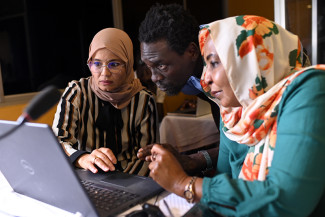
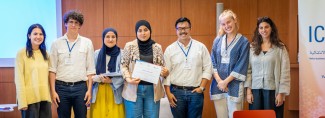
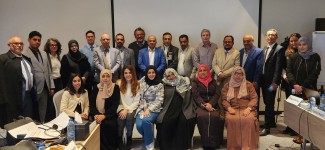
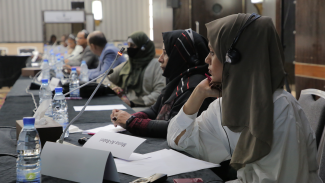
ICTJ recently convened human rights defenders, journalists, and lawyers from Libya, Sudan, Syria, Tunisia, and Yemen for a workshop on digital, open-source investigations. Held on November 3-8 in Kampala, Uganda, the course trained participants on open-source tools with a view to strengthening their work investigating, documenting, and monitoring human rights violations.

Since 2014, conflict in Yemen has caused hundreds of thousands of deaths, displaced millions, destroyed the economy, and exacerbated systemic marginalization, creating one of the world’s worst humanitarian catastrophes. Yet currently, transitional justice and reconciliation take up little space in the Yemeni political arena. In this context, ICTJ has released a new report that explores pathways to a just and sustainable peace in Yemen.

This report explores pathways for transitional justice in Yemen, emphasizing victims’ experiences, political dynamics, and existing justice mechanisms. It examines national and local efforts, including mediation and reconciliation initiatives, and highlights the role of Yemeni civil s...

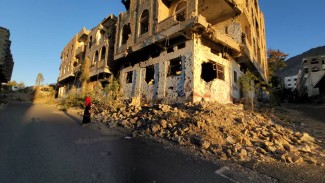
The sun shines into an urban courtyard of what it appears to be residential buildings.

In this era of technological transformation, it is critically important to develop digital strategies for documenting human rights violations, analyzing data for accountability or reparations purposes, and safely advocating for human rights online. This is particularly true in contexts where victims, human rights actors, and members of the media live in fear. To this end, ICTJ has recently led trainings for human rights activists in conflict-affected countries on open-source investigation tools to help them do their work more effectively.

Yemen's nine-year conflict has devastated the country and created one of the world’s worst humanitarian crises. The regional upheaval stemming from the ongoing war on Gaza has created more obstacles on the country's already complex path toward peace and shifted attention away from the set of UN-brokered commitments agreed upon by the parties to the conflict in December 2023, which include a nationwide ceasefire. Amid these challenges, it is more imperative than ever to support civil society and victims and bring attention to victims’ grievances and needs.

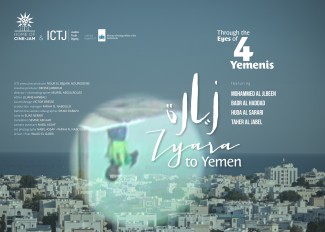
The Arabic word “Zyara” means “visit” in English. The Zyara documentary series takes an innovative, deeply personal approach to storytelling with a view to nurturing collective social and emotional healing. Through candid encounters, it paints poetic portraits of four Yemenis refugees living in Oman, including a human rights lawyer and activist, a restaurant worker, a martial arts champion, and a businessman. By telling their stories and celebrating the resilient spirit of the Yemeni people, the Zyara project seeks to raise awareness and preserve truth and memory.

The Arabic word “Zyara” means “visit” in English. The Zyara documentary series takes an innovative, deeply personal approach to storytelling with a view to nurturing collective social and emotional healing. Through candid encounters, it paints poetic portraits of four Yemenis refug...

The Arabic word “Zyara” means “visit” in English. The Zyara documentary series takes an innovative, deeply personal approach to storytelling with a view to nurturing collective social and emotional healing.

In 2016, the Yemeni National Commission to Investigate Alleged Violations to Human Rights began documenting violations committed since the 2011 uprising and during the subsequent brutal civil war, which continues today. To date, the commission has documented more than 23,000 human rights abuses and referred over 2,000 cases to Yemen’s Public Prosecutor for prosecution. However, no verdict has been issued in any of these cases. To help the commissioners and members of Yemen’s judiciary advance accountability, ICTJ organized a workshop for them on transitional justice mechanisms. However, to deliver a justice that meets all the reparative needs of victims, these efforts must be an integral part of a broader, multifaceted transitional justice process.

Even as the parties to the war in Yemen fail to extend the UN-brokered ceasefire, field monitors of the National Commission to Investigate Alleged Violations to Human Rights (NCIAVHR) continue to document and investigate human rights violations despite enormous challenges and serious risks to their...

This report aims to help practitioners in the transitional justice field to understand the experience of establishing and operating hybrid courts and to address some common assumptions about these entities. To do so, it looks at hybrid or mixed courts in practice, drawing on experienc...

As we look back on 15 years of ICTJ's work, we recognize that our greatest asset is the people whose knowledge, experience, and dedication made our contribution possible. To celebrate all who have been part of ICTJ’s story over the years, we asked some of our former colleagues to share their reflections and memories of moments that stand out: moments that throw the stakes of our work into sharp relief. In the weeks and months to come we will bring you their stories in Reflections on the Struggle for Justice. Caitlin Reiger, ICTJ's former Deputy Director of Prosecutions (2005–2010), reflects on the humanizing power of testimony, on display in East Timor.

ICTJ spoke with Patrick Walsh, an Australian human rights advocate who helped establish and advise East Timor's Commission for Reception, Truth, and Reconciliation (CAVR).

Some of the relatives’ stories start with the banging of a door at night, followed by a sudden abduction; others begin with a seemingly innocent citation to appear at a police station for a “routine procedure”. In any case, the stories always unfold in a desolate manner: as a loved one ...

In this edition of ICTJ's Program report, Kelli Muddell, director of ICTJ's Gender Justice program, reflects on ICTJ’s vision of gender justice, the challenges facing survivors of sexual and gender-based violence in times of transition, and how ICTJ is working to address inequality in countries like Colombia, Nepal, and Tunisia.

This paper considers the efforts of Timor-Leste’s Commission for Reception, Truth and Reconciliation to address the forced displacement that occurred during the period of Indonesian occupation and in the post-Popular Consultation violence of 1999. It examines linkages between the work...

The 2006 crisis in Timor-Leste saw close to 15 percent of the population displaced from their homes, threatening to sink the country into protracted instability and violence. Remarkably, five years later the country was back on track, with the internal displacement issue largely resol...

JAKARTA, Nov. 15, 2011—Experts and stakeholders from Cambodia, the Philippines, Bangladesh, Indonesia, Burma, Timor-Leste, Thailand, and Nepal, along with international experts are gathering in Jakarta’s Hotel Atlet from November 15–16 to discuss the need for progress on prosecuting serious crimes in Asia.

This paper analyzes the Maubuti case in Timor-Leste, the third serious crimes case to be brought to trial after the closure of the UN-supported Serious Crimes Unit in 2005. Maubuti was indicted for crimes against humanity including murder, attempted murder, and rape. The decision and ...

This paper analyzes the serious crimes process the UN established in Timor-Leste to try serious violations of human rights perpetrated in 1999. The main difficulty facing this process is that the vast majority of suspects are in Indonesia, and the Timorese government has not been able...

This report examines community expectations and experiences of Timor-Leste’s unique transition from occupation to independence. It documents the results of focus group discussions on an array topcis including violence and conflict, truth recovery, justice, accountability, reconciliat...

This paper considers the UN-sponsored regime established to respond to the crimes committed in East Timor during the Indonesian occupation between 1975 and 1999. The story of the quest for justice in East Timor perhaps can be summed up as one involving good intentions that were not ba...

In August 2006 the Security Council created the UN Serious Crimes Investigation Team, as an extension of the previous investigation under the UN Integrated Mission Timor-Leste.

ICTJ hosted a meeting, “Peace and Justice in Asia,” with a particular focus on Indonesia, Timor-Leste, and Nepal, on December 2-3, 2008. The two-day conference brought together senior experts, officials, and community leaders from three distinct areas that have suffered conflict in In...

Indonesia and Timor-Leste created the Commission for Truth and Friendship (CTF) bilaterally in 2005. The commission has not yet delivered substantive transitional-justice benefits, and its public hearings have seriously compromised the goals of truth and resconciliation. This report i...