


1519 results

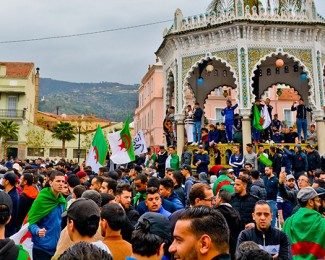
Throughout the week of April 23, I have been attentively following the news to know what would be the impact of this Friday’s hirak (Arabic for protests or mass rallies) in Algeria. The tenth consecutive Friday of protests that began on February 22 is a reaction to the announcement made by an invalid president, Abdelaziz Bouteflika, from a hospital in Geneva, of his intention to continue holding his position for a fifth term.

After a society is torn apart by conflict or repression, who decides whether to remember or forget the painful past? Can forgiveness happen without acknowledgement of wrongdoing? Is there a difference between forgetting and denial? Join us as ICTJ debates the impact of remembrance on reconciliation with David Rieff and Pablo de Greiff.

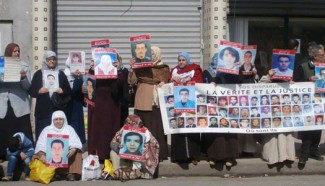
For more than two decades, some 40 women have been protesting every Wednesday against government inaction on the disappeared in front of Algeria’s official human rights commission. They stand on the sidewalk holding photos of their disappeared relatives — their children, fathers, and husbands — breaking the silence at a dangerous time in Algeria.

This Wednesday saw the beginning of formal peace talks between the Colombian Government of Juan Manuel Santos and the leadership of the left-wing FARC guerrillas. This op-ed from ICTJ Vice President Paul Seils argues that a successful outcome will not be measured simply in the effective demobilization of roughly 8,000 militants. Durable peace will require a reimagining of the Colombian state, which has become both victim and perpetrator in a conflict now over half a century old.

The announcement by the Executive Committee of Ethiopia’s ruling party that the country will implement the 2002 Algiers peace agreement and decisions of the Ethiopia-Eritrea Boundary Commission brings hope that a 20-year war that divided families and communities is finally over.

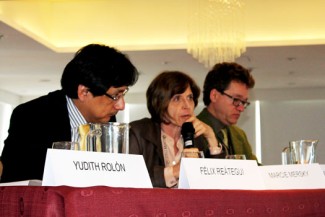
The one-day forum “Latin American Experiences with Truth Commissions,” organized by the International Center for Transitional Justice in Bogotá on July 22, brought together leading experts to discuss experiences and lessons learned from truth-seeking processes that shed light on massive human rights violations in four countries: Argentina, Guatemala, Paraguay, and Peru.

This briefing paper calls on the soon-to-be-established NLD-led Burmese government to seriously consider taking steps to deal with Myanmar’s troubled past as a way to help end the cycle of violence and human rights violations in the conflict-torn country.

The Maryland Lynching Truth and Reconciliation Commission held its first public hearing in Cumberland, Allegany County, Maryland, on October 2, 2021. The event, broadcast live from Emmanuel Episcopal Church, brought together commissioners, panelists, and guests to acknowledge and memorialize the tragic lynching of 18-year-old Robert Hughes (aka William Burns) in Cumberland in 1907. In the coming months, the commission will convene several more of these public hearings in counties across the state of Maryland.

This report explores pathways for transitional justice in Yemen, emphasizing victims’ experiences, political dynamics, and existing justice mechanisms. It examines national and local efforts, including mediation and reconciliation initiatives, and highlights the role of Yemeni civil s...

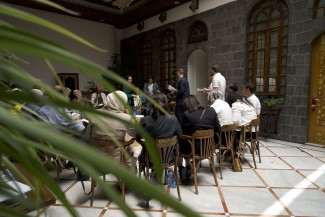
The sun shines into an urban courtyard of what it appears to be residential buildings.

Expectations for advancing much-needed justice and dismantling state and non-state criminal networks that persistently violate human rights have been dashed over the past three years in Mexico. Violence and impunity have increased. President Andrés Manuel López Obrador's campaign promises have not materialized in a serious effort to address the lack of security in the country or the justice system’s inefficiency. However, several efforts have persisted, characterized by cooperation among state institutions, civil society, and victims’ groups that not only give hope, but confirm the way forward.

In Venezuela, there is now an absence of representative democracy and a vacuum of public trust in politicians. However, this situation presents an opportunity for other actors and other approaches, so far disparaged by hardliners on both sides. Civil society organizations, which have earned credibility through their dedicated work addressing the humanitarian crisis and defending human rights, can seize this opportunity.

This guide is designed to engage young people who are interested in or are working on transitional justice issues in their communities. Intended to serve primarily as a training tool, it provides basic information about transitional justice and related principles and offers tips and s...

The Truth and Reconciliation Commission (TRC) of Canada held its fourth national event in Saskatoon, Saskatchewan June 21. After attending a prior hearing, students from the We'koqma'q Mi'kmaw School in Nova Scotia created “Our Legacy Our Hope,” a documentary bearing witness to the intergenerational effects of Residential Schools and the ongoing work of the commission to address these legacies.

Banjul, The Gambia – On October 26, 2019, t he International Center for Transitional Justice (ICTJ) in partnership with an artist collective in The Gambia will premier e a short documentary film about a group of young musicians and activists taking part in the country’s unfolding transitional justice process.

This report summarizes the key observations offered by Syrians during community dialogues in April 2025. Convened by Bridges of Truth, a collaboration of Syrian civil society organizations and ICTJ, the dialogues captured a wide spectrum of perspectives and experiences and provided va...

Some 20 people sit in chairs around a table located inside a courtyard.

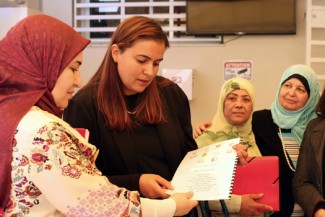
The voices of Tunisian women were in danger of being lost in the country's transitional process. Salwa El Gantri explains how one network of women's organizations made sure that did not happen by helping women find their voice and fight for justice.

This document presents a non‐exhaustive summary of some of the topics discussed at a workshop on outreach organized by the ICTJ in collaboration with the ECCC from March 3-5, 2010. It first provides a general overview of the ECCC functions and outreach activities. Thereafter, it highl...

70-94% of the victims of enforced disappearances are men. But what happens to the women left behind? ICTJ's Amrita Kapur explains why women are uniquely impacted by the crime, and how transitional justice can help.

Recent recognition of the work of Nobel Laureate Nadia Murad has drawn global attention to the issue of sexual violence and gender-based violence in conflict. But, as ICTJ Expert Kelli Muddell argues, the nuances of gender norms and how they impact women, men, and vulnerable populations are still often missing from conversations about victims.

This paper discusses the challenges encountered during efforts to pursue justice in a number of sub-Saharan African countries in transition, including Burundi, the Democratic Republic of Congo, Ghana, Liberia, Rwanda, Sierra Leone, and South Africa. It presents a background and geneal...

Background of the generations-long conflict in Colombia involving the state, the guerilla group FARC and paramilitaries. The shifting boundaries between drug trafficking and political crime remain a serious obstacle to efforts to promote accountability and respect for human rights in ...

Pablo de Greiff, director of Research at ICTJ, has presented his candidacy for the role of Special Rapporteur for the Promotion of Truth, Justice, Reparation, and Guarantees of Non-Recurrence. This new position is being established by the United Nations Human Rights Council to bring greater attention to accountability for serious crimes and human rights violations.

ICTJ is pleased to announce that Pamela Hogan and Jamie Metzl have joined ICTJ’s Board of Directors. “We are delighted to welcome Jamie and Pamela to the ICTJ Board,” said President David Tolbert.

For the past few months, ICTJ, along with our partners at the Center on International Cooperation at New York University, has been working on a comprehensive new policy paper on the situation of the many thousands of Syrians detained somewhere in the country’s vast network of prisons. The depravity that goes on inside these detention sites is already so appalling that it would have been hard to imagine when we started the project that the situation for the prisoners could get any worse. And then the COVID-19 pandemic hit, upending all of our preconceptions, and our lives, in ways none of us ever expected.

What happens when a state refuses to acknowledge the suffering of victims of mass atrocities? Or when the public celebrates perpetrators as heroes? Earlier this month, a panel discussion hosted by The International Center for Transitional Justice and New York University’s Center for Global Affairs grappled with the impact of denial on justice.