The establishment of the Reparations Commission in April 2025 and the recent appointment of British barrister Martin Hackett in April 2026 as The Gambia’s first special prosecutor for the human rights abuses committed during the 22-years rule of former dictator Yahya Jammeh represent crucial and long-awaited steps in the country’s transitional justice process. For victims, they signal that authorities may finally transform the findings of the Truth, Reconciliation and Reparations Commission (TRRC) into concrete action. But to succeed, they require sustained public, political, and financial support both in The Gambia and internationally.
The Gambian people, particularly victims, deserve justice, healing, and lasting peace, and it would be a regrettable failure if the process put in place to deliver them does not receive the broad support it needs in the next stages. In 2017, Gambians courageously ousted Jammeh and forced him into exile. The new government soon after launched a comprehensive transitional justice process that is now widely considered to be one of the most innovative and promising the African continent has seen. This process, which included the TRRC, has been characterized by remarkable public ownership, the involvement of the members of the diaspora, the strategic use of new information technologies, and the ability to adapt to local realities.
For its part, the TRRC incorporated reparations into its mandate. And when the commission submitted its final report in 2021, it recommended reparations for victims, prosecutions for dozens of individuals linked to serious human rights violations, and restorative justice measures. Following the TRRC’s closure, the country then established a post-TRRC unit responsible for coordinating the implementation of the recommendations and designated the National Human Rights Commission as the monitoring body.
Clearly, the Gambia has already accomplished something immensely significant through the process thus far, in documenting violations and laying the groundwork for criminal accountability, reparations, and guarantees of non-recurrence. But, it is now at a critical juncture. The next test is whether the state can sustain the political will, institutional discipline, and financial support necessary to provide justice in practice.
It is important to recognize that the country remains largely dependent on international aid to sustain its transitional justice process over the long term. The sharp reduction in such aid starting in January 2025 and the global shift in international development priorities more generally pose a serious threat to the success of this process.
Meanwhile, victims and survivors have grown frustrated over the slow pace of the process and the associated legal reforms and political negotiations. Their exasperation is understandable: Delaying justice can deepen trauma, weaken public trust, and contribute to the perception that political leaders have little interest in accountability.
For years, victims have carried the national process, and they cannot be left waiting any longer. Today, victims are suffering from process burnout. ICTJ conducted a monitoring exercise with victims in early 2026, which found signs of fatigue linked to emotional, cognitive, and physical exhaustion; disappointment with the process; and disengagement from it. The identified causes of the fatigue include long waiting periods, a gap between expectations and the actual outcomes, and a loss of trust in the institutions.
Among the countries that have undertaken a national transitional justice process, The Gambia remains one of the few to have made substantial progress in implementing the recommendations of a truth commission. Yet much more remains to be done. State actors, politicians, and civil society groups in The Gambia as well as international justice leaders and donors must continue to push the process forward. To give up on it now would be to renege on their commitment to human rights and their promise to the victims who have tirelessly advocated for the justice and repair and all Gambians seeking reconciliation and lasting peace.
_______
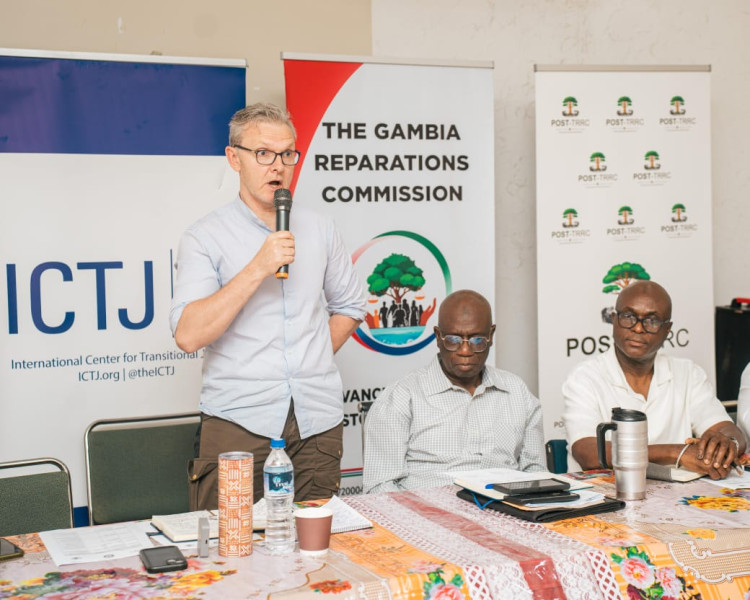
PHOTO: Special Prosecutor Martin Hackett, with representatives of the Reparations Commission to his left, addresses a town hall meeting organized by ICTJ in Birkama, The Gambia, in May 2026. (ICTJ)