
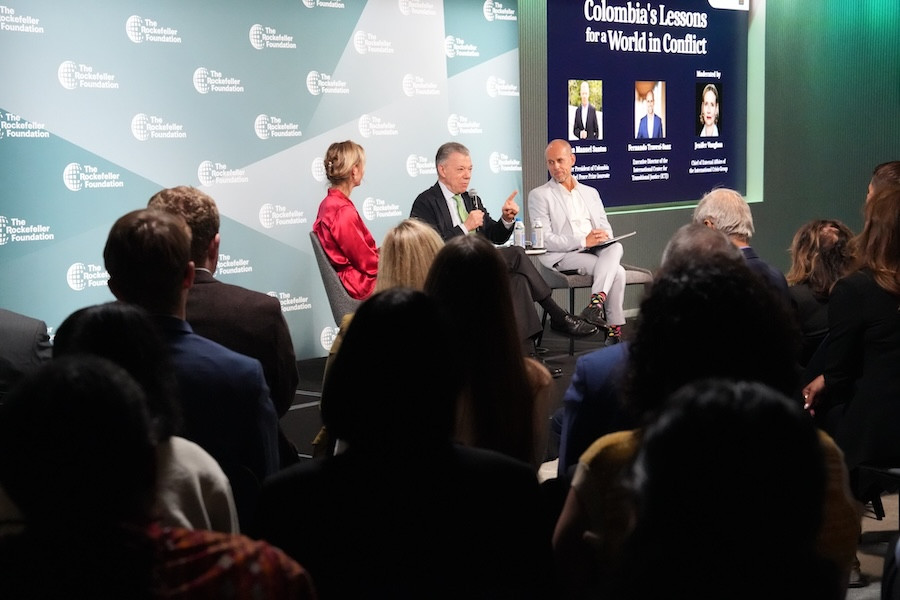
Ten years ago, Colombia signed a peace agreement with the Revolutionary Armed Forces of Colombia–People’s Army (FARC–EP), ending one of the longest armed conflicts in the world. The agreement stands as one of the most ambitious transitional justice frameworks ever negotiated, though its implementation remains incomplete. At a recent panel discussion co-hosted by ICTJ, the COMPAZ Foundation, and the International Crisis Group and held at the Rockefeller Foundation in New York, former Colombian President and Nobel Peace Prize laureate Juan Manuel Santos and ICTJ Executive Director Fernando Travesí-Sanz looked back at what it took to get here and the work that remains to be done. The International Crisis Group’s Chief of External Affairs Jenifer Vaughan moderated the conversation.
Santos, who served as Colombia’s president from 2010 to 2018 and led the peace process, described the risks of negotiating with the FARC after decades of war. For him, it came down to a question of conscience: How many lives could be saved by trying, compared with the cost of never trying at all? Reflecting on the moral weight of the question, he recalled the advice he once received from former South African President and Nobel Peace Prize laureate Nelson Mandela, which helped convince him to pursue the talks. “If I took the risk and succeeded in making peace in Colombia, how many lives would I have saved? And if you don't take the risk, and you're in front of your grave, would you go to your grave with your conscience at peace?” Santos said.
The massive scale of the conflict in Colombia called for a novel and comprehensive approach to transitional justice. When the peace agreement was first signed in September 2016, more than 8 million people were registered as victims of the conflict. Prosecuting every case individually would never be possible. The Special Jurisdiction for Peace, which was established by the peace agreement, therefore developed a prosecutorial strategy that incorporated truth telling and reparative sanctions and required perpetrators to acknowledge and fully disclose their crimes and help repair the harm they caused.
“We need to open and broaden the understanding of justice,” explained ICTJ’s Fernando Travesí-Sanz, “not to see it as criminal prosecution alone.”
Santos admitted that he had worried whether the people would accept a justice model without conventional prison sentences. He recounted how he asked victims why they supported the approach. Many, he said, replied, “because we don't want others to suffer this.” He described their response as “a lesson in life.”
Both speakers were candid about the gaps in the peace agreement’s implementation. Armed conflict and criminal violence have returned to some territories the FARC once controlled, while the rural reforms and measures to ensure gender and ethnic equality stipulated in the agreement have not been fully carried out.
Yet Travesí-Sanz rejected the idea that the peace agreement has failed. Despite its many shortcomings and public criticisms, he argued that it has brought consequential positive changes to the country. What also matters, he asserted, are leaders who can build public trust and support for the values underpinning the agreement. “There are leaders who take you to war and leaders who take you to peace,” Travesí-Sanz said. “Leaders have the capacity to mobilize and to gain the trust of individuals who need to understand the complexity of the peace agreement, but who will never read—nor do they need to—its 3,000 pages.”
There is also a reason for hope. About 87 percent of former FARC combatants who signed the accord remain committed to it. That said, signatures in and of themselves do not end a war. The political will that is required for the agreement’s implementation must be renewed year after year, and institutions must continue to put victims at the center. Building peace and delivering justice must become state policy rather than agenda items of any single government administration.
The speakers closed the conversation with a shared reflection: A peace agreement is not an endpoint, but the beginning of a long, complex, and often contested process. They stressed the vital importance of fully implementing the agreement and reinvigorating the political will to see all its promises through. Those responsible must continue to answer for what they did. A peace without accountability may stop the violence for some time, but it will not last and it will never heal anyone.
_______
PHOTO: Former Colombian President Juan Manuel Santos (center) and ICTJ Executive Director Fernando Travesí-Sanz (right) participate in a panel discussion on Colombia’s lessons for a world in conflict at the Rockefeller Foundation in New York on September 25, 2026. (Firas BouZeineddine/ICTJ)

