23 results

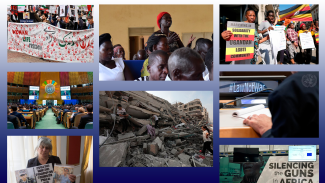
Throughout 2025, ICTJ’s experts offered thoughtful analysis on conflicts and major political developments in more than 10 countries as part of the World Report newsletter. Their insightful commentaries shed light on the obstacles that victims, civil society, and their partners must navigate as they pursue sustainable peace and justice. In this edition, we look back on the past year through the Expert’s Choice column.

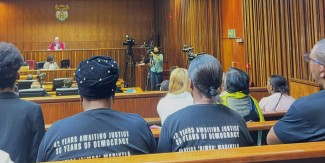
On April 14, 2025, the Johannesburg High Court handed down a landmark judgment. From his bench in courtroom 4D, Judge Dario Dosio dismissed the defense team’s objections to the inclusion of murder and apartheid as crimes against humanity charges in the indictment against two individuals accused of a deadly 1982 attack on anti-apartheid student activists. In so doing, the court cleared the way for crimes against humanity charges to be pursued in a South African domestic court for the first time. It also opened the door to the first ever prosecution of apartheid as a crime against humanity anywhere in the world.

Throughout 2023, ICTJ’s experts have offered their unique perspective on breaking news around the globe as part of the World Report. Their insightful commentaries have brought into focus the impact these events have on victims of human right violations as well as larger struggles for peace and justice. In this edition, we look back on the past year through the Expert’s Choice column.

The end of 2022 in Venezuela was marked by signs of willingness from all parties to take concrete steps toward democracy. The government and the opposition resumed negotiations and agreed to allow the United Nations to manage a fund for billions of dollars of frozen assets, which would be gradually released to address the country’s humanitarian crisis. The United States authorized the Chevron Corporation to resume limited operations for importing Venezuelan oil. Finally, the 2015 National Assembly voted to end the opposition-led interim government. While these steps are initial ones to create the conditions for trust among the parties, they offer opportunities to improve the dire circumstances in which many Venezuelans currently live.

In Venezuela, there is now an absence of representative democracy and a vacuum of public trust in politicians. However, this situation presents an opportunity for other actors and other approaches, so far disparaged by hardliners on both sides. Civil society organizations, which have earned credibility through their dedicated work addressing the humanitarian crisis and defending human rights, can seize this opportunity.

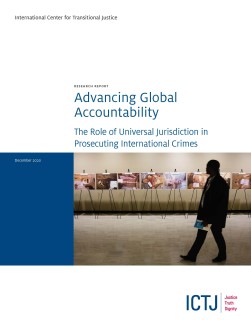
Invoking the principle of universal jurisdiction opens the door to the possibility of some accountability in circumstances where justice is not possible in countries where the crimes took place. This study considers the challenges facing the exercise of universal jurisdiction and asse...

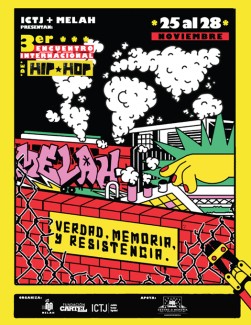
Bogotá, November 20, 2020—ICTJ and the Movement of Latin American Hip Hop Expressions have joined forces to cohost the third International Hip Hop Encounter, which will take place virtually this week from November 25 to November 28. The four-day online event will bring together artists and musicians from across Latin America and Africa along with activists, social leaders, and civil society representatives. The festival’s theme is the role of hip hop music and culture in uncovering truth, preserving memory, and resisting violence and oppression.

The political crisis in Venezuela has reached a breaking point. The upcoming parliamentary elections scheduled for December 6 threaten to deprive the opposition of its institutional foothold, on which the legitimacy of its demand to establish an interim government rests. Moreover, observers both inside and outside Venezuela have repeatedly warned that the conditions are unsuitable for fair and impartial elections. A political solution now depends on the government backpedaling from its recent refusal to postpone the elections and allowing the European Union to observe them. It also requires the opposition to take a clear stance beyond calling for the removal of the president.

The political crisis in Venezuela seems to have reached a stalemate. In September, the Norway-mediated negotiations between the Maduro government and the opposition came to a halt, leaving both sides struggling for the upper hand. But since it remains difficult for either party to prevail, it is likely that this impasse is a momentary setback rather than an indication that the negotiations are defunct.

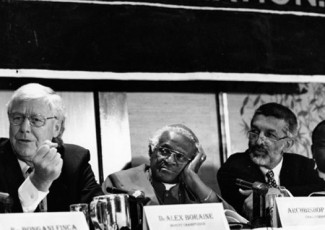
Regardless of how the world remembers Alex Boraine's legacy—or the success and shortcomings of the truth and reconciliation process in South Africa—history will recall that Boraine withstood his own, and his nation’s, transitions to cement his legacy as an architect for truth and reconciliation and a champion for justice for victims.