605 results

In designing transitional justice in Armenia, policymakers, civil society activists, and international actors should remember those who have not had justice for so long: the families of those killed or injured in March 2008, the victims of torture and political detention, the mothers in black seeking the truth about why their soldier sons were killed, the old pensioners who live in cold and hunger, farmers and rural communities who need access to social services, and students and young citizens who saw that their hope for a better future required a revolution.

Regardless of how the world remembers Alex Boraine's legacy—or the success and shortcomings of the truth and reconciliation process in South Africa—history will recall that Boraine withstood his own, and his nation’s, transitions to cement his legacy as an architect for truth and reconciliation and a champion for justice for victims.

New York, June 3, 2019—Today, with just over a month to go before the 2019 UN High-Level Political Forum (HLPF) on Sustainable Development, ICTJ and its partners have released the Report of the Working Group on Transitional Justice and SDG16+, entitled “On Solid Ground: Building Sustainable Peace and Development After Massive Human Rights Violations.”

This report analyzes the macro-criminality approach that was taken in Colombia’s Justice and Peace process and draws key lessons for the Special Jurisdiction for Peace. It examines how Law 1592 of 2012 and other regulatory instruments sought to move beyond a case-by-case method, prior...

Cover of Macrocriminality report

This paper explores political exclusion in Kenya and its consequences on the social fabric of the nation. It draws from past governmental reports and analysis to formulate new recommendations that can inform current discourse. It first provides an overview of ethnicity in Kenya. ...

On February 14, Kenyans once again confronted their painful relationship with law enforcement and revisited the deep mistrust born of historical abuses. In an unprecedented ruling, a court found five senior police officers potentially culpable in gruesome murder during the police response to the 2017 post-election protests. On the same day, a senior police officer was convicted of murder and jailed for life.

In December 2018, we mourned the loss of ICTJ's founder, Alex Boraine. On December 12, Fernando Travesí sat down for an intimate conversation with Vincent Mai—ICTJ’s first chairman—to learn more about a life that we will continue to commemorate in the months and years to come.

The Working Group on Transitional Justice and SDG16+ calls on the international community, including policymakers, donors, and practitioners, to: provide consistent support and investment to context-specific transitional justice, as a tool of sustainable peace and development. formulate development...

On February 8, at the Peace Palace in The Hague, the high-level international Task Force on Justice will meet to finalize its report on increasing access to justice for people and communities around the world—or reducing the “justice gap”—as an integral element of the Sustainable Development Goals (SDGs).

On January 15, 2019, victims of the 2010-2011 post-election violence in Côte d'Ivoire were shocked, yet again, to learn that the Trial Chamber I of the International Criminal Court in The Hague had acquitted former President Laurent Gbagbo and the former Youth Minister Charles Blé Goudé of crimes against humanity allegedly committed during the crisis.

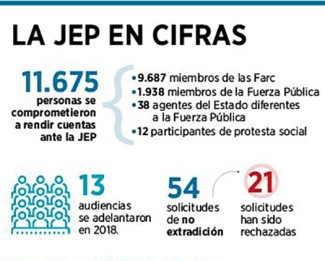
In little less than 10 months, Colombia has witnessed the creation of a completely new jurisdiction, the Special Jurisdiction for Peace (JEP). JEP has already opened two cases and three situations in its Chamber for the Acknowledgment of Truth and Responsibility.

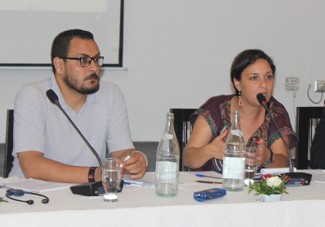
As the work of Tunisia's Truth and Dignity Commission winds down, ICTJ's Salwa El Gantri and Kelli Muddell discuss some of the challenges and successes of its work and their vision for transparent, participatory processes to advance Tunisia’s transitional justice mandate in the short and long term.

The Task Force on Justice is gathering inputs in order to encourage greater provision of justice to people and communities outside the protection of the law. As the Task Force has pointed out, the “justice gap” that it seeks to reduce is greatest in conflict-affected countries, where only 3 percent of development assistance goes to justice.

Many countries have endured a violent past or a dictatorship that left behind a trail of human rights violations. During transitions to peaceful societies or democracies, there is a need to address that painful past to ensure that the violations do not recur in future. While some countries have made or are making laudable efforts to deal with the atrocities of the past, others like Kenya are regrettably still at the phase of wishing the painful past away.

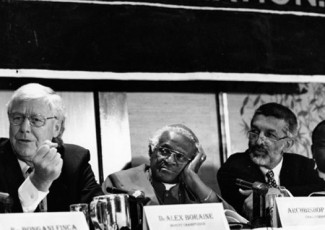
Alex Boraine, founder of the ICTJ and soldier in the struggle for human rights around the world, will be laid to rest in Cape Town today. He has been called the “Prince of Peace” for his lifelong commitment to transforming South Africa’s society through truth, reconciliation, justice, following the horrors of apartheid.

Dr. Alex Boraine, founder of the ICTJ, was larger than life. In his long career, he touched the lives of thousands in his beloved South Africa and around the world.

This report aims to help practitioners in the transitional justice field to understand the experience of establishing and operating hybrid courts and to address some common assumptions about these entities. To do so, it looks at hybrid or mixed courts in practice, drawing on experienc...

NEW YORK – The Swedish International Development Cooperation Agency (Sida) has awarded the International Center for Transitional Justice (ICTJ) a grant of 40 million Swedish kronor to implement its Strategic Plan 2018-2022. During this period, ICTJ will respond to the growing demand for its services...

The first of its kind and the culmination of three years of planning and development, Gender Modules is a comprehensive curriculum that uses case studies to illustrate topics such as gender and reparations and the prosecution of gender-based crimes. It provides concrete guidance to those seeking to implement gender-sensitive processes – informed by successes and failures in contexts around the world.

During a forum held in Bogotá, Colombia, on November 1, 2018, ICTJ launched the Spanish-language version of its Handbook on Complementarity: An Introduction to the Role of National Courts and the ICC in Prosecuting International Crimes. The Deputy Prosecutor of the International Criminal Court (ICC), James Kirkpatrick Stewart, gave the keynote address.

Kenyan media house Africa Uncensored has teamed up with the International Center for Transitional Justice (ICTJ) on a documentary that explores the Bulla Karatasi massacre that took place in the northern region of Garissa, Kenya, and its impact on communities in the North. The documentary will advance ICTJ’s efforts to partner with civil society on community-state dialogue initiatives, engage stakeholders around political and constitutional reforms stemming from the TJRC’s recommendations, and achieve redress for the legacy of state violence in Garissa and other communities in Northern Kenya.

Victims in Nepal have been calling on the government for public consultation to ensure wider discussion, a process that would allow them to share their expectations, help them to comprehend the dense language of the proposed amendments and its many gaps. They needed to understand the dubious phrasing especially on issues of criminal accountability that created suspicion, instead of trust and legitimacy in the process.

On September 18, the trial of Dominic Ongwen resumed at the ICC. Ongwen is on trial for 70 counts of war crimes and crimes against humanity – including various forms of sexual violence and the recruitment of child soldiers – committed in the former IDP camps of Lukodi, Odek, Abok, and Pajule during the 20-year insurgency in Northern Uganda. Ongwen is the first former child soldier who is facing trial at the ICC for crimes in which he was also a victim.

On the eve of Côte d'Ivoire’s 58th independence anniversary, in a dubious attempt at “social cohesion,” President Alassane Ouattara granted amnesty to 800 persons accused or convicted of crimes against the state during the post-election crisis of 2010-2011. Former First Lady Simone Gbagbo — who had been tried for undermining state security — and other high-ranking officials associated with former President Laurent Gbagbo’s party, the Ivorian Popular Front (FPI), were among those released. The lapses in accountability and acknowledgment in Cote d’Ivoire have emboldened perpetrators and made it impossible for many victims to move on with their lives. The challenges of transitional justice processes present clear obstacles to the sustainable peace that the people of Cote d’Ivoire have been working toward.

In July, ICTJ’s Program Director Anna Myriam Roccatello and Senior Transitional Justice Expert Ruben Carranza traveled to Yerevan to meet with civil society organizations, human rights and anti-corruption activists, and key government officials, to join them in exploring strategies for change.