




188 results

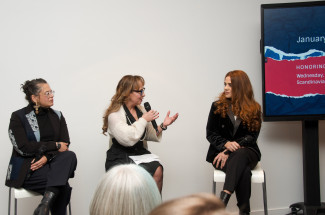
On January 28, 2026, ICTJ held its annual January for Justice Leaders benefit dinner in New York City, an event celebrating leaders advancing justice around the world. This edition also marked the beginning of ICTJ’s 25th anniversary year and served as an opportunity to look back on a quarter century spent standing alongside victims, civil society, and institutions in the pursuit of truth, accountability, and lasting peace after mass atrocities.

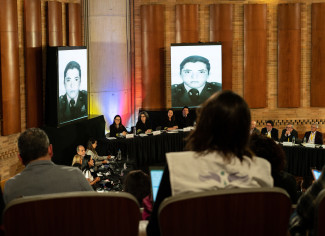
To commemorate the 20th anniversary of the Justice and Peace Law—which created Colombia's first transitional justice system—media outlet Verdad Abierta, the Friedrich Ebert Stiftung, and ICTJ partnered to produce an investigative four-part series in Spanish that critically assesses its legacy. Now translated into English, this second installment explores the unprecedented challenges the country faced as the process got underway.

To commemorate the 20th anniversary of the Justice and Peace Law—which created Colombia's first transitional justice system—media outlet Verdad Abierta, the Friedrich Ebert Stiftung, and ICTJ partnered to produce an investigative four-part series in Spanish that critically assesses its legacy. ICTJ has now translated the first two installments into English.

This year, Colombia commemorates the 20th anniversary of the Justice and Peace Law, which established the country’s first formal transitional justice mechanism. On this milestone anniversary, ICTJ reflects on the evolution that led to the groundbreaking law, the lessons that have been learned so far, and the challenges that lie ahead.

ICTJ, in collaboration with the Center for Media Integrity of the Americas, the Cyrus R. Vance Center for International Justice, and the New York City Bar Association, recently hosted a screening of the Colombian documentary Después del Frío ("After the Cold"). Coproduced by ICTJ and Colombian journalist María Jimena Duzán, with the support of the Embassies of Sweden and Norway in Colombia, the film paints an intimate portrait of a nation seeking healing and transformation, where the scars of the past give way to hope.

This year, Colombia commemorates the 20th anniversary of Law 975, which established the country’s first transitional justice process, called Justicia y Paz (or Justice and Peace). With this anniversary top on mind, and as the current government engages with eight of the remaining armed groups in pursuit of its “Total Peace” strategy, ICTJ recently teamed up with podcast producers Sillón Estudios to create a four-part series that delves into the peace process with the AUC and considers key lessons learned.

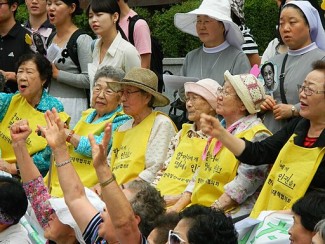
In February 2024, the Office of the United Nations High Commissioner for Human Rights hosted an event in Seoul, South Korea, marking the 10th anniversary of the release of the report of the United Nations Commission of Inquiry on Human Rights in the Democratic People's Republic of Korea. ICTJ Senior Expert Ruben Carranza spoke at the event and discussed lessons learned involving nonjudicial forms of accountability. In this interview, he talks about why a broader approach to transitional justice is necessary and how transitional justice measures can help promote peace and possible reunification on the peninsula.

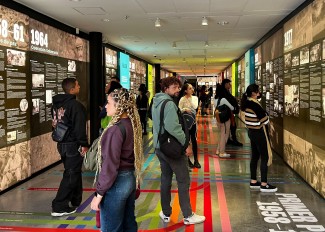
On February 13, 2024, the interactive cultural exhibit “If There Is Truth, There Is Future” opened to the public at Bogotá’s Center for Memory, Peace and Reconciliation. As part of the Colombian Truth Commission’s post-closure cultural and educational outreach activities, the exhibit aims to inform Colombians of all generations about the commission’s findings and inspire them to take action to prevent a recurrence of conflict.

ICTJ’s partner Afghanistan Human Rights and Democracy Organization (AHRDO) recently opened a new virtual museum and database dedicated to Afghan victims of conflict and human rights abuses. “The Afghanistan Memory House” not only preserves the memory of these victims but helps pave the path for truth and justice. To launch the virtual museum, ICTJ and AHRDO cohosted a panel discussion on memorialization, moderated BBC journalist Lyse Doucet, in ICTJ’s office in New York this past December.

On November 28, 2023, ICTJ organized an international dialogue in Bogotá, Colombia, to share innovative strategies for advancing victims’ rights to redress for human rights abuses and for establishing more victim-centered development policies. The gathering also marked the official launch of ICTJ’s new report—Advancing Victims’ Rights and Rebuilding Just Communities Local Strategies for Achieving Reparation as a Part of Sustainable Development—which presents findings from a two-year comparative study of local efforts in Colombia, The Gambia, Tunisia, and Uganda to advance reparations.