1519 results

This paper explores practical issues regarding the relationship between the Truth and Reconciliation Commission (TRC) and Special Court (SC) in Sierra Leone. It looks at: 1) the legal relationship of the Commission and the Court; 2) the question of whether the TRC information should b...

Fourteen members of Syrian civil society recently gathered for a five-day workshop on community facilitation and transitional justice organized by ICTJ and its partners in the Bridges of Truth project. The workshop marked a major step in the preparation for extensive community dialogues that will take place across Syria in the months ahead.

As Yemen prepares to embark on a national dialogue about its future, addressing the legacy of the past human rights violations remains one of its key challenges. A Law on Transitional Justice and National Reconciliation has been under discussion since February 2012 and may now be adopted in the coming weeks.

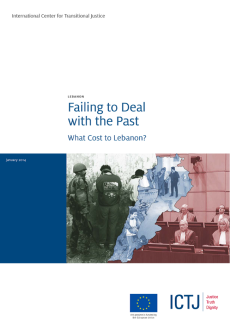
This report examines the situation of impunity in Lebanon that has persisted since the 1975-1990 war through the lenses of core elements of transitional justice. It analyzes Lebanon’s past experience of ineffective transitional justice measures -- including limited domestic trials, na...

For decades, Kenyans have yearned for a police service that is accountable to the people and adheres to national laws and international human rights standards. The police stand accused of regularly meting out violence on the public, extra-judicial killings, and other human rights viol...

Thembi Nkadimeng, the sister of disappeared anti-apartheid activist Nokuthula Simelane today filed an application before the Pretoria High Court compelling the National Director of Public Prosecutions and the Minister of Justice to refer the kidnapping, torture, disappearance and murder of Nokuthula Simelane to a formal inquest. This case is aimed at bringing closure to the 32 year old abduction, torture and enforced disappearance of Nokuthula Simelane.

Victims in Nepal have been calling on the government for public consultation to ensure wider discussion, a process that would allow them to share their expectations, help them to comprehend the dense language of the proposed amendments and its many gaps. They needed to understand the dubious phrasing especially on issues of criminal accountability that created suspicion, instead of trust and legitimacy in the process.

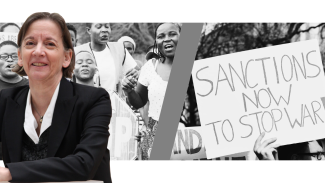
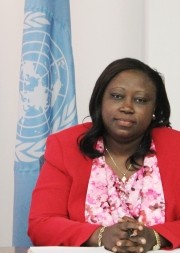
ICTJ is pleased to announce that Fatmata Claire Carlton-Hanciles has joined its Advisory Board. Mrs. Carlton-Hanciles is currently the Principal Defender, The Special Court for Sierra Leone (SCSL).

The social dynamics of ethnic identities is a huge subject. This article narrows the issue by looking specifically at ethnic conflict. It surveys for a transitional justice audience the key factors driving ethnic conflict, and describes some of the more well-known methods of addressin...

There is no way to calm the pain left by war, much less erase the traces or water down the responsibilities into oblivion.  What does exist are the experiences of people who are making or made that transition in search of reconciliation.  These are some of their voices.

Colombia’s Justice and Peace Law (JPL) lies at the heart of the country’s efforts to dismantle notorious paramilitary groups and provide justice to thousands of their victims. As the government seeks to reform the JPL to allow for a more effective process, ICTJ will run a series of features to provide a deeper insight into the background and successes and challenges of the law.

Bangladesh has taken several steps to seek redress for mass atrocities committed during the course of their “Liberation War” in 1971 that split West and East Pakistan into modern Pakistan and Bangladesh. In March 2009, the Awami League party announced the creation of an International ...

The International Center for Transitional Justice (ICTJ), together with the University of Western Ontario Faculty of Law and the Permanent Mission of Canada to the United Nations, hosted an Expert Group Meeting entitled Closing the International and Hybrid Criminal Tribunals: Mechanis...

The political crisis in Venezuela seems to have reached a stalemate. In September, the Norway-mediated negotiations between the Maduro government and the opposition came to a halt, leaving both sides struggling for the upper hand. But since it remains difficult for either party to prevail, it is likely that this impasse is a momentary setback rather than an indication that the negotiations are defunct.

On September 15, ICTJ organized a side event on the missing and disappeared in Syria, sponsored by the governments of Luxembourg and Finland, during the 77th session of the United Nations General Assembly. The event was a timely one, as it addressed a recent proposal for the creation of a new...

More than 20 years after the end of the Yugoslav Wars of the 1990s, Kosovo is still contending with unresolved ethnic tensions. Formerly an autonomous region of Serbia within the former Yugoslavia, Kosovo declared independence in 2008. Ethnic tensions were a root cause of the violent conflicts, during which an estimated 140,000 died and numerous atrocities were committed. ICTJ recently sat down with ICTJ's Anna Myriam Roccatello and Kelli Muddell to learn more about ICTJ's work and the present challenges to truth and justice in the country.

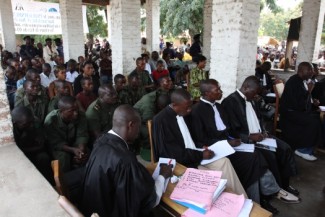
The development of effective transitional justice policies in the Democratic Republic of Congo has been plagued by lack of security, fear of destabilization, limited political will, and scarce resources. This paper focuses on three specific measures of transitional justice: prosecutio...

On July 10, the long-awaited UN High-Level Political Forum on Sustainable Development got underway in and around UN Headquarters in New York. This was the first time that Sustainable Development Goal 16 was up for review, so it marked a major event, and a pathway for the global justice and peacebuilding communities to shape conversations about development.

New York, February 22, 2022—The International Center for Transitional Justice (ICTJ) is pleased to announce the addition of five distinguished members to its Board of Directors. F. William (Bill) Barnett, Dr. Alexis Keller, Leisle Lin, Rahim Moloo, and Patricia Sellers bring to ICTJ decades of experience in leadership roles at major global institutions.

When reflecting on peace agreements and their implementation, it is tempting to begin by saying that these processes are generally slow and complex. While that may be true in many contexts, it contributes little to the discussion about what has happened in Colombia since the government signed a final peace deal in November 2016 with the Revolutionary Armed Forces of Colombia, or FARC-EP—the oldest and largest guerrilla group in the county—that ostensibly ended 50 years of war.

The International Center for Transitional Justice welcomes the recent agreement between the Government of Colombia and the Revolutionary Armed Forces of Colombia to create a special criminal jurisdiction as part of an integrated system of truth, justice, reparations and guarantees of non-recurrence.

In this op-ed, ICTJ's President David Tolbert urges President Uhuru Kenyatta and Kenyan institutions to take concrete actions without further delay to provide reparations for victims, tackle the struggling police vetting reform, and prosecute the serious crimes that were committed during the post-election violence.

In this op-ed, ICTJ's Virginie Ladisch and Lindsay McClain Opiyo argue that children born of war remain largely ignored in responses to sexual violence in conflict.

ICTJ is pleased to announce it will host a series of online debates on new challenges and cutting-edge issues in transitional justice.

A new report from ICTJ provides insights on how women in northern Uganda have been affected by conflict, and gives recommendations on how transitional justice measures can recognize and redress the specific harms suffered by women as a result of the LRA conflict.