1519 results

This study identifies the range of agencies in and outside the former Yugoslavia that collect documentation on war crimes and other human rights violations committed in the 1991-1999 wars. Several factors that point to the need for an overview of data-collecting agencies in the region...

There is a new way to support ICTJ, and chances are it’s something you’re already doing. Are you one of the 197 million people around the world who buys groceries, household supplies, electronics, or gifts on Amazon every month? If so, shop AmazonSmile instead and select the International Center for Transitional Justice as your preferred charity, and a portion of your purchase will go to a cause you care about most.

The International Center for Transitional Justice (ICTJ) and the United Nations Development Programme, with the support from the governments of Denmark and South Africa, held a retreat on Supporting Complementarity at the National Level: An Integrated Approach to the Rule of Law, at G...

Cote d’Ivoire has embarked on a process of addressing the legacy of internal strife that culminated in the post-election violence of 2010. On June 12, 2013, ICTJ will co-host high-level talks on strengthening Cote d’Ivoire’s judicial capacity to prosecute serious crimes proscribed by the Rome Statute of the International Criminal Court (ICC).

Evelyn Amony tells the harrowing story of her years in captivity with the LRA, and experience of grinding poverty and stigma after returning home with two children, in her new memoir, I Am Evelyn Amony: Reclaiming my Life from the Lord's Resistance Army. The autobiography, which tells the difficult truths of women and girls in wartime as only a firsthand witness can, will be launched today in New York, at the Japan Society.

On February 8, at the Peace Palace in The Hague, the high-level international Task Force on Justice will meet to finalize its report on increasing access to justice for people and communities around the world—or reducing the “justice gap”—as an integral element of the Sustainable Development Goals (SDGs).

This article examines and evaluates the Iraq Tribunal's Dujail Trial. The trial marks the beginning of a longer accountability process in the country and can potentially make a lasting contribution to transitional justice. This study assesses the fairness and effectiveness of the tria...

The International Center for Transitional Justice (ICTJ), in cooperation with the United Nations Development Programme (UNDP), with support from the Governments of Denmark and South Africa, and in close consultation with the Assembly of States Parties to the Rome Statute (ASP), held a...

As the international community considers its response to the surging violence in Syria, those responsible for gross human rights violations in the country should be held to account, said the International Center for Transitional Justice (ICTJ) today.

In this op-ed, ICTJ Vice President Paul Seils calls on the international community to prioritize the return of Syrian refugees to their homes instead of posturing about Assad's ouster.

Across Syria today, we continue to witness human rights violations and abuses that run counter to the very principles upon which the revolution was built. In particular, recent violence in the coast and Sweida has deepened the sense of fear and mistrust already felt by many communities. Meanwhile, Syria's new transitional justice commissions have been working hard to lay the foundations of their mandates. Now, at this critical juncture, they must show that they are ready to lead and first and foremost to serve victims.

As part of its mandate, Colombia's Commission for the Clarification of Truth carried out 68 processes of acknowledgment led or supported by a specialized team. These processes sought to acknowledge victims and the harms they suffered, as well as individual or collective responsibiliti...

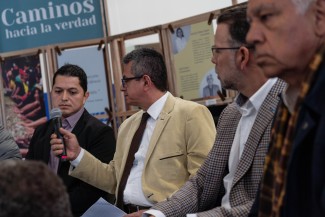
Former guerrilla member Gabriel Ángel holds the microphone for former paramilitary member Nodier Giraldo during an event at the Truth Commission.

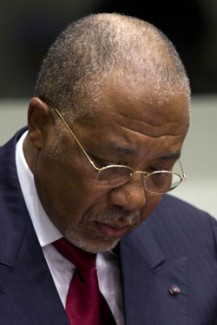
The significance of Charles Taylor’s judgment rendered few days ago in The Hague goes far beyond Taylor himself, or even the Special Court for Sierra Leone. This decision will be an unavoidable legal precedent in any future deliberation of the role played by leaders and states in crimes committed by forces they support in other countries, writes ICTJ's president David Tolbert in this op-ed.

As the Canadian Truth and Reconciliation Commission provides its final report this week, ICTJ presents a video in culmination of our work with youth in support of the TRC over the course of its mandate. "The Truth in the Classroom" demonstrates the commitment of children and youth across Canada to engage with issues related to Indian Residential Schools and to promote education about their legacy.

During the Ben Ali dictatorship in Tunisia, Najet Gabsi, an educator pursuing a diploma in law, was imprisoned for six months for her political activities. Through her participation in the "Voices of Memory" art exhibition, she was able to reignite her passion for activism and articulate the harms she endured at the hand of the regime.

1,300 are still missing in Nepal, nearly a decade after the country's bloody civil war ended. The peace agreement was meant to provide for the families of the disappeared, but today they are still searching for answers. As a new government body begins investigations, victims wonder: is the commission fully committed to addressing their needs?

Ten years ago, on August 28, 2003, the Truth and Reconciliation Commission (TRC) of Peru presented its final report, clarifying the grave human rights violations committed between 1980 and 2000 during the internal armed conflict and the regime headed by Alberto Fujimori. This month, ICTJ joins Peru to examine the legacy and impact of the TRC.

As ICTJ celebrates ten years of existence and contribution to the development of the field of transitional justice, we are poised for a future of continued engagement with partners and communities seeking to overcome legacies of mass violence and repression. Ten years on, we now work in a world increasingly aware of the of the costs of failing to systematically transition from conflict and human rights abuse to the rule of law and equal rights for all citizens, and on the other hand, of the increasing complexity of doing so.

Bosnians have a range of expectations of the ICTY—or as it is known in the region, “the Hague Tribunal” or simply “The Hague”—comparing their hopes to the goals enunciated by the Security Council when it created the Tribunal and by the ICTY itself.

Drawing from data and testimonies of Syrians both inside the country and in the diaspora collected by civil society organizations, this report looks at the justice needs of Syrian victims of human rights violations in the context of ongoing debates on refugee returns. It critically ex...

Illustration depicting an elderly woman carrying an armchair on her back

This briefing paper reviews the Kenyan government’s response to sexual and gender-based violence committed against women, men, and children during the 2007/2008 post-election crisis. It draws on interviews with over 40 survivors about their experience and analyzes the laws and transit...

This report analyzes the response of Congolese judicial authorities to international crimes committed in the territory of the Democratic Republic of the Congo from 2009 to 2014, with a particular focus on the war-torn East (North Kivu, South Kivu, and Ituri). It finds that the number ...

This briefing paper summarizes the findings of an ICTJ report (by the same name) on the judicial response to international crimes in the Democratic Republic of the Congo. It makes substantive recommendations to justice stakeholders in the DRC on how to advance prosecutions of internat...

The purpose of Resolution 1325 is to highlight the particular way in which women and girls suffer in situations of conflict, as well as the critical role they play in peacebuilding. To commemorate the 20-year anniversary of the resolution, ICTJ would like celebrate the life and work of one its own women peacebuilders: María Camila Moreno Múnera, head of ICTJ’s Colombia office. She exemplifies what a woman leader can achieve in advancing truth, justice, reparation, and peace.

On February 19, 2026, Venezuela’s National Assembly passed the Amnesty Law for Democratic Coexistence, which seeks to extinguish criminal liability for certain acts committed in the country over the past 26 years. While the law has sparked debate, it undeniably represents a significant development in the country's political landscape.