1519 results

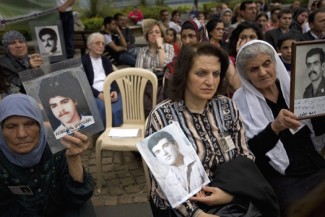
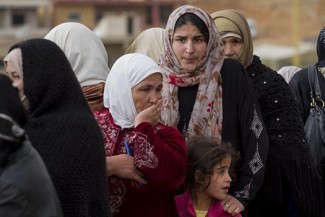
The wives of the missing and disappeared in Lebanon continue to suffer serious social, psychological, legal and financial effects on their lives, and the lives of their children, says a new report by ICTJ and the Institute for Women’s Studies in the Arab World at Lebanese American University.

Life continues to stand still for the many families of the missing and disappeared in Lebanon. The Lebanese War ended 28 years ago, but for these families the war rages on. A recent legislative breakthrough, however, might finally pave the way for Lebanon to confront this legacy.

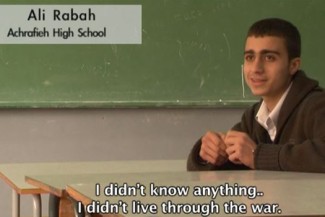
While Lebanon is post-peace agreement, it is not necessarily "post-conflict." The country struggles to address the legacy of decades of violence, and the lack of a comprehensive approach to dealing with the past means the country's youth are growing up with scant knowledge of their history. But they want to know more: one project is helping them ask those around them about the past, and giving those who lived it a chance to tell their stories.

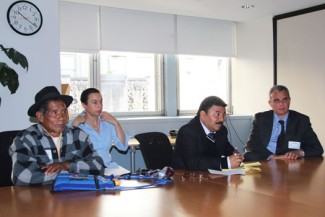
A two-day roundtable discussion on a draft law on the missing and forcibly disappeared persons was held February 24–25 in Beirut, Lebanon. Organized by the Committee of the Families of the Kidnapped and Disappeared in Lebanon, Support of Lebanese in Detention and Exile (SOLIDE), Act for the Disappeared, and ICTJ, the roundtable was part of the project “Lebanon’s unaddressed legacy: the missing and the families’ right to know,” funded by the European Union (EU) and the Embassy of Switzerland in Lebanon.

A black-and-white photo of an open book pierced by a single bullet hole was chosen as the grand-prize winner of the International Center for Transitional Justice’s Youth Photo Contest, “THE WAR AS I SEE IT” in Lebanon. The photo, titled “Dominique,” was taken by Sibylle George, a 22-year-old architecture student at American University of Beirut.

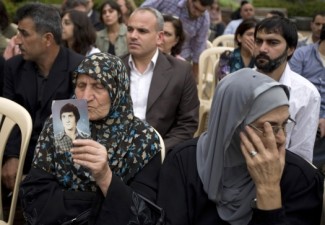
Twenty-five years after the end of the Lebanese Civil War, the families of the missing and forcibly disappeared in Lebanon are still waiting for answers about the fate of their loved ones. A new report by the International Center for Transitional Justice says the country seems to be ready to address this issue through an independent national commission and lays out the features of a successful future commission.

This report compiles information on hundreds of incidents of serious human rights violations that occurred in Lebanon from 1975 to 2008, including mass killings, enforced disappearances, assassinations, forced displacement, and the shelling of civilian areas. It reveals patterns of vi...

On November 12, 2018, Lebanon finally passed the long-awaited, landmark Law for Missing and Forcibly Disappeared Persons in Lebanon. This breakthrough development is a result of the steadfast commitment of mobilized families and years of joint advocacy efforts, lobbying, and initiatives by local and international organizations aimed at advancing the families’ cause.

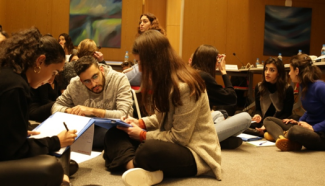
ICTJ held a two-day workshop on transitional justice for a group of university students in Beirut on February 14 and 15 as part of its ongoing support to the Committee of the Families of the Kidnapped and Disappeared in Lebanon. The students are currently serving as volunteers on a project to create an archive of the committee’s decades-long struggle and activism.

For decades, Lebanese governments have made only partial and ineffective attempts to hold powerful individuals, groups, and foreign states accountable for violations committed on Lebanese soil, including against civilians. The consequences of their failure to act – for victims and Lebanese society – are grave. ICTJ's new report looks at the culture of impunity for serious violations of human rights continues to thrive in Lebanon.

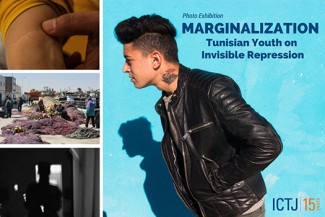
Ongoing economic and social inequality, a legacy of the dictatorship, affects Tunisians across generations, but has particularly pronounced impacts on young people. ICTJ worked with four young photographers to confront the consequences of marginalization and explore its impacts on Tunisian youth. Their four photo galleries comprise the exhibition "Marginalization in Tunisia: Images of an Invisible Repression.”

Education, as a critically important institution that is widely considered to be both formative and transformative, is something that transitional justice cannot afford to overlook. Transitional justice in its early years did not directly engage with education, but today this has chan...

In some contexts, the global community has resorted to international tribunals to prosecute the most serious past crimes, such as war crimes, crimes against of humanity, and genocide. While these international efforts contributed significantly to international justice, they were ...

This is a guest post by Professor Jennifer Trahan, Clinical Professor, NYU SPS Center for Global Affairs, in advance of the "Atrocity Crimes and the Veto" panel discussion at NYU's the Center for Global Affairs on April 17th, 2019. ICTJ's deputy director, Anna Myriam Roccatello, will also...

From its inception in 2003, the process of de-Baathification – the purge of Iraq’s state institutions of Saddam Hussein’s Baath Party members in the aftermath of the US-led invasion - polarized Iraqi politics and led to the collapse of many state functions. Today, Iraq continues to be haunted by its legacy. An examination of Iraq’s flawed vetting experience is presented in a major new ICTJ report, titled "A Bitter Legacy: Lessons of De-Baathification in Iraq."

This case study reviews and analyzes the deployment of international judges and prosecutors in Kosovo. It is part of a series providing information on hybrid courts' policy and practical issues. Although the Kosovo system of international judges and prosecutors has made significant st...

This paper analyzes the contents of the Final Report that the Kenyan Truth, Justice and Reconciliation Commission (TJRC) presented to President Uhuru Kenyatta on May 21, 2013, after four years of investigations. In particular, it evaluates the report’s information and findings, the lo...

This report disscusses the Greensboro Truth and Reonciliation Commission's Final Report on the 1979 killings of five anti-Ku Klux Klan demonstrators. It focuses on a meeting of representatives from truth recovery efforts around the world to assess the Greensboro experience. Topics cov...

Seven and a half years after the signing of the Comprehensive Peace Agreement, Nepal's Parliament voted to establish the Truth and Reconciliation Commission and a Commission of Investigation on Disappeared Persons. In this op-ed, ICTJ's Eduardo González Cueva explains why many victims have rejected the bill.

The International Center for Transitional Justice expresses concern about the decision to overturn the registration of Forum des Organizations de la Societe Civile (FORSC) through the decree of the Minister of Interior on November 23, 2009.

This report examines the role of women in the implementation of international peace and security instruments through a case study of transitional justice mechanisms in the Liberian context. The experiences of Liberian women have much to teach the world about women’s role in peacebuild...

NEW YORK, Feb. 22, 2011—As violence surges in Libya, the African Union, the Arab League and the United Nations must urgently establish investigation mechanisms into the allegations of unlawful killings and other serious violations of international law. Those responsible for planning and ordering...

NEW YORK, Mar. 3, 2011—The international community should maintain the robust stance for accountability in Libya that it has shown in recent days, said the International Center for Transitional Justice (ICTJ) today after welcoming the decision of the prosecutor of the International Criminal Court...

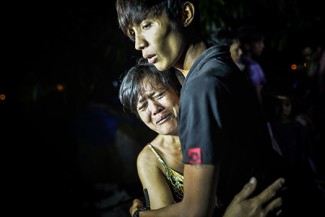
Although the Philippines’ withdrawal from the International Criminal Court (ICC) took effect on March 17, the pursuit of justice and accountability for the thousands of extrajudicial killings in President Rodrigo Duterte’s so-called drug war can proceed. In February 2018, after warning Philippine officials that she was “deeply concerned about these alleged killings and the fact that public statements of high officials of the Republic of the Philippines seem to condone such killings,” ICC Prosecutor Fatou Bensouda opened a preliminary examination, as an initial step.

Jaya Luintel was a radio reporter in Nepal during the country's civil war, covering the conflict's impact on women. Now, she's helping female victims produce and broadcast their own stories to a national audience. Discover how her organization, The Story Kitchen, empowers women in Nepal.

Reparations play a unique role within the transitional justice framework in providing justice for victims.

As with most post-conflict challenges, the issues of displaced populations and weak security institutions each have profound effects on the other. A common cause of displacement in post-conflict environments is a lack of physical security, either because formal security institutions f...

This paper examines linkages between transitional justice processes and the broader issue of land tenure reform in countries with a long and complex history of property dispossession or where land has been a root cause of conflict. It is argued that greater coordination between t...

As human rights advocates and state representatives increasingly acknowledge the necessity of involving children in truth-seeking processes, there is a growing need for practical tools that facilitate children’s participation while prioritizing their protection. This statement-taking ...

As Kenya continues to address its 2007-08 postelection violence, greater emphasis should be placed on victims’ reparative justice demands, according to a new ICTJ report. The report, “To Live as Other Kenyans Do”: A Study of the Reparative Demands of Kenyan Victims of Human Rights Violations, is a...

This paper documents the opinions of victims of human rights violations in Kenya about the country’s unfolding transitional justice process. The first section gives background into the human rights violations; the second section presents victims ideas about reparative justice. The rep...

Tunisia's Truth and Dignity Commission continues its public hearings, focusing on violations of digital freedom.

At 3 pm, Eastern Time, Tunisia's Truth and Dignity Commission is scheduled to resume its public hearings with a session focusing on violations against women. Watch the livesteam below and follow us on twitter at @theICTJ for live coverage.

Among the key challenges facing the Democratic Republic of Congo (DRC) today is the question of how the country will address the massive human rights atrocities of its recent past to establish a foundation for peace and security, the rule of law, and respect for human rights to prevai...

In the brutality of armed conflict or tyranny of a repressive regime, many who go missing are never found again: whether “disappeared” by agents of the state or abducted by an armed faction, the whereabouts of thousands are still unknown to this day. On this International Day of the Disappeared, ICTJ recognizes that enforced disappearances constitute crimes against humanity, and they affect women in ways unique from the impact on men.

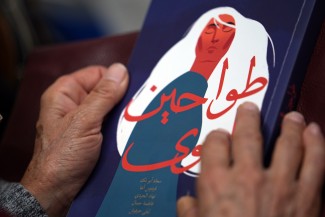
This report examines the impact on women of enforced disappearances committed during Lebanon’s civil war, focusing in particular on the effects on wives of the missing or disappeared—and their children. The research is based on interviews conducted by ICTJ with 23 wives of missing or ...

Local justice is sometimes presented as an alternative to or substitute for other measures of transitional justice, often due to political, cultural, or practical considerations. This chapter argues that local justice addresses the (comparatively neglected) reintegration asp...

The millions of Syrians displaced by the grinding decade-long war have sought out safety far and wide, in safe havens within the country, in neighboring countries in the region, and further afield. Those who managed to reach Europe often did so against the odds and often after experiencing displacement more than once. Now, one of these countries, Denmark , is taking away from Syrians living in its borders the protection they so desperately sought and still need and, with it, the tiny bit of hope that they have worked so hard to preserve.

As subscribers, you enjoy timely commentary on what’s happening in transitional justice around the world written by one of our experts exclusively for our monthly World Report newsletter. In this month’s edition, we bid farewell to 2019 by looking back on the experts’ choices of the past year.

As part of a transitional justice process, truth commissions are crucial mechanisms for clarifying the past and safeguarding victims’ rights. With over 50 truth commissions worldwide, they remain relevant in increasingly complex contexts shaped by rapid technological change and challe...

Cover of the book Una mirada a la Comisión de la Verdad de Colombia

The study of macro-criminality is critically important to transitional justice and specifically to efforts to pursue accountability for large-scale, systematic human rights violations. To help enliven debates concerning macro-criminality and broaden access to them, ICTJ has translated into Spanish for the first time ever the seminal essay "Can Politics Be Criminalized?" written by German criminologist Herbert Jäger.

In cooperation with the High Judicial Council, ICTJ held a seminar today with senior representatives of the Congolese military and civilian judiciary and prosecutor’s office to discuss the dual jurisdiction of military and civilian courts over international crimes in the DRC.

The Maine Wabanaki-State Child Welfare Truth and Reconciliation Commission (TRC), the first of its type in the United States, marks one year of work.

Maine’s foster care system was intended to act in the best interests of all children. But for indigenous children removed from their communities and placed with white families, often without the consent of their parents or tribes, the foster care system caused the painful loss of their cultural identity and traumatic severing from their heritage.

ICTJ advocates for the inclusion of mental health and psychosocial support (MHPSS) in all transitional justice initiatives and undertakes research on best practices for the field. Leading this work is ICTJ Senior Expert Virginie Ladisch. She is the lead author of the forthcoming report, ‘The Search for People’s Well-Being’: Mainstreaming a Psychosocial Approach to Transitional Justice. In this interview, Ladisch discusses the importance of MHPSS for transitional justice and her work on the topic.

As gunfire dies down over Tripoli, the new Libyan authorities will be coming to terms with enormous dilemmas about the hierarchy of priorities in building a new society. Their offices will see long processions of emissaries from near and far in the coming days and weeks. Some will be sternly pressing for issues of security to be immediately addressed and others will demand that business and development concerns precede all else, while there are also bound to be those advocating for justice to be done first and quickly.

In this op-ed, ICTJ Vice President Paul Seils argues that the front line of justice must always be national courts and justice systems. "Citizens must see social institutions at work in their home countries, as it is there that courts can repudiate wrongdoing and reaffirm the most fundamental elements of the contract that binds a society together. It is there that having the dignity of a citizen can have its fullest meaning," writes Seils on International Justice Day.

The Task Force on Justice is gathering inputs in order to encourage greater provision of justice to people and communities outside the protection of the law. As the Task Force has pointed out, the “justice gap” that it seeks to reduce is greatest in conflict-affected countries, where only 3 percent of development assistance goes to justice.

Mali's Truth Justice and Reconciliation Commission has a mandate to examine violence dating back to 1960, but it faces serious challenges. Can it serve as a foundation of a peaceful future in Mali? We discuss with transitional justice expert Kora Andrieu, who is currently working with the TJRC as an independent consultant.