Ukraine

Russia’s full-scale aggression against Ukraine in 2022 dramatically escalated the armed conflict started by Moscow’s initial invasion in 2014. Ukraine now faces a dual challenge of continuing to strengthen its democracy while pursuing accountability for the widespread human rights violations committed during the aggression. ICTJ contributes to the advancement of both goals by supporting victim-centered justice initiatives that solidify Ukraine’s social cohesion and democratic institutions and, crucially, advance just and sustainable peace.

Image
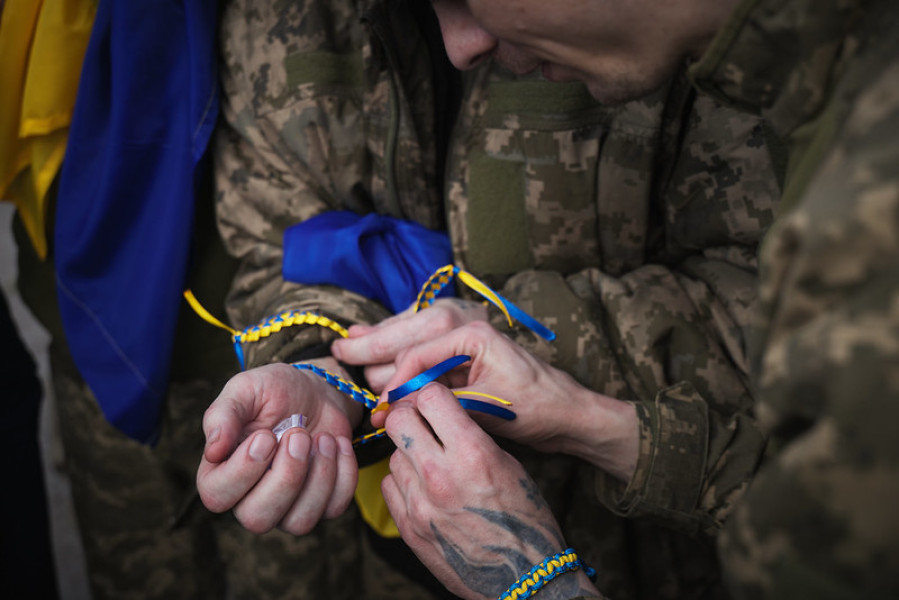
Two sets of hands exchange bracelets

Returned Ukrainian prisoners of war put on blue-and-yellow-colored bracelets on May 23, 2025. (Office of the President of Ukraine)

Current

Background

Russia’s aggression against Ukraine has two key phases. The first phase was the initial 2014­–2021 invasion, which included the occupation of Ukraine’s Crimean peninsula and armed conflict in its eastern Donbas province. The Kremlin tried to downplay its role in Donbas, but Russia’s effective control over parts of eastern Ukraine since 2014 were confirmed by a Dutch court in the downing of the MH-17 flight case and by the European Court of Human Rights. The second phase started with Russia’s full-scale invasion of Ukraine in 2022 and remains ongoing.

Both phases of the armed conflict have been accompanied by a torrent of human rights violations perpetrated predominantly by Russian actors. Prevalent crimes include enforced disappearances; unlawful detentions; torture; summary executions; deportations; direct and public incitement to violence; sexual, reproductive, and other gender-based violence; and indiscriminate attacks against civilians.

Ukraine has been addressing conflict-related atrocities since 2014. The initial responses from the state and civil society focused largely on criminal justice and prioritized extensive documentation for domestic and international prosecutions. In 2019, Ukraine’s Office of the Prosecutor General established the War Crimes Unit. The unit has designated teams working on particularly challenging violations, such as conflict-related sexual violence (CRSV) and environmental crimes. While commendable, these domestic steps are affected by the ever-growing number of crimes, complexity of cases, absence of the accused, and a problematic approach to certain offenses such as collaboration.

In parallel, since 2019, Ukraine has been developing a transitional justice framework. While no formal, holistic transitional justice policy has been adopted yet, many transitional justice initiatives have been launched. Various memorialization activities are underway. In 2024, through a landmark initiative, Ukraine approved urgent interim reparations for CRSV survivors. Importantly, the scheme recognizes children born out of CRSV as eligible survivors. However, many more victims of other crimes require recognition and urgent redress.

ICTJ's Role

Having had to address conflict-related crimes committed during the 2014–2021 invasion without much international support, Ukraine’s government and civil society sector have developed rich expertise on a vast spectrum of accountability matters. ICTJ engages with Ukraine’s vibrant domestic experience and vision to enhance change across three main objectives:

  • Advancing holistic justice for atrocity survivors, which encompasses prosecutions but also necessarily includes reparations and other transitional justice measures.
     
  • Expanding the understanding of and support for less visible survivors such as male CRSV victims, children born from CRSV, LGBTQI+ persons, and victims of the crime of aggression.
     
  • Drawing lessons from Ukraine’s distinctive experience of pursuing accountability amid ongoing aggression and occupation to inform and expand the traditional approaches to transitional justice globally.

Specific areas of work include:

  • Contributing to reviving Ukraine’s holistic and forward-looking transitional justice framework. Ukraine began to develop a transitional justice policy in 2019, but the full-scale invasion interrupted the process. Additionally, the full-scale invasion has generated a much broader set of challenges, such as the increased number and variety of the crimes, an increased number of survivors requiring urgent and long-term support, and a staggering 3.7 million internally displaced persons and 6.9 million refugees. Survivors, Ukraine’s civil society, international partners, and the acutely varied realities of the post-2022 warfare require a comprehensive and nuanced justice vision. ICTJ is assisting with the revitalization of this work, which will provide the guiding framework for reparations, criminal accountability, education programs, memorialization, and prevention initiatives.
     
  • Global transitional justice webinars. To ensure that Ukraine has direct access to hands-on transitional justice expertise globally and shares its own innovative approaches, ICTJ co-organizes the #GlobalTransitionalJustice webinar series. Webinars are run in partnership with leading Ukrainian legal voices: the Ukrainian Bar Association, Truth Hounds, and the National University of Kyiv-Mohyla Academy. Discussions are open to public participation and recorded for viewing.
     
  • Advice on policymaking, criminal accountability, and reparations for marginalized persons and issues. Slavery crimes, male CRSV survivors, children born out of CRSV, and violent masculinities are a particular focus.
     
  • Supporting the expansion and sustainability of Ukraine’s reparation programs, domestically and internationally.
