
Civil society actors involved in transitional justice processes use narrative communication in strategic and agile ways. This work is vitally important, and yet it does not receive the attention and support it should.
In trying to identify and understand the value and impact of transitional justice, research and analysis in the field often consider justice processes in terms of their contributions to objectives such as the rule of law, democracy, peace, and development. Previous ICTJ research and the reports of the Working Group on Transitional Justice and SDG16+, for example, have identified some of the pathways through which such contributions can be made, such as inclusion, reform, and trust.
But how do those who are involved with transitional justice processes on the ground think about and articulate their value and impact? In its collaboration with civil society partners in many different contexts, ICTJ has seen that those actors frame their work in different ways. Some may describe what they do as human rights, some as social and economic justice or equality, some as governance, and some as a specific form of justice such as reparation, accountability, and truth. This is particularly the case for activities that are inherently at the intersection of justice and development, such as collective reparations programs.
We tackle these questions in a new ICTJ report, 'Stories We Bring to Life': How Civil Society Uses Narrative in Transitional Justice Contexts, which draws on research conducted with civil society organizations in Colombia, The Gambia, and Kenya. While these societies have experienced violence and abuses in different ways, and are at different stages of addressing their pasts, we found valuable commonalities and lessons in how local civil society actors use stories, narratives, and communication techniques to achieve their goals.
In the study, we organize our findings across three axes: framing (what is told), construction and ownership (by whom, and against whose competing claims), and dissemination (to which audiences, in what form). Overall, we believe this research demonstrates the significance of the ways in which civil society actors describe their work, the framings that they choose, and the complex decision-making contexts in which they bring their stories to life for different audiences.
Narratives are patterns of stories that are told by individuals or groups and that convey beliefs or understandings about the way the world works. Narrative is an important element of transitional justice, in that efforts to address past human rights violations involve different accounts or representations of what happened and why, who was harmed, who is responsible, and how the violations can be addressed or prevented from happening again. Despite the role that narrative can play in transitional justice, however, its explicit use as a focus for research and analysis and a tool for communication, dialogue, advocacy, mobilization, and policy engagement is arguably underutilized by transitional justice practitioners and stakeholders.
In response to this gap, our research treats narrative as a lens through which to analyze how actors involved in transitional justice understand and project their own role within a community’s or society’s journey from the past to an imagined future. Applying this lens does not imply that each actor consciously engages in “narrative work” or “storytelling,” although some do. Narrative is instead the conceptual framework that ties together notions of story, discourse, and communication, one that can be particularly helpful in transitional justice contexts.
Civil society actors are agile in selecting different narratives to present their work, convey their impact, and engage audiences. For example, one Gambian civil society organization explained how the advent of a transitional justice process led it to change the way it described its work. “There was no way we could have just focused on sexual and reproductive health or sexual and gender-based violence without addressing transitional justice,” said a representative. By contrast, one Kenyan organization avoids using the term “transitional justice” with politicians entirely, believing that the term functions as a barrier to dialogue and engagement. These narrative choices are made in response to available resources, audience, and stage of transitional justice process.
Civil society actors tell their stories as part of a broader narrative landscape, in which ownership is contested and in which listening can be as important as telling. In The Gambia, for example, a civil society group discussed how it revised its planned activities three times to track shifting donor priorities. In Colombia, an organization described carefully negotiating between how they frame their work vis-à-vis official accounts on the one hand and victim testimony on the other.
Civil society actors disseminate their narratives in varied ways, including through emerging digital technologies and media as well as traditional and culturally specific modes of communication. For them, deciding on what will resonate with different audiences is central. For example, a Kenyan organization spoke about its work identifying and partnering with “champions” in decision-making spaces who help them to adjust their message to be more persuasive. One Colombian organization described using arts-based communications to engage communities confronting difficult and traumatic experiences.
Civil society actors use narratives to generate, promote, and disseminate impact, but they operate on different scales and timelines and have different access to resources and visibility. This aspect of their work is vitally important and often puts them at risk or under strain. Yet, it tends to be under-funded, under-discussed, and under-researched, partly due to limited resources and skills but also to a broader gap in transitional justice practice and thinking. If the narrative communications work of transitional justice stakeholders were to be taken seriously and adequately supported, our research suggests, it has the potential to improve justice, peace, and development outcomes.
_________
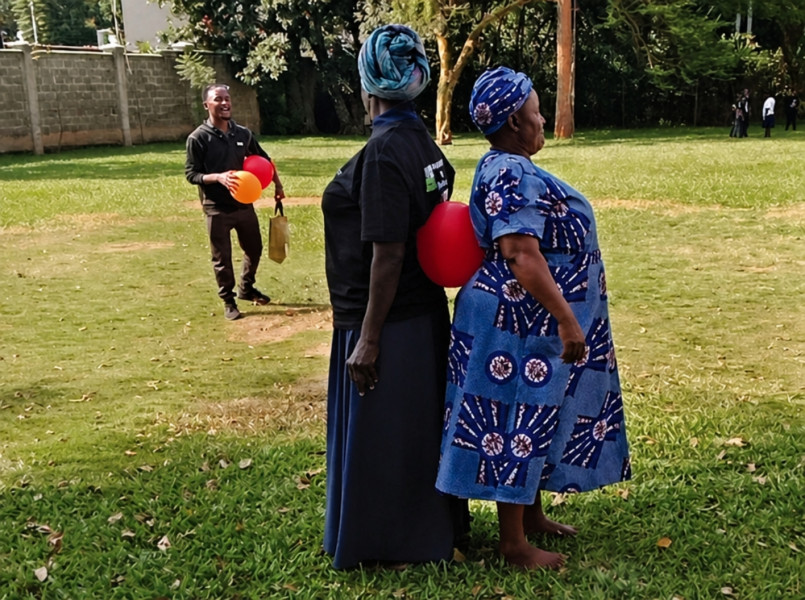
PHOTO: The civil society organization Grace Agenda undertakes a project activity in Kenya on the 2021 Kinshasa Declaration on Reparations by survivors of sexual violence on March 1, 2025 (Grace Agenda).

