Across Syria today, we continue to witness human rights violations and abuses that run counter to the very principles upon which the revolution was built: respect, dignity, freedom, and justice for all. Recent events in the coast and Sweida have only deepened the sense of fear and mistrust already felt by many communities. Regardless of who carries them out, these violations risk deepening wounds that are still raw, inflicting new ones, and undermining the nation’s struggle to rebuild trust between its citizens and the institutions meant to serve them.
In recent months, the Syrian National Commission for Transitional Justice and the Syrian National Commission for the Missing have worked hard to establish themselves, begin consultations, and lay the foundations of their mandates. They have made efforts to build credibility with Syrians and the international community. But trust cannot be granted by decree. It must be earned. And now, at this critical juncture, the commissions must show through their actions that they are ready to lead with independence, transparency, and courage, and that they exist first and foremost to serve victims.
Transitional justice, at its core, is about bringing change to and transforming societies like Syria’s in the aftermath of war and oppression. It is about providing redress to victims and holding perpetrators to account in order to break the cycles of exclusion, denial, and abuse that have defined Syria’s past and build new ways for Syrians to relate to one another and to the state.
If instead, as has happened in the past, the new institutions remain silent when victims need acknowledgment or shy away from firm positions when abuses occur, then the process risks becoming neither credible nor meaningful. Syrians will not place their trust in institutions that appear indistinguishable from those that failed them before.
For this reason, the new commissions must be willing to clearly acknowledge violations wherever they occur and to speak out for victims without discrimination or fear of political pressure. They must demonstrate true independence by ensuring that no community or individual will be left behind, no matter where they live or who the perpetrator is. They must reflect Syria’s full diversity in their composition and decision-making so that no one feels excluded from the process, and victims see themselves represented and heard.
Acknowledgment requires both words and actions. Formal condemnation of the atrocities in Sweida and in other areas where violations are taking place and recognition of all victims are needed and expected.
Equally important, the commissions must take action to coordinate with other bodies, when necessary and appropriate, to ensure their missions are advanced. They must also communicate openly and consistently with Syrians, particularly victims and their families. They must explain how they are working, who they are listening to, and how they are addressing people’s needs, especially at this time when trust in institutions remains so fragile. Building credibility requires continuous engagement, accessible messaging, and a willingness to acknowledge the constraints they face.
The commissions have repeatedly expressed their commitment to being victim centered, inclusive, and independent. This is the moment to live up to those promises. How they act now will set the tone for the entire transitional justice process. Failing to do so will only engender mistrust and undermine their credibility. Clear, principled, and tangible action will instead show Syrians and the world that these institutions are genuine mechanisms for truth, justice, and healing.
This is not simply about responding to one crisis or the needs of one region. The way the commissions respond now will set a precedent for how they will act when violations or civic grievances arise anywhere in Syria. They must develop a proactive approach that allows them to respond to any situation with moral clarity and independence even when direct engagement is difficult. They must develop a strategic plan and policies to guide their work. This includes establishing clear principles for public communication, protocols for interacting with and safeguarding individuals and communities when they participate in consultations and other processes, and victim-centered engagement even when access to communities is limited. The commissions should also continue to hold consultations as per their mandates and commit to releasing a public version for comment.
Syria’s people have waited far too long for institutions that truly serve them. Each decision the commissions take now will move them closer to or further away from earning the trust and respect they need to succeed. This is the moment to lead by example. The credibility of Syria’s transitional justice process and the hope of millions who yearn for a future free from oppression depend on it.
_____________
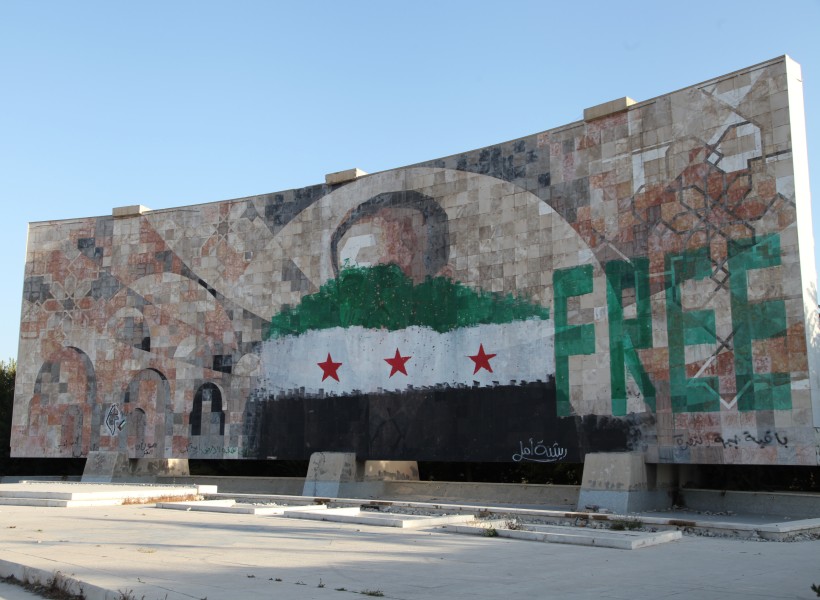
PHOTO: A mural in Damascus of former President Hafez al-Assad, known for directing brutal massacres of civilians in the 1980s, is painted over with the Syrian revolution flag, April 28, 2025. (Abedalbaset Alhasan/ICTJ)