

The questions at the heart of transitional justice are as old as violent conflict itself. How does a society confront the violence that was done in its name? What do we owe those who were harmed? How can those responsible be held accountable? How do former enemies learn to live together again?
Long before ICTJ existed, societies everywhere wrestled with these dilemmas, and victims, communities, and courageous leaders found answers of their own. What was missing was a place where people who took part in those different experiences could meet, share knowledge and lessons, exchange ideas, and build a community to respond together to the evolving challenges to justice and peace. In 2001, ICTJ was created to be that place and to catalyze a collective effort to address massive human rights violations and build a peaceful, inclusive, and just future. Twenty-five years later, we reaffirm that this remains our purpose. The work is far from finished.
I have spent more than a quarter of a century working to advance peace and uphold human rights in countries torn apart by conflict. I have sat with people of all kinds whose plans and dreams were shattered by violence, with mothers searching for their disappeared loved ones, with former combatants trying to imagine a different life, and with officials afraid of what the truth would cost them. In their own words and with their personal experiences in mind, they all asked the same question: How do we rebuild our lives, our communities, and our country so that justice is served, everyone's rights are guaranteed and protected, and peaceful coexistence can last?
I have learned that no institution, no treaty, and no courtroom can do this work alone. What makes it possible is people who come together and refuse to give up.
ICTJ began as an idea and has grown into a global community. Over 25 years, we have worked in more than 70 countries, and today we are active in more than 20 at any given time. A team of roughly 100 people (staff, consultants, and board and honorary council members) of different nationalities and backgrounds comes together every day around a shared conviction: that justice is the cornerstone of sustainable peace.
Behind those numbers are hundreds of partners, including national governments, multilateral institutions, peer organizations, and civil society groups. Their steady collaboration and support have made our independence and long-term commitments possible. Without their trust, ICTJ would not be the organization it is today.
But institutions and organizations as such are empty vessels. They matter because of the people who breathe life into them. In every country where we work, the true protagonists are victims and the communities that endured the harm: those who demand to know what happened, who insist that their loved ones be remembered, and who ask not for vengeance but for acknowledgment, justice, and the guarantee that the violations will never happen again. Our role has been to stand beside these protagonists, to help turn their demands into processes that societies can sustain, and to build bridges between those who hold power and those who have long been denied a seat at the table.
We mark this anniversary at a difficult moment. The Uppsala Conflict Data Program has recorded the highest number of conflicts since it began counting in 1946. Conflict-related deaths are at levels not seen since the end of the Cold War. Meanwhile, the institutions created to prevent and resolve such crises are under severe strain, as they reel from deep cuts to budgets supporting international development, human rights, rule of law, peacebuilding, and justice, and as multilateralism is questioned even by some of its traditional champions.
Democratic institutions are eroding in many countries. The digital public square—once a promise of broad democratic participation—too often amplifies misinformation and exacerbates polarization. Concepts such as peace, justice, inclusion, and democracy are manipulated or emptied of meaning. Disrespect for domestic institutions increasingly extends to international norms and obligations. Civic space is shrinking, and the people and organizations who defend rights, including our own partners, face growing legal, administrative, and security pressures.
It would be easy to despair. But that is not what this moment calls for.
Experience has taught us that today's conflicts—from Ukraine to Sudan, from Palestine to Myanmar, from the Democratic Republic of the Congo to Iran, and in many other places—will not end when the fighting stops. The consequences can linger, individually and collectively, for generations. Repairing the harms and building a peaceful, just, and inclusive society takes decades. This fact is not a reason to postpone justice. To the contrary, it is the strongest reason to advance it. The more devastating a conflict becomes, the greater the need for truth, accountability, acknowledgment, and repair. The sooner we begin laying that foundation, the more likely it is that peace will last.
At the time of writing these lines, the Norwegian Nobel Committee awarded the 2026 Peace Prize to Navi Pillay, the South African jurist who has spent a lifetime defending human rights and international law. In announcing the prize, the committee said it wished to remind the world that the rule of law underpins the system built to guarantee peace and resolve conflicts without violence. Justice, its chair insisted, is not an add-on to peace and security. It is an absolute necessity. Peace requires justice.
Those of us who do this work do not need to be convinced. But in a period of so much cynicism, it matters that one of the world's most prominent voices for peace has reminded us so clearly.
The idea that peace depends on justice is not new. Working around the world over the last 25 years, we have learned what justice requires if it is to buttress lasting peace.
Justice cannot be achieved in courtrooms alone. A criminal court, when it is ready and able to handle the complexity of mass violence, can hold some perpetrators accountable and reaffirm the promise that no one is above the law and that impunity will not be tolerated. But, on its own, it cannot deliver everything a society devastated by violence needs. Justice has to put all victims at the center, guaranteeing their participation and access, not just those whose cases are part of select criminal proceedings.
Justice must reveal the truth about what happened, acknowledge victims, answer their demands, and repair the harm they endured. It also has to speak to society as a whole, so that everyone comes to understand the abuses that were committed in their name and resolve to prevent them from happening again.
At ICTJ, working side by side with victims, we see this every day. The language and the contexts change. The demands do not.
The pursuit of justice is a shared responsibility, and it is hard work. It does not rest only on governments, courts, or any single movement. It lies with all of us: the student who is just beginning to ask why societies repeat their worst chapters; the victim who has waited decades for someone to say, “This happened, and it was wrong”; the policymaker deciding where to invest scarce resources; the activist working in a hard-to-reach place; and the neighbor, teacher, journalist, and donor who understand that no community is safe while injustice goes unanswered. None of us can do it alone, and none of us can afford to wait for someone else to take on the task.
My hope is that, in 25 years, ICTJ will still be carrying out its mission. The new generation of justice activists leading and staffing the organization, with their energy and unique talent, will build on what we have learned and take the organization further than we ever could. That is the future I look forward to: a movement that keeps growing, stays close to the people it serves, and turns hope for justice and peace into reality.
Because no one walks this road alone, and those who follow will also need companions, here is my request: Stay with us. Support this work and advocate for its principles. Connect with others who share our vision and invite us to join you. Bring young people into the conversation and help us prepare a new generation of leaders for the decisions they will one day make to advance peace and justice. And when the work feels hopeless, remember the people whose resilience moved us to act.
The world will keep changing. What will not change is our conviction that justice is possible, that it is necessary, and that it is worth every effort we can make together.
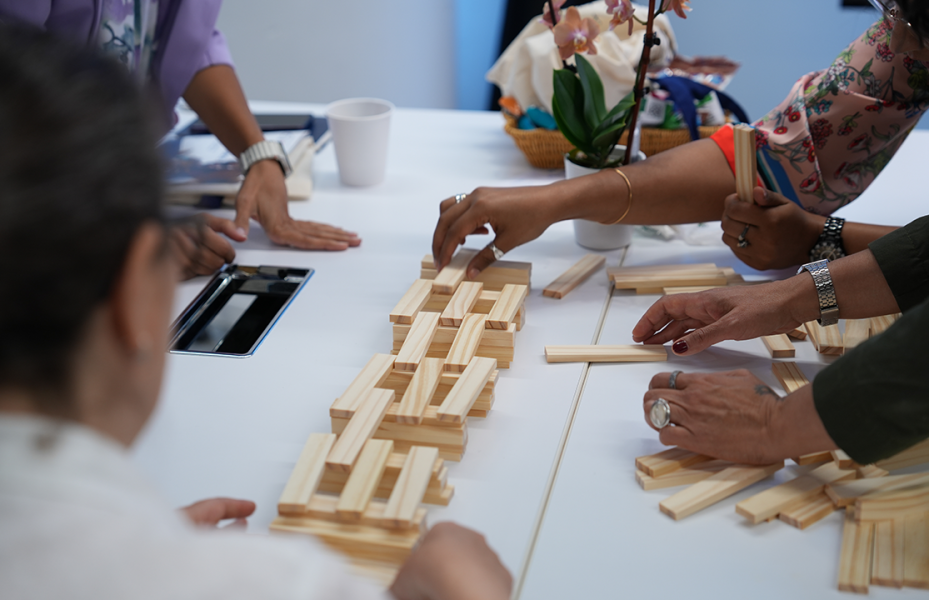
Twenty-five years ago, we began to build bridges between victims and institutions, and between communities and societies confronting their violent past. Let us keep building these bridges and others between this generation and the next. Let us build them together for a more just future.
_______
PHOTO: As a part of an exercise at the ICTJ staff retreat in fall 2026, colleagues build a model bridge using rectangular blocks of wood. (Maria Margarita Rivera/ICTJ)

