110 results

Civil society actors involved in transitional justice processes use narrative communication in strategic and agile ways. This work is vitally important, and yet it does not receive the attention and support it should.

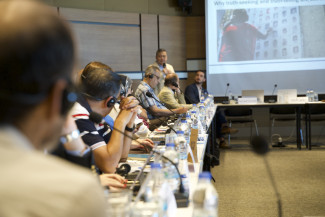
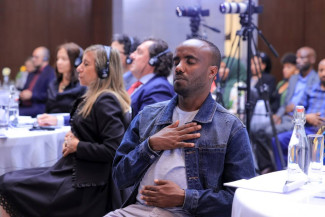
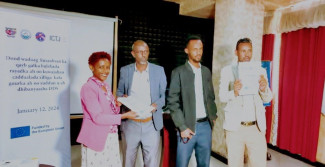
Over 100 representatives of civil society organizations, victims’ associations, government institutions, and diplomatic missions recently gathered in Addis Ababa to discuss what an inclusive transitional justice process in Ethiopia should look like. Participants explored best practices, local approaches, as well as persistent challenges to ensuring that those most affected by injustice play a central role in any process designed to address it.

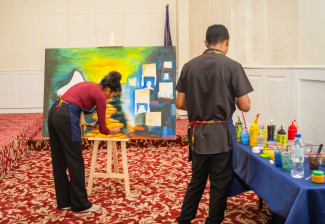
At an ICTJ-organized symposium in Istanbul, artists, civil society leaders, journalists, academics, and transitional justice practitioners from around the world discussed the ways art can serve as a catalyst for change in societies emerging from conflict or repression as well as explored local non-state-led approaches to truth seeking and truth telling.

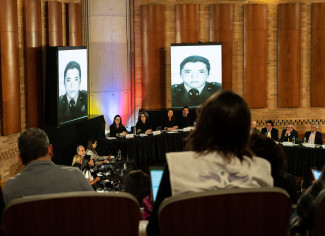
In an interview first published in "El Espectador," ICTJ’s María Camila Moreno discusses the first rulings of Colombia’s Special Jurisdiction for Peace, the state’s obligations to implement them, and why restorative justice is vital to lasting peace.

Victims, civil society advocates, policymakers, and development partners recently met for a high-level policy roundtable on integrating mental health and psychosocial support (MHPSS) in Ethiopia’s transitional justice process. Organized by ICTJ and the Advocacy Center for Democracy and Development, the convening offered a space for participants to discuss the need for MHPSS and how to improve access to it across the country.

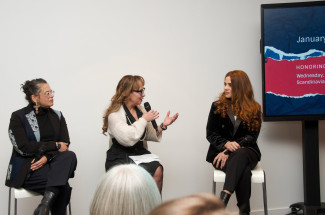
On January 28, 2026, ICTJ held its annual January for Justice Leaders benefit dinner in New York City, an event celebrating leaders advancing justice around the world. This edition also marked the beginning of ICTJ’s 25th anniversary year and served as an opportunity to look back on a quarter century spent standing alongside victims, civil society, and institutions in the pursuit of truth, accountability, and lasting peace after mass atrocities.

To commemorate the 20th anniversary of the Justice and Peace Law—which created Colombia's first transitional justice system—media outlet Verdad Abierta, the Friedrich Ebert Stiftung, and ICTJ partnered to produce an investigative four-part series in Spanish that critically assesses its legacy. Now translated into English, this second installment explores the unprecedented challenges the country faced as the process got underway.

To commemorate the 20th anniversary of the Justice and Peace Law—which created Colombia's first transitional justice system—media outlet Verdad Abierta, the Friedrich Ebert Stiftung, and ICTJ partnered to produce an investigative four-part series in Spanish that critically assesses its legacy. ICTJ has now translated the first two installments into English.

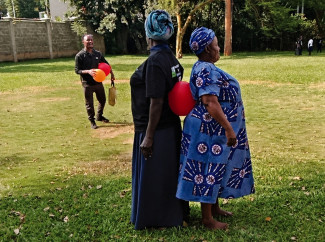
On July 28, 2025, the Somali Regional State Council passed a resolution designating April 6 as Victims’ Memorial Day, formally recognizing those who experienced violence and human rights violations across Ethiopia’s Somali Region. For years, victims and civil society actors, with support from ICTJ and other international partners, have persistently advocated for this acknowledgment, which marks a milestone in Ethiopia’s journey toward accountability and repair.

This year, Colombia commemorates the 20th anniversary of the Justice and Peace Law, which established the country’s first formal transitional justice mechanism. On this milestone anniversary, ICTJ reflects on the evolution that led to the groundbreaking law, the lessons that have been learned so far, and the challenges that lie ahead.