


69 results

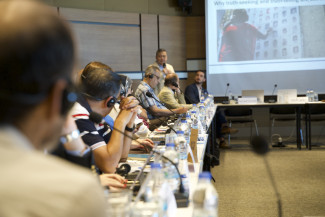
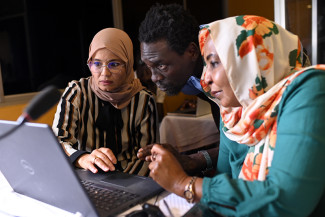
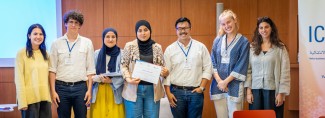
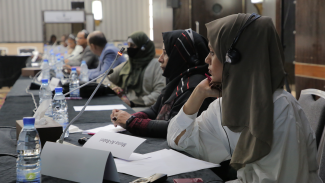
ICTJ recently convened human rights defenders, journalists, and lawyers from Libya, Sudan, Syria, Tunisia, and Yemen for a workshop on digital, open-source investigations. Held on November 3-8 in Kampala, Uganda, the course trained participants on open-source tools with a view to strengthening their work investigating, documenting, and monitoring human rights violations.

Throughout 2025, ICTJ’s experts offered thoughtful analysis on conflicts and major political developments in more than 10 countries as part of the World Report newsletter. Their insightful commentaries shed light on the obstacles that victims, civil society, and their partners must navigate as they pursue sustainable peace and justice. In this edition, we look back on the past year through the Expert’s Choice column.

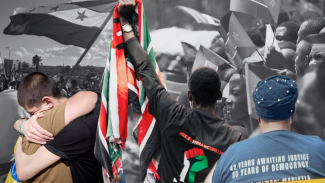
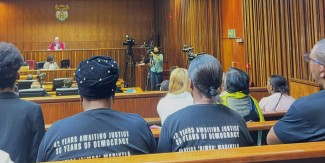
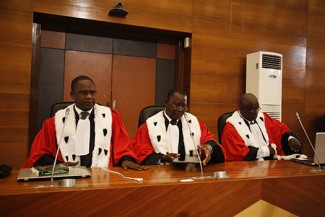
On April 14, 2025, the Johannesburg High Court handed down a landmark judgment. From his bench in courtroom 4D, Judge Dario Dosio dismissed the defense team’s objections to the inclusion of murder and apartheid as crimes against humanity charges in the indictment against two individuals accused of a deadly 1982 attack on anti-apartheid student activists. In so doing, the court cleared the way for crimes against humanity charges to be pursued in a South African domestic court for the first time. It also opened the door to the first ever prosecution of apartheid as a crime against humanity anywhere in the world.

Since 2014, conflict in Yemen has caused hundreds of thousands of deaths, displaced millions, destroyed the economy, and exacerbated systemic marginalization, creating one of the world’s worst humanitarian catastrophes. Yet currently, transitional justice and reconciliation take up little space in the Yemeni political arena. In this context, ICTJ has released a new report that explores pathways to a just and sustainable peace in Yemen.

This report explores pathways for transitional justice in Yemen, emphasizing victims’ experiences, political dynamics, and existing justice mechanisms. It examines national and local efforts, including mediation and reconciliation initiatives, and highlights the role of Yemeni civil s...

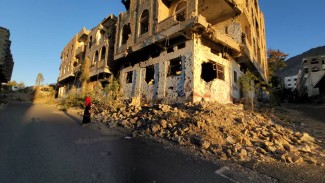
The sun shines into an urban courtyard of what it appears to be residential buildings.

In this era of technological transformation, it is critically important to develop digital strategies for documenting human rights violations, analyzing data for accountability or reparations purposes, and safely advocating for human rights online. This is particularly true in contexts where victims, human rights actors, and members of the media live in fear. To this end, ICTJ has recently led trainings for human rights activists in conflict-affected countries on open-source investigation tools to help them do their work more effectively.

Yemen's nine-year conflict has devastated the country and created one of the world’s worst humanitarian crises. The regional upheaval stemming from the ongoing war on Gaza has created more obstacles on the country's already complex path toward peace and shifted attention away from the set of UN-brokered commitments agreed upon by the parties to the conflict in December 2023, which include a nationwide ceasefire. Amid these challenges, it is more imperative than ever to support civil society and victims and bring attention to victims’ grievances and needs.

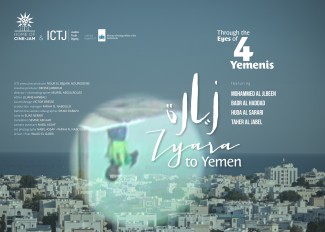
The Arabic word “Zyara” means “visit” in English. The Zyara documentary series takes an innovative, deeply personal approach to storytelling with a view to nurturing collective social and emotional healing. Through candid encounters, it paints poetic portraits of four Yemenis refugees living in Oman, including a human rights lawyer and activist, a restaurant worker, a martial arts champion, and a businessman. By telling their stories and celebrating the resilient spirit of the Yemeni people, the Zyara project seeks to raise awareness and preserve truth and memory.

The Arabic word “Zyara” means “visit” in English. The Zyara documentary series takes an innovative, deeply personal approach to storytelling with a view to nurturing collective social and emotional healing. Through candid encounters, it paints poetic portraits of four Yemenis refug...

The Arabic word “Zyara” means “visit” in English. The Zyara documentary series takes an innovative, deeply personal approach to storytelling with a view to nurturing collective social and emotional healing.

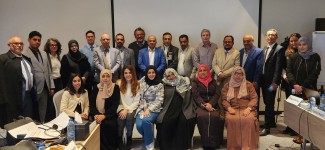
In 2016, the Yemeni National Commission to Investigate Alleged Violations to Human Rights began documenting violations committed since the 2011 uprising and during the subsequent brutal civil war, which continues today. To date, the commission has documented more than 23,000 human rights abuses and referred over 2,000 cases to Yemen’s Public Prosecutor for prosecution. However, no verdict has been issued in any of these cases. To help the commissioners and members of Yemen’s judiciary advance accountability, ICTJ organized a workshop for them on transitional justice mechanisms. However, to deliver a justice that meets all the reparative needs of victims, these efforts must be an integral part of a broader, multifaceted transitional justice process.

Even as the parties to the war in Yemen fail to extend the UN-brokered ceasefire, field monitors of the National Commission to Investigate Alleged Violations to Human Rights (NCIAVHR) continue to document and investigate human rights violations despite enormous challenges and serious risks to their...

This multimedia project brings together voices of five Sierra Leoneans of different backgrounds reflecting on the legacy of the court as it nears the completion of its mandate.

Invoking the principle of universal jurisdiction opens the door to the possibility of some accountability in circumstances where justice is not possible in countries where the crimes took place. This study considers the challenges facing the exercise of universal jurisdiction and asse...

Given the political challenges emerging from authoritarian states and conflicts in Africa, what is the best way to pursue accountability for violations of international human rights and humanitarian law on the continent? ICTJ experts Chris Gitari and Howard Varney sit down to discuss regional initiatives, complementarity, and other strategies for pursuing accountability.

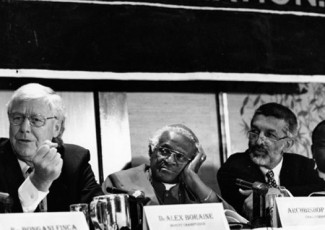
Regardless of how the world remembers Alex Boraine's legacy—or the success and shortcomings of the truth and reconciliation process in South Africa—history will recall that Boraine withstood his own, and his nation’s, transitions to cement his legacy as an architect for truth and reconciliation and a champion for justice for victims.

In December 2018, we mourned the loss of ICTJ's founder, Alex Boraine. On December 12, Fernando Travesí sat down for an intimate conversation with Vincent Mai—ICTJ’s first chairman—to learn more about a life that we will continue to commemorate in the months and years to come.

Alex Boraine, founder of the ICTJ and soldier in the struggle for human rights around the world, will be laid to rest in Cape Town today. He has been called the “Prince of Peace” for his lifelong commitment to transforming South Africa’s society through truth, reconciliation, justice, following the horrors of apartheid.

Dr. Alex Boraine, founder of the ICTJ, was larger than life. In his long career, he touched the lives of thousands in his beloved South Africa and around the world.

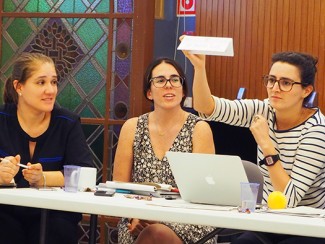
From October 1 to October 5, 2018, ICTJ hosted its eleventh intensive course on transitional justice in collaboration with the International Peace Center for in Barcelona. Participants included leaders in their respective fields, including human rights law, community justice and legal services, peacebuilding, education, and humanitarian affairs.

Anti-apartheid activist Ahmed Timol died in South African police custody in 1971, and his family continues to demand justice. While police claimed Timol died by suicide, evidence indicated that he was tortured and murdered. The family’s tenacious efforts led to the reopening of an inquest into Timol's death this year, with ICTJ senior program advisor Howard Varney representing the family. Last month the Pretoria High Court ruled in the family’s favor, finding that Timol did not kill himself but was indeed murdered while in police custody. ICTJ’s Sam McCann sat down with Varney to discuss the ruling, what it means to Timol’s family, and its significance for the fight for justice in South Africa.

Is reconciliation a central aim of transitional justice processes? Or does it have different bearings in different settings? A new paper presents possible understandings of the concept of reconciliation as well as its relationship to the field of transitional justice.

South Africa Parliament faces a historic moment. In this op-ed, ICTJ's Vice President Paul Seils remembers the great hope that marked the ICC’s emergence: "No country embodied that hope and that reality more powerfully and more inspiringly than South Africa."

The Africa Union's resolution to collectively support a strategy to withdraw from the ICC looks more like a machination of those who have instrumentalized an argument against the court to protect themselves from the long arm of justice, write ICTJ's top experts on Africa.

South African authorities apparently believe that once the country has officially withdrawn from the ICC, it will be free to invite the likes of Sudanese President al-Bashir to the country. That's not so, writes ICTJ's Howard Varney, who explains why the country's obligations would continue beyond its departure from the court.