

1519 results

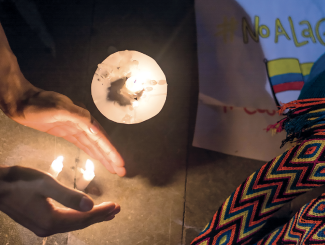
Since the 1950s, the FARC had been present in the southern department of Caquetá in Colombia. The local population suffered from decades of armed confrontations between the FARC and the Colombian Army. This is the story of the collective memory project implemented with the El Pato municipal farmers’ association (AMCOP) in the El Pato-Balsillas farmer reserve zone.

In designing transitional justice in Armenia, policymakers, civil society activists, and international actors should remember those who have not had justice for so long: the families of those killed or injured in March 2008, the victims of torture and political detention, the mothers in black seeking the truth about why their soldier sons were killed, the old pensioners who live in cold and hunger, farmers and rural communities who need access to social services, and students and young citizens who saw that their hope for a better future required a revolution.

This is the second of our Stories of Change series; in it, Tarek al-Massri, an 18-year-old from Homs now living in Germany, knows all too well the horrors of the Syrian conflict and its devastating impact on schools.

When Janet Arach was still a schoolgirl, she was abducted by Joseph Kony’s Lord’s Resistance Army (LRA) in northern Uganda. During her eight years in captivity, she was forced to marry an LRA rebel and gave birth to two children. Read more on Janet's journey to become an agent of change for her community in Uganda.

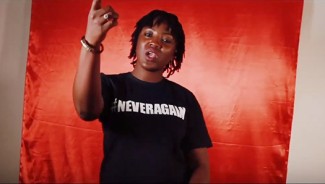
Banjul, June 12, 2019—“Never Again!” sings Awa Bling in her recently released song produced with the support of ICTJ. She is part of a movement of youth and prominent artists who are reclaiming this universal slogan by creating their own songs about transitional justice and bringing their voices to some of the most forgotten regions of The Gambia. Local and international fans can now access new music videos released on social media by five talented Gambian hip hop artists.

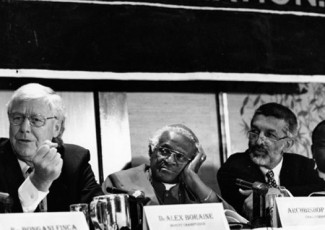
Regardless of how the world remembers Alex Boraine's legacy—or the success and shortcomings of the truth and reconciliation process in South Africa—history will recall that Boraine withstood his own, and his nation’s, transitions to cement his legacy as an architect for truth and reconciliation and a champion for justice for victims.

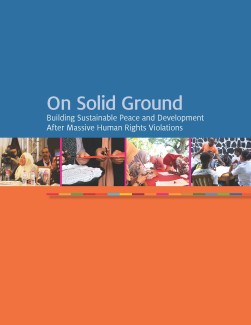
New York, June 3, 2019—Today, with just over a month to go before the 2019 UN High-Level Political Forum (HLPF) on Sustainable Development, ICTJ and its partners have released the Report of the Working Group on Transitional Justice and SDG16+, entitled “On Solid Ground: Building Sustainable Peace and Development After Massive Human Rights Violations.”

This report of the Working Group on Transitional Justice and SDG16+ articulates the contributions of transitional justice to the Sustainable Development Goals (SDGs), particularly SDG 16 on peace, justice, and inclusion, but also related goals on gender and inequality. The report...

In the United States, the debate over a national reparations program for slavery and Jim Crow has until now encountered political opposition. However, transitional justice approaches at the community level are increasingly surfacing to address racial injustice. A handful of 2020 presidential candidates have come out in support of reparations for slavery. Recently, Georgetown University took center stage in this debate when its student body voted in favor of a student-led initiative to establish a fee that will fund education and health care programs for the descendants of 272 enslaved persons sold by the university in 1838.

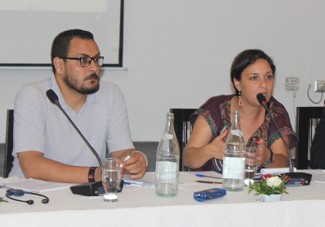
ICTJ’s Gender Symposium, held on February 2 to 4, 2019, in Tunis, Tunisia, brought together fearless women leaders working in 8 countries to advance the needs of victims and to bring gender issues to the center of transitional justice processes. What was achieved? What experiences cut across these diverse contexts? Kelli Muddell and Sibley Hawkins reflect on these questions and more in this short podcast.

This report analyzes the macro-criminality approach that was taken in Colombia’s Justice and Peace process and draws key lessons for the Special Jurisdiction for Peace. It examines how Law 1592 of 2012 and other regulatory instruments sought to move beyond a case-by-case method, prior...

Cover of Macrocriminality report

We sat down with Roger Duthie, ICTJ’s senior research expert, to reflect on the findings from the new report, An Uncertain Homecoming: Views of Syrian Refugees in Jordan on Return, Justice, and Coexistence, and the prospects for Syrian refugees if and when the conflict ends.

This briefing paper presents findings from a study based on interviews with 121 Syrian refugees living in Jordan. It aims to provide a better understanding of the impact the conflict in Syria has had on refugees, including the harms and losses they have suffered; their expectatio...

The new ICTJ report, An Uncertain Homecoming: Views of Syrian Refugees in Jordan on Return, Justice, and Coexistence, presents findings from a study based on interviews with 121 Syrian refugees living in Jordan. It documents the views, expectations, and priorities of these men, women, and children on the prospects of returning home and on future coexistence and justice in Syria.

This report presents findings from a study based on interviews with 121 Syrian refugees living in Jordan. It aims to provide a better understanding of the impact the conflict in Syria has had on refugees, including the harms and losses they have suffered; their expectations, concerns,...

On April 11, 2019, Jaqy Mutere, cofounder and coleader of Grace Agenda, accepted an award from Physicians for Human Rights recognizing the work of the Survivors of Sexual Violence in Kenya Network and Grace Agenda, a leader in this movement. Jaqy cofounded Grace Agenda after she began working with women who, like her, had experienced sexual violence during the protests that erupted in Kenya after the contested December 2007 elections.

Throughout the week of April 23, I have been attentively following the news to know what would be the impact of this Friday’s hirak (Arabic for protests or mass rallies) in Algeria. The tenth consecutive Friday of protests that began on February 22 is a reaction to the announcement made by an invalid president, Abdelaziz Bouteflika, from a hospital in Geneva, of his intention to continue holding his position for a fifth term.

This paper explores political exclusion in Kenya and its consequences on the social fabric of the nation. It draws from past governmental reports and analysis to formulate new recommendations that can inform current discourse. It first provides an overview of ethnicity in Kenya. ...

This is a guest post by Professor Jennifer Trahan, Clinical Professor, NYU SPS Center for Global Affairs, in advance of the "Atrocity Crimes and the Veto" panel discussion at NYU's the Center for Global Affairs on April 17th, 2019. ICTJ's deputy director, Anna Myriam Roccatello, will also...

From February 22 to March 1, ICTJ held its annual retreat in Litchfield Hills, Connecticut. Staff members convened at the Wisdom House—an interfaith conference center that seeks to provide an environment conducive to introspection and teambuilding.

Although the Philippines’ withdrawal from the International Criminal Court (ICC) took effect on March 17, the pursuit of justice and accountability for the thousands of extrajudicial killings in President Rodrigo Duterte’s so-called drug war can proceed. In February 2018, after warning Philippine officials that she was “deeply concerned about these alleged killings and the fact that public statements of high officials of the Republic of the Philippines seem to condone such killings,” ICC Prosecutor Fatou Bensouda opened a preliminary examination, as an initial step.

The internationally acclaimed documentary “The Silence of Others" about the forgotten victims of Franco's fascist dictatorship in Spain brings much-needed attention to the right to the truth.

On February 14, Kenyans once again confronted their painful relationship with law enforcement and revisited the deep mistrust born of historical abuses. In an unprecedented ruling, a court found five senior police officers potentially culpable in gruesome murder during the police response to the 2017 post-election protests. On the same day, a senior police officer was convicted of murder and jailed for life.

On September 22, 2018, the International Center for Transitional Justice and the University of Birmingham launched Voices of Memory, an interactive exhibition inspired by a group of nine Tunisian women from across the country and from different generations. It is the first collective te...

The International Center for Transitional Justice and NYU Law’s Center for Human Rights and Global Justice hosted this event, which featured Pablo de Greiff, the former UN special rapporteur on the promotion of truth, justice, reparation and guarantees of non-recurrence.