1519 results

"Victims: Anonymous in War, Protagonists in Peace" is the story of an unprecedented event in world peace accords: that the victims were - during the negotiations - at the center of the construction of the justice agreement between the Colombian government and the FARC guerilla.

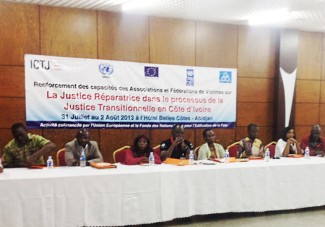
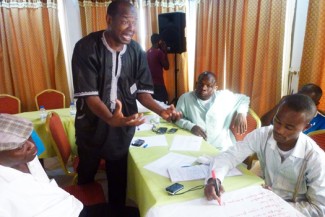
In Cote d’Ivoire, victims of the 2010-11 post-election violence have yet to receive reparations for violations that occurred during the political upheaval following the election of President Ouattara. Victims’ organizations in Cote d’Ivoire joined ICTJ and the ONUCI Human Rights Section for a three-day training session in Abidjan on reparative justice and the right to reparation.

As the peace talks progress between the Colombian government and FARC representatives in Havana, many Colombians are increasingly hopeful that the country will be able to put an end to more than 50 years of armed conflict. Despite broad support by many different sectors of society, the ...

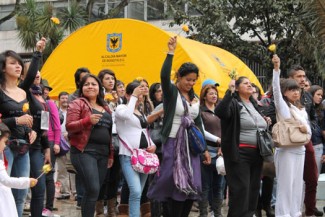
With the aim of reinforcing the legitimacy of the peace process, which could lead to a historic compromise that would deeply influence the future of the country, thousands of Colombians are marching today to express their support for the discussions, for peace, and for democracy. Their motto is: “We are the majority: Now is the time for peace!”

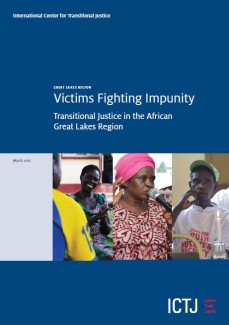
In many countries of the African Great Lakes region, state-led approaches to transitional justice have been created by wide-ranging agreements or policies that have been later forgotten or only partially implemented. Even when implemented, they are often subject to years of delay and/...

After seven years of waiting for the UN-backed Special Criminal Court (SCC) in the Central African Republic to begin operations, victims of the country’s civil war had hoped to finally see the first tangible step toward justice on April 25 when the first trial opened in the capital Bangui. The trial was initially set to begin on April 19, 2022, but was abruptly postponed when the defense attorneys failed to show up in an apparent boycott over their wages. When the defense lawyers returned to court on April 25, they immediately requested an adjournment, which was granted, and the trial was postponed again until May 16. It is very likely that this incessant postponement will further deflate already diminished confidence among victims in the SCC’s ability to deliver justice.

In order to create lasting reconciliation between the victims of post-election violence and the Côte d’Ivoire state, the reparations program must respond to the most serious consequences of the violence for victims through measures that address their long-lasting socioeconomic, psychosocial, and education-related effects for victims and their children. To do that, ICTJ's Cristián Correa and Didier Gbery spent more than a year discussing needs with victims groups throughout the country.

ICTJ acknowledges and welcomes the decisive action undertaken by the Office of the Prosecutor of the International Criminal Court, requesting the arrest of Israeli Prime Minister Benjamin Netanyahu, Defense Minister Yoav Gallant, and three Hamas leaders – Yahya Sinwar, Mohammed Diab Ibrahim Al-Masri, and Ismail Haniyeh – for war crimes and crimes against humanity.

Thousands of victims of Peru’s internal conflict are still awaiting compensation and benefits as part of a 2005 national reparations plan, says a report released today by ICTJ. “Reparations in Peru: From Recommendations to Implementation,” looks at the government of Peru’s mixed record of providing compensation to individuals and communities that suffered some of the most serious crimes during the conflict.

Reparations for victims of sexual and gender-based violations (SGBV) raise a series of complicated questions and implementation challenges around how to acknowledge this category of victims and deliver reparations without exposing victims to stigma and rejection. Victims must weigh the risk of...

On March 22, Syrian victims and activists will gather in Geneva, Switzerland for a public hearing-style event examining the impact of the destruction of schools in the context of the Syrian conflict. The event will be hosted by the International Center for Transitional Justice and the ten Syrian organizations that together comprise the Save Syrian Schools project. A livestream will be available.

Kampala—On the 23rd of July, the Ugandan Judiciary announced that the pretrial hearing of the case Uganda v. Thomas Kwoyelo had been adjourned indefinitely, due to a shortage of funds needed to hold the hearing. The Pretrial Judge of the International Crimes Division (ICD) was expected to deliver a...

A new report from the International Center for Transitional Justice and the Martin Chautari Institute highlights the continued need for truth about the human rights abuses committed during the country’s 10-year civil war. The report is aimed at helping those working on truth seeking in Nepal to better understand the gaps that currently exist between victims’ needs and rights, public policy and the current transitional justice process.

In Lebanon, in the absence of an overarching curriculum, young people are growing up with scant knowledge of the country’s civil war. Over the past year, ICTJ has sought to fill this knowledge gap by holding oral history workshops with university students and connecting them with the Co...

For many young people in countries that have experienced gross human rights violations, hip hop culture has been a lifeline and a surefire way to communicate their concerns and their will to resist oppression and change reality for the better. Through its initiatives in several countri...

On October 14, The Gambia’s Truth, Reconciliation and Reparations Commission will begin public hearings with women victims who have dared break the nation’s silence around sexual violence. The hearings represent an important step toward the inclusion of women and their experiences in the Gambian truth-seeking process. But we cannot stop there.

A new, photo-filled publication from the International Center for Transitional Justice details how photos taken by Lebanese young people across the country helped to spark discussion about the disturbing, often-overlooked legacy of the Lebanese civil war.

The story of two courageous women from Colombia, and their struggle for acknowledgement and redress in a country where more than four million people have been affected by decades of civil war.

Where states commit widespread and systematic crimes against their citizens, or fail to seriously try to prevent them, they have a legal obligation to acknowledge and address the suffering of victims. Reparations, both symbolic and material, publicly affirm that victims are entitled to redress. Through video and three photogalleries, ICTJ’s multimedia project Voices of Dignity tells the story of two courageous women from Colombia, and their struggle for acknowledgement and redress in a country where more than four million people have been affected by decades of civil war.

On September 22, 2018, the International Center for Transitional Justice and the University of Birmingham launched Voices of Memory, an interactive exhibition inspired by a group of nine Tunisian women from across the country and from different generations. It is the first collective te...

The story of Mark and Sharon, two Kenyan youths who believed in the importance of unveiling the truth about past crimes in Kenya and participated in the TJRC process.

As the conflict in Syria nears an end, the human toll continues to rise, with millions of Syrians forcibly displaced, including millions who have been forced to flee the country. Children have experienced particular harms, including lasting trauma and disabilities, a lack of education, ...

After emerging from its revolution with a new constitution and a comprehensive transitional justice law, Tunisia is setting into motion a process to learn the truth about the country’s time under repressive rule.

This report presents the findings of an in-depth survey of more than 400 conflict victims in 10 districts of Nepal, researching their immediate and long-term needs and aspirations. Participants included those who had received benefits through the government’s Interim Relief Program an...

More than fifty years of conflict in Colombia have left hundreds of thousands of victims of multiple forms of violence, such as forced disappearance, murder, extra-judicial executions, kidnappings, torture and various forms of sexual and gender-based violence, including rape.