30 results

Throughout 2023, ICTJ’s experts have offered their unique perspective on breaking news around the globe as part of the World Report. Their insightful commentaries have brought into focus the impact these events have on victims of human right violations as well as larger struggles for peace and justice. In this edition, we look back on the past year through the Expert’s Choice column.

The role of victim participation in international criminal proceedings, whether in international, hybrid, or national courts, has long been a matter of public deliberation among criminal justice practitioners and human rights activists. In the aftermath of mass atrocities and repression, the...

This study, carried out in partnership with Aulas de Paz and Universidad Santo Tomás, explores experiences of acknowledgment of responsibility under Colombia’s Justice and Peace Law. Drawing on interviews with victims, former combatants, and judicial officials, it identifies key lesso...

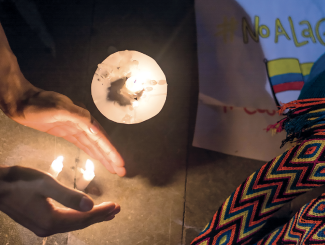
A person lights a candle during an anti-war protest in Barranquilla, Colombia.

To commemorate the 20th anniversary of the Justice and Peace Law—which created Colombia's first transitional justice system—media outlet Verdad Abierta, the Friedrich Ebert Stiftung, and ICTJ partnered to produce an investigative four-part series in Spanish that critically assesses its legacy. ICTJ has now translated the first two installments into English.

This year, Colombia commemorates the 20th anniversary of Law 975, which established the country’s first transitional justice process, called Justicia y Paz (or Justice and Peace). With this anniversary top on mind, and as the current government engages with eight of the remaining armed groups in pursuit of its “Total Peace” strategy, ICTJ recently teamed up with podcast producers Sillón Estudios to create a four-part series that delves into the peace process with the AUC and considers key lessons learned.

International Center for Transitional Justice The Final Peace Agreement signed in 2016 between the Revolutionary Armed Forces of Colombia (FARC-EP) guerrillas and the Colombian government created an ambitious and innovative transitional justice system called the Comprehensive System of Truth...

Colombia’s new president Gustavo Petro was elected to office on a progressive campaign to strengthen democracy, implement social reforms, and bring “total peace” to the country. His approach to peace encompasses political negotiations with all remaining insurgent groups and simultaneous dialogues with criminal organizations geared toward their voluntary submission to justice in exchange for punitive leniency. But eight months into his administration, Petro’s efforts to deliver on his campaign promise are facing numerous challenges.

On September 15, ICTJ organized a side event on the missing and disappeared in Syria, sponsored by the governments of Luxembourg and Finland, during the 77th session of the United Nations General Assembly. The event was a timely one, as it addressed a recent proposal for the creation of a new...

Colombia currently faces a transformed, fragmented form of violence centered on territorial and social control rather than the traditional insurgency. This briefing paper argues that state security strategies remain misaligned, relying on outdated military approaches and metrics. To a...

Image of first page of the briefing paper "From Combat to Territorial Control"

Colombia currently faces a transformed, fragmented form of violence centered on territorial and social control rather than the traditional insurgency. This report argues that state security strategies remain misaligned, relying on outdated military approaches and metrics. To avoid lon...

An aerial view of a group of soldiers interacting with a large civilian crowd in a rural setting