

Don’t miss out on ICTJ's latest news. Subscribe to our newsletter.
Acknowledgment of Responsibility in the Framework of the Justice and Peace Law: Lessons and Recommendations for the Comprehensive System for Truth, Justice, Reparation, and Non-Recurrence
This study, carried out in partnership with Aulas de Paz and Universidad Santo Tomás, explores experiences of acknowledgment of responsibility under Colombia’s Justice and Peace Law. Drawing on interviews with victims, former combatants, and judicial officials, it identifies key lessons for truth and reconciliation processes and offers concrete recommendations to strengthen Colombia’s Comprehensive System for Truth, Justice, Reparation, and Non-Recurrence.
Image
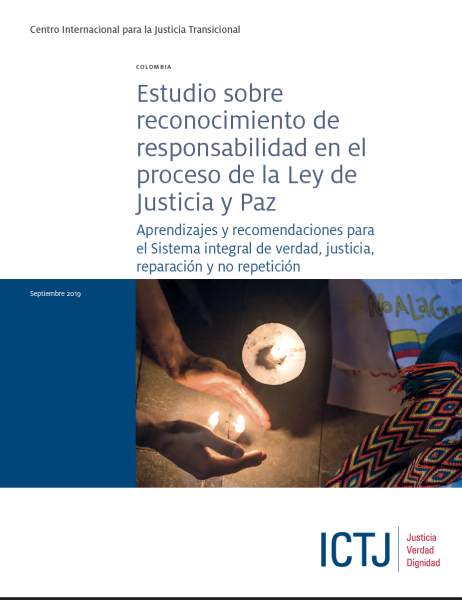
Based on qualitative research and interviews conducted in five Colombian cities by ICTJ, Fundación Aulas de Paz, and Universidad Santo Tomás (Medellín campus), this study explores how former combatants acknowledged their responsibility before victims under the Justice and Peace Law, and under what conditions these acts have or have not contributed to processes of forgiveness and reconciliation.
Findings show that although the Justice and Peace Law did not explicitly establish restorative spaces, the “instances for integral reparation” became pivotal moments for meaningful encounters between victims and those responsible. Cases such as the Mampuján hearing marked a turning point for judicial truth, acknowledgment of harm, and victim participation.
The study identifies several factors that help enable these transformative encounters: the emotional preparation of participants, the role and approach of magistrates, the dignified treatment of all parties, the symbolic weight of language and context, and opportunities for direct dialogue. It also documents structural shortcomings in the early stages of the process, including overly formal procedures, mechanical narratives, and the exclusion of victims.
The study presents recommendations that aim to strengthen the restorative dimension of Colombia’s Comprehensive System for Truth, Justice, Reparation, and Non-Recurrence by emphasizing participatory methods, psychosocial support for all parties, and protocols that recognize the importance of symbolic, emotional, and collective dimensions in both judicial and non-judicial settings.
It further offers human and methodological insights for rethinking justice based on lived experience and for advancing more transformative, reparative, and non-repetitive approaches.
