
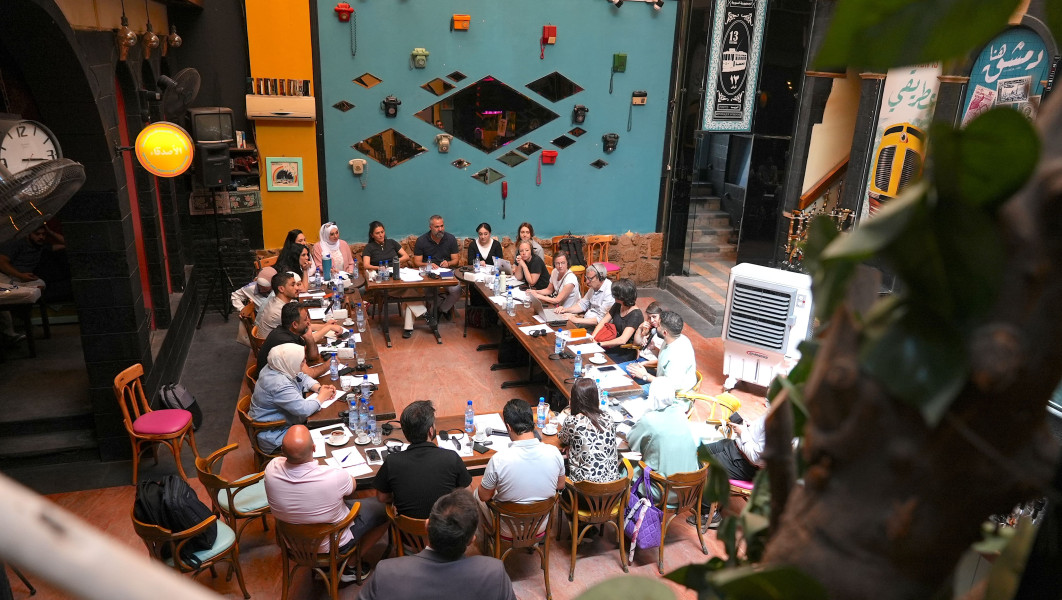
ICTJ recently convened Syrian civil society partners, members of Syria’s newly established transitional justice commissions, and government representatives to support the country’s nascent transitional justice process. In a series of workshops in June, civil society partners shared their extensive experience working with victims of the county’s conflict and the former regime’s repression, while representatives of the National Commission for Missing Persons (NCMP), the National Commission for Transitional Justice (NCTJ), and the Ministry of Social Affairs and Labor explored best practices and victim-centered approaches for operationalizing their mandates.
“Syrians have fought for these institutions for years,” said Nousha Kabawat, head of ICTJ’s Syria program. “Now, the hard work is making them function in a way that families can see, understand, and trust.”
Representatives from the Bridges of Truth presented their work leading community dialogue sessions across Syria, including recent sessions in the towns of Saqba and Deir al-Asafir, as well as their plans for dozens more in the months ahead. The discussions emphasized the importance of connecting the newly established national institutions directly with the communities and families most affected by violations.
“People didn’t want promises,” one participant said. “They just wanted a place to speak. They haven’t been able to speak for 14 years, and it is enough to just be heard.”
“What is the benefit for me if he’s in jail when my kids don’t have education?” asked an attendee. “Accountability can continue after my death, but we need reparation while we’re still living,” said another, underscoring the need for reparative measures alongside accountability.
Representatives of the NCMP took part in workshops addressing strategic questions facing the commission and its role in the broader transitional justice process. “In every Syrian household, there is a missing person,” said one participant, reflecting on the massive scale of enforced disappearances in the country.
In the workshops with members of the NCTJ, participants discussed a range of topics related to accountability and truth seeking. “Truth seeking can preserve what criminal trials alone may never capture,” asserted a participant.
ICTJ also organized a workshop with representatives of the Ministry of Social Affairs and Labor, which is documenting and searching for missing children and tracking those who survived the regime’s care system. “I am a wife of a missing husband, yet I say children are prioritized over my missing husband,” said one participant, bringing the urgency of the ministry’s work into sharp focus.
Across the course of the two-week convening, participants stressed the value of working side by side with affected individuals and acknowledging their frustration when they have not yet seen concrete results. “It is only through time, very careful talking, and a lot of listening that people finally open up and tell you what happened to them,” noted Elena Naughton, ICTJ senior expert.
“Every single interaction with a family member is important,” added Howard Varney, ICTJ senior expert. “It’s a moment where you can acknowledge them and recognize them, not just collect information from them.”
While Syria’s new justice institutions are being asked to move quickly, their legitimacy will depend on whether they keep victims and families at the center of their work and coordinate with one another. “Support is built through trust, and trust is built through transparency and visible work on the ground,” one participant said. “No one is required to support the NCTJ simply because it exists,” another asserted. “Trust must be built.”
The work ahead demands sustained coordination and outreach to victims and families to ensure the nation’s transitional justice process is inclusive and delivers a justice that is meaningful to those most affected. ICTJ will continue to support the NCMP, the NCTJ, the Ministry of Social Affairs and Labor, and Syrian civil society partners as they transform mandates into robust, victim-centered processes for truth, accountability, and the search for the missing. “Families have carried this work for years,” said Nousha Kabawat. “These new institutions are a chance to turn that struggle into something concrete: answers, recognition, and a process that begins to restore trust.”
____________
PHOTO: Members of ICTJ’s Syria program team meet with representatives of the Association of Detainees and the Missing in Sednaya Prison in Damascus on June 18, 2026. (Abedalbaset Alhasan/ICTJ)

