
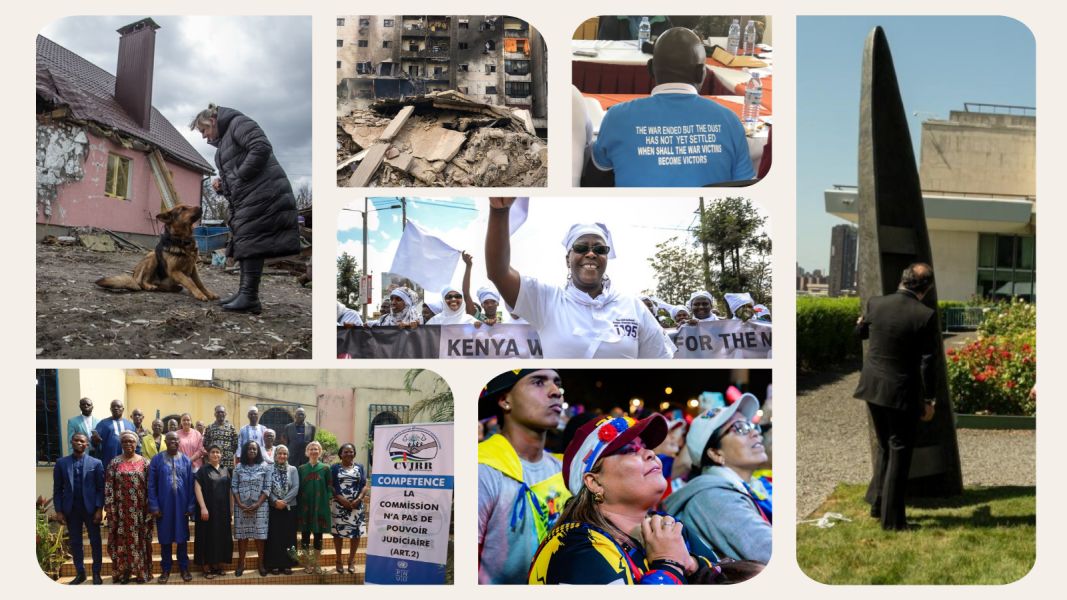
Throughout 2024, ICTJ’s experts offered their unique insight on breaking news and critical developments in more than 11 countries as part of the ICTJ’s World Report newsletter. Their incisive analyses shed light on the political and socioeconomic forces at work and what it all means for victims and the pursuit of peace and justice. In this edition, we look back on the past year that was through our Expert’s Choice commentaries.
Our experts weighed in on the conflicts in Gaza and Lebanon as well as the peace processes in Yemen and Colombia. Executive Director Fernando Travesí and Head of Program for Lebanon and Yemen Nour El Bejjani reflected on the immeasurable human suffering and massive destruction in Gaza and Lebanon caused by a widening armed conflict with Israel. They called for an immediate ceasefire in the region, the release of hostages, and unhindered access to humanitarian assistance.
El Bejjani also considered the varied obstacles impeding the peace process in Yemen. Any revitalized process, she argued, must support civil society and victims and bring attention to victims’ grievances and needs. Researcher and Monitoring and Evaluation Coordinator Veronika Hoelker and Technical Coordinator Danna Ramírez took stock of the progress Colombia has made in implementing the 2016 peace agreement between the Colombian government and the guerrilla group Revolutionary Armed Forces of Colombia, stressing the vital role bilateralism has played in the successes.
Travesí more broadly reflected on the brief windows of opportunity for peace and justice that occasionally manifest in context of conflict or repression. To make his case, he considered the then-recent massive protests in Venezuela contesting the presidential election results and the three-year anniversary of the Taliban’s return to power and the subsequent severe restrictions on women’s rights in Afghanistan.
Women and girls continued to face discrimination and violence in many parts on the world, not just in Afghanistan. In Kenya, for instance, incidents of femicide and violence against women are on the rise, prompting public protests and calls for government action. In her Expert’s Choice, Senior Program Expert Agatha Ndonga stressed the need for robust legislation to combat violence against women, as recommended by the 2008 Truth, Justice and Reconciliation.
Victims must be front and center in any transitional justice process, and ICTJ tirelessly advocates for their inclusion at all stages. In the Central African Republic (CAR), ICTJ has facilitated the participation of victims in the country’s the Truth, Justice, Reparation and Reconciliation Commission. In her commentary, Head of Program for Libya and CAR Reem El Gantri described how collecting victims’ testimonies is a first step in truth seeking and toward justice in CAR. Similarly, Program Writer and Department Coordinator Alec Knight underscored the importance of including victims in the efforts to hold to account perpetrators of international crimes in Ukraine, drawing attention to the need for Ukrainian-language communication and outreach at the International Criminal Court (ICC) related to the cases it is pursuing. Reparations initiatives, too, must be survivor centered and participatory to be effective and meaningful, as Head of Office in Uganda Sarah Kasande asserted in her analysis of the historically large-scale reparations order for victims of mass atrocities in Northern Uganda that the ICC issued in The Prosecutor vs. Dominic Ongwen case.
International criminal justice mechanisms such as the ICC alone do not have the capacity to deliver accountability for all atrocity crimes. National criminal justice systems and sometimes hybrid courts are needed. This year, The Gambia and the Economic Community of West African States (ECOWAS) decided to establish a hybrid court to address crimes committed during the Jammeh regime. In his Expert’s Choice, Head of Office in The Gambia Didier Gbery explained the significance of the decision for criminal accountability and for victims in The Gambia.
Preserving memory and building a shared narrative of the past are essential to justice and the prevention of a recurrence of violence or repression. This year, the world marked the 30th anniversary of the 1994 genocide against the Tutsi in Rwanda. Kasande and Program Coordinator Tafadzwa Christmas solemnly remembered the lives lost and contemplated the lessons learned from the tragedy in how to address such mass atrocities and prevent them from ever happening again. Meanwhile, the United States observed the federal holiday Juneteenth for the fourth time. To honor this holiday, which commemorates the end of slavery in the country, Senior Expert Virginie Ladisch celebrated some recent victories in the pursuit of racial justice around the country.
Looking to the year ahead, the challenges to peace and justice already seem daunting. ICTJ’s commitment to these objectives, however, remains unwavering. We at ICTJ will continue to monitor news around the world for the latest in transitional justice. Please make sure you have signed up for our newsletters and be the first to receive our monthly World Report and Expert’s Choice.

