
ICTJ and the Advocacy Center for Democracy and Development (ACDD) recently brought together victims, civil society advocates, policymakers, and development partners for a high-level policy roundtable on integrating mental health and psychosocial support (MHPSS) in Ethiopia’s transitional justice process. Funded by the European Union, the April convening provided a space for participants to discuss the need for MHPSS across Ethiopia, consider existing efforts to respond to those needs, and identify entry points for more coordinated action.
The national transitional justice process formally began in April 2024, when the Council of Minsters adopted the Transitional Justice Policy of Ethiopia to address decades of repressive governance, conflict, human rights violations, and historical injustices. Since then, however, the federal government’s implementation has been slow. Nevertheless, victims and civil society actors have continued to advocate for justice and redress, often despite security concerns and limited resources.
“Justice without healing is incomplete,” said Samrawit Tassew, head of ICTJ’s Ethiopia program. During the roundtable, she emphasized the risks of failing to integrate MHPSS into transitional justice processes, describing experiences from the Somali region, where one such process is underway. “There was fainting and dissociation during public hearings, and it happened not only to victims, but also to experts and members of the truth commission,” she said.
Since 2022, ICTJ has been working with victims’ groups and civil society organizations in the Amhara, Oromia, Somali, and Tigray regions to empower them to meaningfully participate in regional and national transitional justice processes, as part of a multi-year EU-funded project. A key obstacle to participation for these local actors, who are committed to justice and have earned their communities’ trust, is access to and training in MHPSS.
Tihut Sisay, a member of one of the victims’ groups from the Amhara region, underscored the value of MHPSS. With support from ICTJ and ACDD, she has led short sessions for victims’ groups that combine MHPSS with transitional justice instruction. “Many would come back and tell us they had a full night’s rest for the first time in years,” explained Tihut.
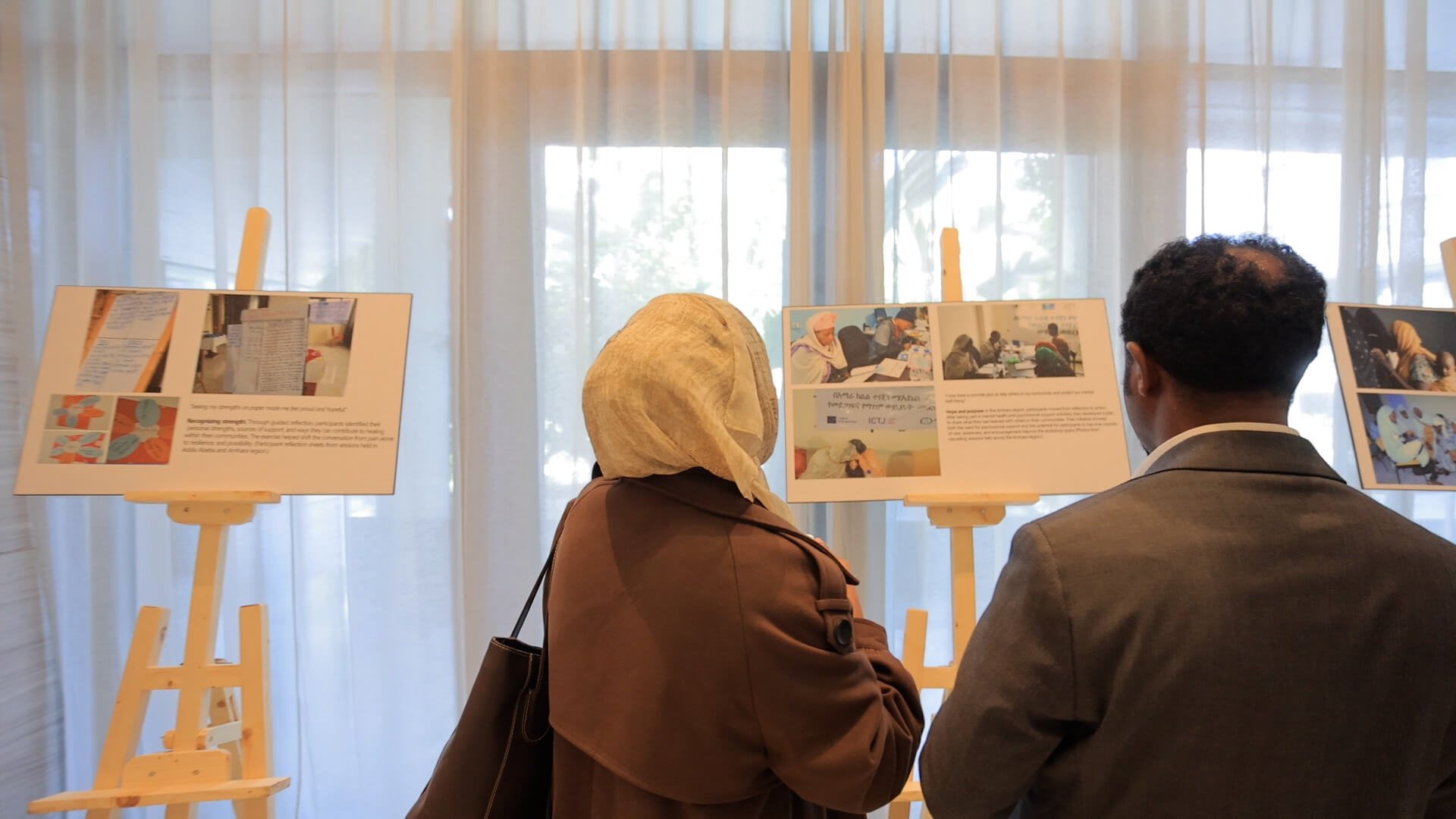
Victims in Amhara continue to suffer from the psychological harms resulting from the violence they experienced, stressed Tihut, and they are eager to receive MHPSS, but financial barriers often prevent them from accessing care. “Even simple costs like transportation can present a significant hurdle to receiving the care that they badly need,” she said.
“They asked that we expand these sessions, especially to rural communities that were even more impacted by conflict,” she continued. Many would also like to actively participate in the transitional justice process. However, scaling up MHPSS services and outreach largely depends on available resources, which remain scarce.
Ahmed Kalif, a former political prisoner and leader of the Somali Region Victims Network, spoke about the challenges that organizations like his face both operating in difficult environments and incorporating MHPSS into their work. After spending 12 years in a prison where he endured torture and forced labor, Ahmed and 50 other prisoners formed an alliance dedicated to ensuring that what they experienced would never happen again. With support from ICTJ and ACDD, the Somali Region Victims Network has documented 21 mass grave sites and helped establish a regional truth commission as well as a public memorial day.
Ahmed also pointed to the uneven availability of resources across regions as a major challenge that policy discussions on MHPSS must address. He cautioned that planning at the national level will be difficult to implement unless it accounts for regional realities, including the shortage of trained professionals and the practical barriers facing victim-led organizations. “There are no MHPSS experts in the Somali region, not even at the highest institutions,” he said.
Experts at the roundtable highlighted key policy opportunities for the integration of MHPSS into the transitional justice process. Notably, they agreed that the national strategy for the participation of victims and other vulnerable groups in the transitional justice process presents an important entry point for coordinated action.
Agitu Tadesse, a delegate from the Ministry of Health and member of the National MHPSS Task Force, also called attention to the ongoing review of the National Mental Health Policy as an important opening. “We are working on bringing together relevant stakeholders to ensure that the policy addresses MHPSS in different sectors,” she asserted. “So, this is an opportune time for all stakeholders.”
The roundtable concluded with breakout sessions in which five multidisciplinary working groups discussed how best to integrate MHPSS in the country’s justice process. The groups proposed many recommendations, including the creation of an implementation roadmap, better coordination among stakeholders, more training and capacity building in the regions with the greatest need, increased direct support to victims’ associations, and more reliable funding and resources.
Gudeta Kenea, chief of staff at the Ethiopian Ministry of Justice, expressed his appreciation for roundtable and that the ministry would closely follow the recommendations that emerged from it. H.E. Sofie From-Emmesberger, head of the EU Delegation to Ethiopia, also underscored the EU’s commitment to supporting Ethiopia’s transitional justice process. Every partner’s presence at the roundtable, she declared, signifies a commitment “to turn policy into action, and pain into purpose.”
______________
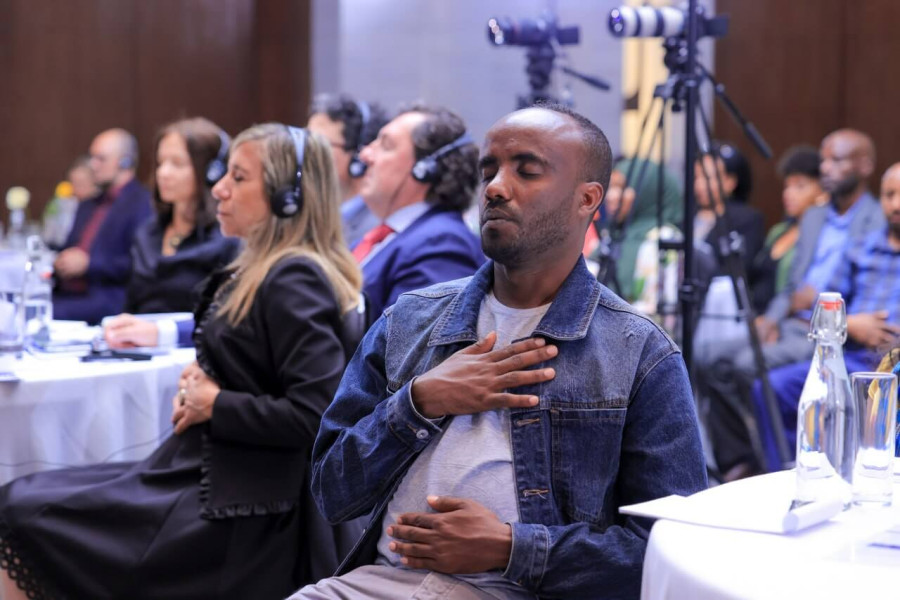
PHOTO: Participants in the roundtable take part in breathing and stretching exercises to demonstrate simple and scalable MHPSS practices. (ICTJ)

