218 results

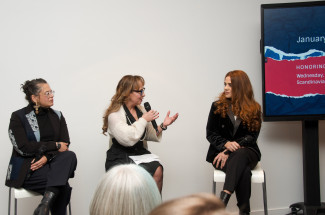
On January 28, 2026, ICTJ held its annual January for Justice Leaders benefit dinner in New York City, an event celebrating leaders advancing justice around the world. This edition also marked the beginning of ICTJ’s 25th anniversary year and served as an opportunity to look back on a quarter century spent standing alongside victims, civil society, and institutions in the pursuit of truth, accountability, and lasting peace after mass atrocities.

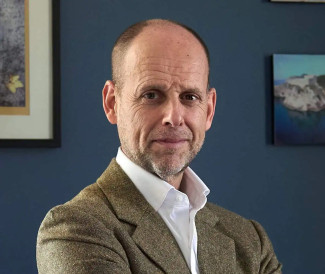
The outlet PassBlue recently interviewed ICTJ Executive Director Fernando Travesí-Sanz about the challenges and breakthroughs ICTJ has encountered while facilitating a victims-led path to transitional justice in post-Assad Syria. Travesí-Sanz compared the experience to the lessons learned from Colombia’s post-conflict transition, revealing the nuanced, fragile nature of both retroactive justice and long-term peacebuilding.

To commemorate the 20th anniversary of the Justice and Peace Law—which created Colombia's first transitional justice system—media outlet Verdad Abierta, the Friedrich Ebert Stiftung, and ICTJ partnered to produce an investigative four-part series in Spanish that critically assesses its legacy. Now translated into English, this second installment explores the unprecedented challenges the country faced as the process got underway.

To commemorate the 20th anniversary of the Justice and Peace Law—which created Colombia's first transitional justice system—media outlet Verdad Abierta, the Friedrich Ebert Stiftung, and ICTJ partnered to produce an investigative four-part series in Spanish that critically assesses its legacy. Now translated into English, this first installment provides an overview of the process.

To commemorate the 20th anniversary of the Justice and Peace Law—which created Colombia's first transitional justice system—media outlet Verdad Abierta, the Friedrich Ebert Stiftung, and ICTJ partnered to produce an investigative four-part series in Spanish that critically assesses its legacy. ICTJ has now translated the first two installments into English.

This year, Colombia commemorates the 20th anniversary of the Justice and Peace Law, which established the country’s first formal transitional justice mechanism. On this milestone anniversary, ICTJ reflects on the evolution that led to the groundbreaking law, the lessons that have been learned so far, and the challenges that lie ahead.

ICTJ, in collaboration with the Center for Media Integrity of the Americas, the Cyrus R. Vance Center for International Justice, and the New York City Bar Association, recently hosted a screening of the Colombian documentary Después del Frío ("After the Cold"). Coproduced by ICTJ and Colombian journalist María Jimena Duzán, with the support of the Embassies of Sweden and Norway in Colombia, the film paints an intimate portrait of a nation seeking healing and transformation, where the scars of the past give way to hope.

This year, Colombia commemorates the 20th anniversary of Law 975, which established the country’s first transitional justice process, called Justicia y Paz (or Justice and Peace). With this anniversary top on mind, and as the current government engages with eight of the remaining armed groups in pursuit of its “Total Peace” strategy, ICTJ recently teamed up with podcast producers Sillón Estudios to create a four-part series that delves into the peace process with the AUC and considers key lessons learned.

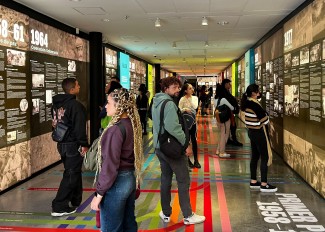
On February 13, 2024, the interactive cultural exhibit “If There Is Truth, There Is Future” opened to the public at Bogotá’s Center for Memory, Peace and Reconciliation. As part of the Colombian Truth Commission’s post-closure cultural and educational outreach activities, the exhibit aims to inform Colombians of all generations about the commission’s findings and inspire them to take action to prevent a recurrence of conflict.

On November 28, 2023, ICTJ organized an international dialogue in Bogotá, Colombia, to share innovative strategies for advancing victims’ rights to redress for human rights abuses and for establishing more victim-centered development policies. The gathering also marked the official launch of ICTJ’s new report—Advancing Victims’ Rights and Rebuilding Just Communities Local Strategies for Achieving Reparation as a Part of Sustainable Development—which presents findings from a two-year comparative study of local efforts in Colombia, The Gambia, Tunisia, and Uganda to advance reparations.

The study of macro-criminality is critically important to transitional justice and specifically to efforts to pursue accountability for large-scale, systematic human rights violations. To help enliven debates concerning macro-criminality and broaden access to them, ICTJ has translated into Spanish for the first time ever the seminal essay "Can Politics Be Criminalized?" written by German criminologist Herbert Jäger.

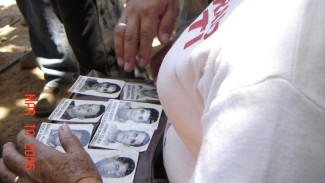
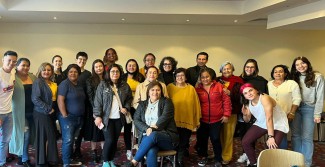
In societies grappling with conflict or repression, LGBTQ+ individuals are often targeted with violence and discrimination and experience some of the cruelest human rights violations. In 2022, Colombia Diversa began collaborating with members of ASFADDES, a prominent association of relatives of the missing or disappeared in Colombia. In June, 24 representatives from the two organizations met in Bogotá to for a series of workshops in which they exchanged knowledge and best practices and developed a better understanding of how to search for missing or disappeared LGBTQ+ persons.

This year marks the 50th anniversary of the hip hop movement. To honor its contributions to the struggle for justice, truth, and equality, the Skoll Foundation hosted a panel discussion and concert event featuring hip hop artists, including cofounder of the legendary rap group Run-DMC Darryl McDaniels and Colombian rapper and producer Ali aka Mind, as part of its 20th World Forum held in April in Oxford, United Kingdom. ICTJ, which received the Skoll Award for Social Innovation in 2009 and has partnered with the Skoll Foundation since, invited Ali aka Mind as a representative of Rexistencia Hip Hop, an artistic mentorship and creation lab led by ICTJ’s office in Colombia and the Latin American media outlet and foundation Cartel Urbano.

In a fast-changing world, ICTJ regularly reexamines and adapts its methodology to develop innovative solutions to emerging problems, advance its mission, and achieve justice for victims of human rights violations. In that spirit, ICTJ recently launched an exciting new website and newsletter design. After over a year of research, planning, surveying stakeholders, designing, and testing, we unveiled a site that better aligns with what ICTJ and transitional justice are today.

On September 15, ICTJ organized a side event on the missing and disappeared in Syria, sponsored by the governments of Luxembourg and Finland, during the 77th session of the United Nations General Assembly. The event was a timely one, as it addressed a recent proposal for the creation of a new...

With the inauguration of Colombia’s new president last month, optimism for the country’s ongoing transitional justice process is at a high. Newly elected President Gustavo Petro has strongly affirmed his commitment to the implementation of the peace agreement and ensuring the institutions it created...

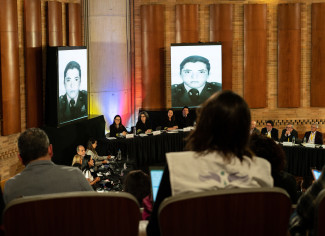
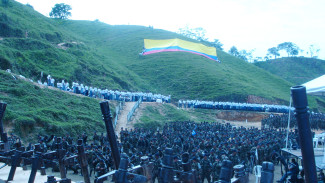
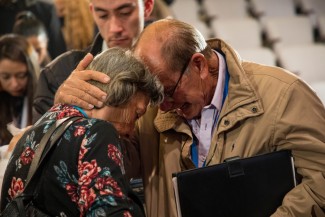
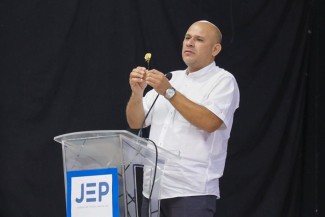
On June 21-23, Colombia’s Special Jurisdiction of Peace (JEP) held its first acknowledgment hearing on the taking hostages, serious deprivation of liberty, and other concurrent crimes (known as Case 01) in Bogotá. Seven former leaders of the guerrilla group Revolutionary Armed Forces of Colombia—People’s Army (FARC-EP) acknowledged their command responsibility for the kidnapping crimes that were the FARC-EP’s policy from 1993 to 2012 in the presence of victims, JEP officials, civil society representatives, and members of the press. This hearing marks the first time ever FARC-EP leaders publicly acknowledged their role in such systemic crimes. A decisive step in the country’s restorative justice process, it would not have been possible without years of preparation.

The role of victim participation in international criminal proceedings, whether in international, hybrid, or national courts, has long been a matter of public deliberation among criminal justice practitioners and human rights activists. In the aftermath of mass atrocities and repression, the...

As part of its ongoing efforts to support Syrian civil society organizations seeking to end enforced disappearances in Syria, ICTJ organized a visit to the United States for members of two prominent family associations: Families for Freedom and the Caesar Families Association. The trip, which was planned in coordination with longtime partner Dawlaty, comes at a time when Syrian civil society and victims’ groups have been intensifying their calls for an international mechanism to uncover the fate of those who have gone missing in Syria since the start of the uprising in March 2011.

By Sean Yoes Terror on the Eastern Shore December 4, 1931, is a night that lives on in the minds of Black residents in Salisbury, Maryland, a small town along the state’s Eastern Shore. That cold winter night, a mob of more than 2,000 racist residents hung 18-year-old Matthew “Buddie” Williams from...

International Center for Transitional Justice The Final Peace Agreement signed in 2016 between the Revolutionary Armed Forces of Colombia (FARC-EP) guerrillas and the Colombian government created an ambitious and innovative transitional justice system called the Comprehensive System of Truth...

As plans to build a massive Wegmans distribution center forge ahead, residents of the historic Black community of Brown Grove, Virginia, demand acknowledgment and redress.

In 2021, there were significant developments, some hopeful and some devastating, in the struggle for truth, accountability, and redress in countries around the world. ICTJ experts covered these events in commentaries and feature stories published on our website and in our newsletters. While 2022 is already underway and we at ICTJ are hard at work, we would like to pause a moment to take stock and reflect on the year that was.

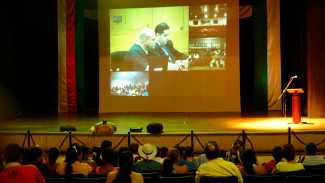
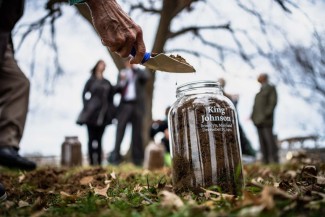
The Maryland Lynching Truth and Reconciliation Commission held its first public hearing in Cumberland, Allegany County, Maryland, on October 2, 2021. The event, broadcast live from Emmanuel Episcopal Church, brought together commissioners, panelists, and guests to acknowledge and memorialize the tragic lynching of 18-year-old Robert Hughes (aka William Burns) in Cumberland in 1907. In the coming months, the commission will convene several more of these public hearings in counties across the state of Maryland.

Expectations for advancing much-needed justice and dismantling state and non-state criminal networks that persistently violate human rights have been dashed over the past three years in Mexico. Violence and impunity have increased. President Andrés Manuel López Obrador's campaign promises have not materialized in a serious effort to address the lack of security in the country or the justice system’s inefficiency. However, several efforts have persisted, characterized by cooperation among state institutions, civil society, and victims’ groups that not only give hope, but confirm the way forward.